

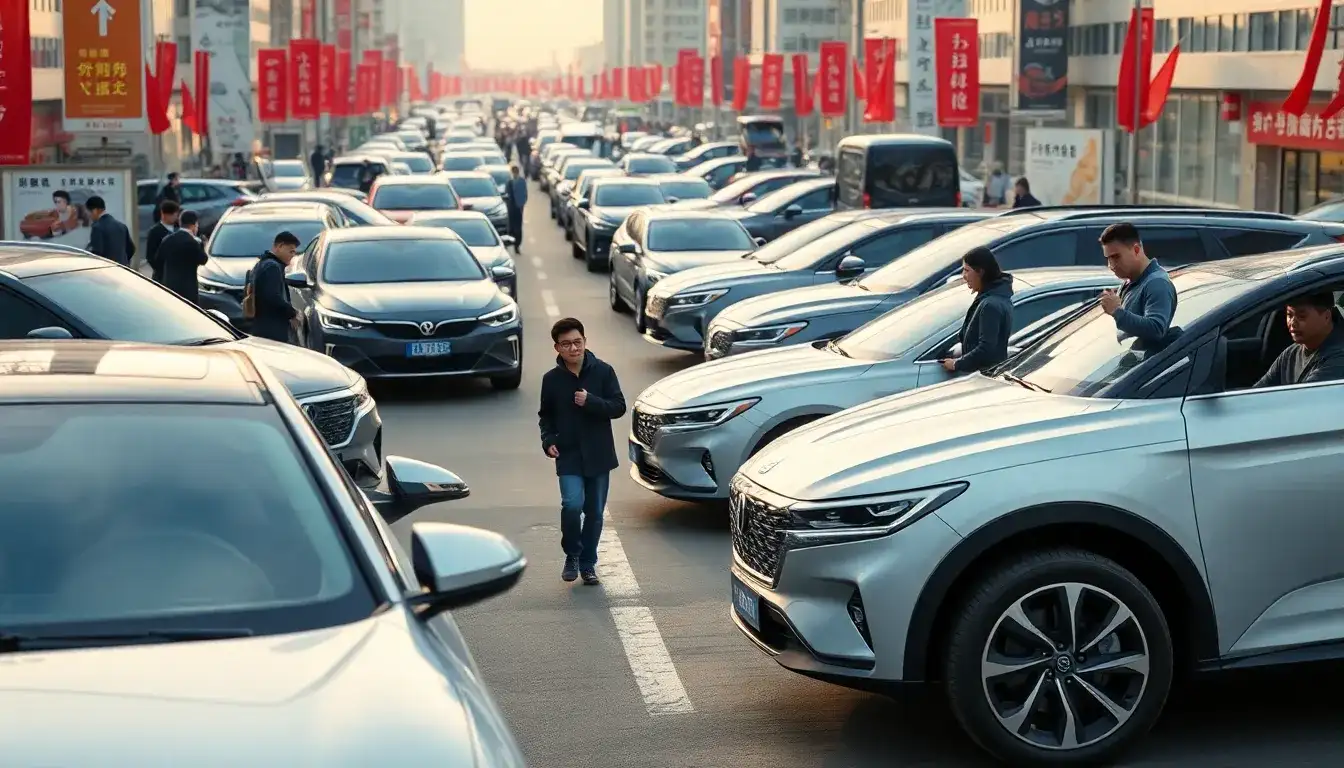
Recently, the globally renowned investment firm Morgan Stanley released a report titled “China Autos Overview”, which provides a comprehensive forecast for the Chinese automotive market through 2025. The report encompasses predictions related to production, sales, exports, electrification, and smart technology. This article summarizes key insights from the Morgan Stanley report, incorporating relevant experiences and information.
Market Size and Structure: Competition and Export Differentiation
Morgan Stanley estimates that by 2025, the total domestic and export sales of passenger vehicles in China will reach 28.3 million units (a growth of 3%), with 14.9 million units of these being new energy vehicles (a growth of 22%), resulting in a penetration rate of 53%. Among the new energy vehicles, pure electric vehicle (BEV) sales are projected to be 7.766 million units (an increase of 8%), while hybrid vehicle sales are expected to reach 7.169 million units (a growth of 40%).
For the domestic passenger vehicle market in 2025, estimated sales will be 22.586 million units, remaining relatively stable compared to 2024, with new energy vehicle sales expected to reach 13.326 million units (an increase of 21%). Export projections for 2025 are set at 5.687 million units (a growth of 15%), with new energy vehicle exports expected to hit 1.609 million units (an increase of 31%).
Interpretation
In the domestic market, the total sales volume of Chinese automobiles, after years of growth, is anticipated to plateau by 2025, followed by a slight decline starting in 2026. Consequently, the growth rate of new energy vehicle penetration is also expected to slow down. These trends signal escalating competition within the domestic automotive industry, characterized by ongoing price wars from manufacturers to supply chains, an oversupply of automotive talent leading to increased layoffs, and mounting pressures across the industry.
As for exports, while the total volume continues to rise, the growth rate is slowing. The increasing growth of new energy vehicle exports indicates that companies focusing on traditional fuel vehicles may face challenges, with new energy exports standing out as a promising area.
Smart Technology: Peak Penetration and Industry Restructuring
By 2025, the penetration rate of Level 1/Level 2 Advanced Driver Assistance Systems (ADAS) and Level 2+ smart driving assistance features in Chinese automobiles is expected to reach 80%, equating to 18 million vehicles equipped with these technologies. Additionally, the penetration rate for Level 2+ smart driving assistance is projected at 25%, with 5.6 million new vehicles adopting these features.
Interpretation
By 2025, the smart driving assistance sector will reach its peak. As previously discussed in our article “BYD’s Smart Driving Dream: Will ‘Smart Cars’ Really Become Mainstream by 2025?“, the initiatives led by BYD for equal access to intelligent driving have rapidly energized the industry. An 80% penetration rate for smart driving assistance signifies significant growth in the industries related to smart driving chips, domain control electronics, sensors, and radars. This surge will also create a demand for talent in the field of smart driving assistance and subsequently quick responses from the insurance market. However, such rapid growth may lead to a swift decline, leaving behind challenges in the supply chain and workforce.
Electrification: Pathways for New Energy Technologies
According to Morgan Stanley, two main categories of new energy vehicles, pure electric vehicles (BEVs) and plug-in hybrid electric vehicles (PHEVs), have been dominant. Since 2022, BYD’s DMi series has gained traction, with sales nearly balancing between BEVs and PHEVs by 2024. However, starting in 2025, a rapid differentiation seems likely; the penetration rate of PHEVs may stabilize or slightly decline, while BEVs are expected to rise sharply. Within the new energy vehicle categories, a shift in internal market share is occurring, and the demand for PHEVs is starting to weaken, while BEVs are rebounding. The extended-range electric vehicle (EREV) segment has accounted for around 10% of total new energy vehicle sales over the past year and has begun to show growth since April.
Interpretation
It is undeniable that pure electric vehicles represent the future of new energy vehicles, while the intermediate plug-in hybrids are likely to see their market share overtaken by extended-range models. Given the simpler technology framework and its parallels to electric vehicle technology, EREVs are expected to rise in prominence over the next few years.
Concluding Thoughts
2025 will mark a critical turning point for the Chinese automotive market, shifting from “scale expansion” to “value reconstruction”. The return of pure electric vehicles, the rise of extended-range models, equality in smart driving, and strategic export positioning will all reshape the competitive landscape. Over the next 2-3 years, the concentration of the automotive industry (CR10) may increase from 65% in 2023 to 75%, with the true “survivors” being a select few players who can balance scale and technological barriers. Companies must make decisive choices regarding technology paths, cost control, and global strategies. Additionally, while there is a surplus of talent in manufacturing and research and development leading to increased layoffs, there remains a scarcity of skilled professionals in smart technology and international markets.
Original article by NenPower, If reposted, please credit the source: https://nenpower.com/blog/chinas-auto-industry-in-2025-navigating-intense-competition-smart-driving-equality-and-the-new-energy-exodus/

