

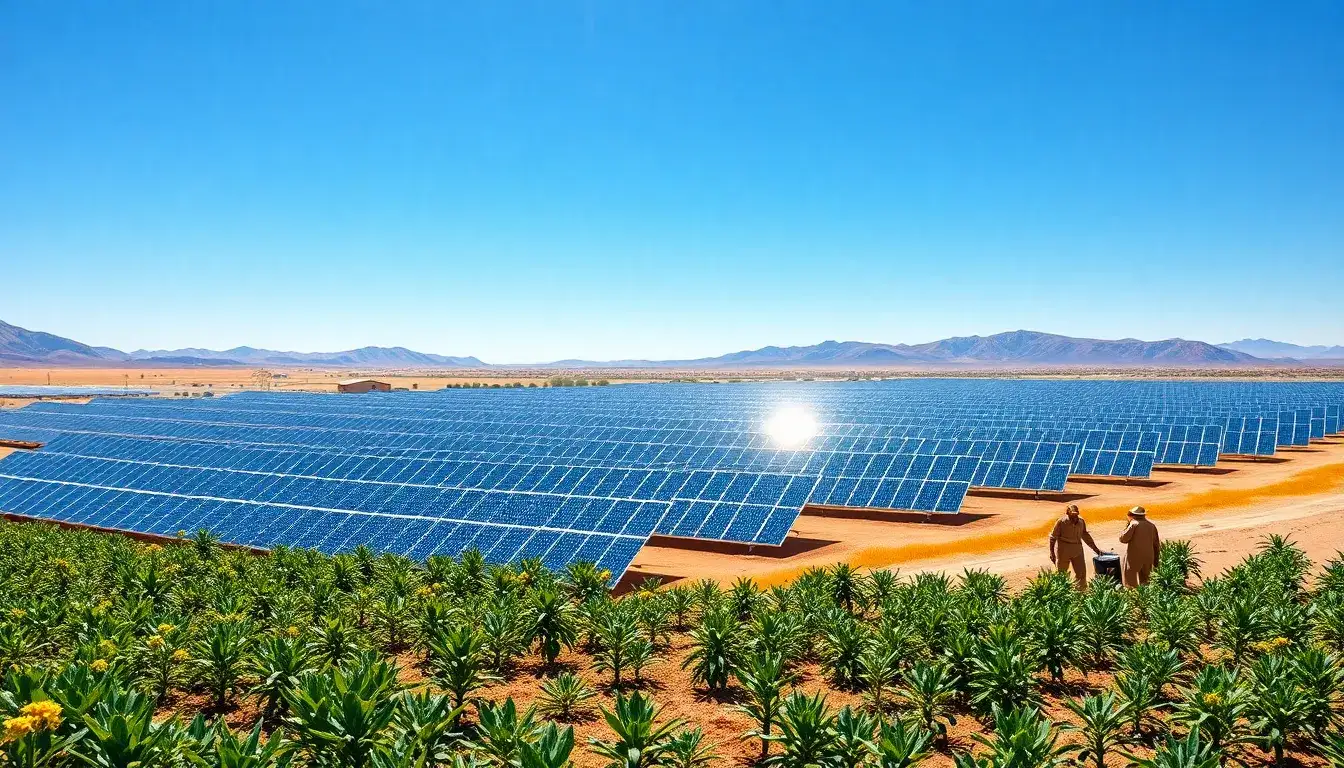
Good News for China’s Infrastructure: A 300 Million Investment in a Power Plant Transforming Desert into Oasis
As global concerns over energy shortages and ecological degradation grow, finding sustainable development paths, especially in severely degraded areas, has become increasingly urgent. The Tara Tan Solar Power Park is a prime example of such an initiative. This project not only makes efficient use of the abundant solar energy resources in the region but also creatively integrates a “livestock + solar” dual-track model, achieving effective management and ecological restoration of desert lands. By introducing sheep to manage vegetation, operational costs are reduced while providing new income streams for local herders.
Are you curious about how this once barren land transformed into a vibrant area of green energy and ecological prosperity?
The Tara Tan solar project is located in the southern part of Hainan Tibetan Autonomous Prefecture, Qinghai Province. This remote area, with an average elevation of nearly 3000 meters, is characterized by a typical cold, arid desert climate. It experiences extreme weather conditions, with annual sunshine exceeding 3000 hours, providing abundant sunlight. However, frequent sandstorms and poor soil quality pose significant challenges, severely impacting agricultural production and threatening residents’ basic living conditions, thus creating enormous ecological challenges.
To tackle these issues, the State Power Investment Corporation launched the construction of the Tara Tan Solar Power Park in 2011. By leveraging solar technology, the project aimed to transform vast areas of unproductive desert into a clean energy production base, capable of generating stable electricity while stimulating local employment and economic growth. The project has a total investment of approximately 300 million RMB, with plans for large-scale solar arrays and a complementary water-solar operation mechanism to enhance the overall efficiency and stability of the energy system. The initial goal was clear: to use green energy as a lever to promote the integrated development of ecological conservation, economic revitalization, and social progress, particularly focusing on curbing the escalating desertification process.
However, the unique geographic and climatic conditions of Tara Tan posed numerous challenges during implementation. The most significant issue came from the frequent sandstorms. Strong winds lifted large amounts of dust, which settled on the solar panels, significantly reducing their photovoltaic conversion capability. Over time, this accumulation could accelerate equipment aging and increase maintenance difficulty. Additionally, the plateau’s intense solar radiation and large temperature fluctuations between day and night exacerbated the wear on the panel surfaces. Despite the solar systems’ inherent adaptability to various environments, maintaining clean panels became a major operational bottleneck under such harsh conditions, directly impacting power generation efficiency.
The local soil conditions were equally concerning. Due to scarce rainfall and high evaporation rates, the ground often remained cracked, with poor water retention. Even when drought-resistant plant seeds like Caragana and Artemisia were sown, their survival rates remained low, and their roots struggled to establish themselves, hindering ecological restoration. The organic matter content in the soil was nearly negligible, and nutrient deficiencies further limited the expansion of green coverage.
In response to these challenges, the project team quickly adapted their strategy to explore integrated management solutions. Before constructing the solar arrays, the contractors initiated sand fixation experiments, widely sowing drought-resistant grass seeds suitable for the plateau climate. They also optimized the design of the solar panel supports, increasing installation heights and implementing shading layouts to reduce near-ground wind speeds, thus creating a relatively humid microclimate. These measures initially improved localized ecological conditions, and patches of grass began to emerge, although uneven growth and subsequent management issues persisted.
A significant turning point came unexpectedly with an ecological chain reaction. With the widespread installation of solar panels, the land in Tara Tan began to change subtly. The solar arrays formed natural windbreaks, effectively reducing surface wind speeds and minimizing dust uplift. More importantly, by blocking some sunlight, the panels caused surface temperatures to drop, slowing down evaporation and maintaining soil moisture. This change in microenvironment created favorable conditions for grass seed germination, leading to a rapid increase in vegetation coverage. Within just three years, the grass coverage in the park exceeded 80%, turning the once-exposed yellow sands into a green landscape and effectively curbing the trend of desertification.
This ecological miracle not only enhanced local biodiversity but also brought additional social value to the project. However, it also gave rise to an unforeseen new problem: overgrown vegetation. Dense grass began to obscure the solar panels, affecting light efficiency and causing fluctuations in power generation. The vigorous growth of weeds not only obstructed light entry but also increased operational pressures. Particularly in dry seasons, accumulated dried grass posed a fire risk; should a fire break out, it could damage the solar facilities, resulting in significant economic losses. What was intended for ecological restoration became a safety hazard and operational obstacle.
Finding a balance between ecological restoration and plant operations became a new challenge for the project team. In 2015, Tara Tan underwent a critical transformation with the official implementation of the “solar + pasture” collaborative model. The project team partnered with Tiegai Township, introducing 600 sheep from 16 local herders into the park for grazing. The core of this initiative was to naturally control grass height: the sheep grazed on excess grass, preventing vegetation from growing too tall and blocking solar panels. Additionally, sheep manure returned to the soil as natural organic fertilizer, promoting healthy rotational growth of the grass, thus creating a positive feedback loop. More importantly, regular grazing effectively removed flammable materials, significantly reducing fire risks.
This ecological management model quickly demonstrated multiple advantages. The sheep not only served as “green gardeners” but also opened new income avenues for local herders. In addition to grazing income, many herders also participated in panel cleaning, weed trimming, and inspection assistance, realizing diversified income streams. As the benefits became evident, the livestock scale gradually expanded from the initial 600 to nearly 20,000 sheep today, with their numbers growing exponentially. The meat produced, known for its long growth cycle, high activity levels, and rich nutrition, gained popularity in high-end markets, gradually forming a regional brand. The rise of animal husbandry has ignited herders’ enthusiasm for industrialization and injected new economic momentum into Tara Tan. The deep integration of solar energy and livestock significantly enhanced the comprehensive land utilization value, propelling traditional livestock farming toward modernization.
The Tara Tan Solar Park has achieved remarkable results in energy output while also generating profound social and economic impacts. Currently, the park generates an annual power output of up to 10 billion kilowatt-hours, equivalent to saving over 3 million tons of standard coal and reducing carbon dioxide emissions by 7.8 million tons, making a significant contribution to China’s carbon neutrality goals. Meanwhile, the “solar shepherding” model has greatly improved the living standards of local herders. Roles in panel cleaning, grazing management, and grass transport have created numerous nearby employment opportunities. Some households have seen their annual incomes rise to 50,000 to 60,000 RMB, significantly higher than before, resulting in improved quality of life. Thanks to the project’s infrastructure investments, public services such as healthcare stations, education facilities, and water supply projects are gradually being enhanced in surrounding villages. The entire area’s employment structure has undergone a profound transformation, shifting from a focus on traditional agriculture and animal husbandry to a multi-faceted economy encompassing energy, ecology, livestock, and services. Tara Tan is experiencing a quiet but significant upgrade in its economic structure.
In conclusion, the successful practice of the Tara Tan Solar Park fully demonstrates the immense potential of combining technological innovation with ecological thinking. Evolving from a simple solar power station into a comprehensive demonstration project that integrates energy production, ecological restoration, and increased income for herders, this initiative has carved a replicable and sustainable development path. It has not only reversed the trend of desert expansion but also reshaped the local economic landscape, allowing residents to genuinely benefit from green development. This plateau desert has now become a model for China’s ecological civilization construction, showcasing the responsibility and wisdom of infrastructure projects in addressing global environmental crises. The experience from Tara Tan teaches us that only by breaking down industry barriers and promoting cross-sector integration and institutional innovation can we truly solve complex ecological and developmental challenges. This model provides a highly valuable Chinese solution for similar regions worldwide.
Original article by NenPower, If reposted, please credit the source: https://nenpower.com/blog/chinas-300-million-solar-plant-transforms-desert-into-oasis-and-boosts-local-economy/

