

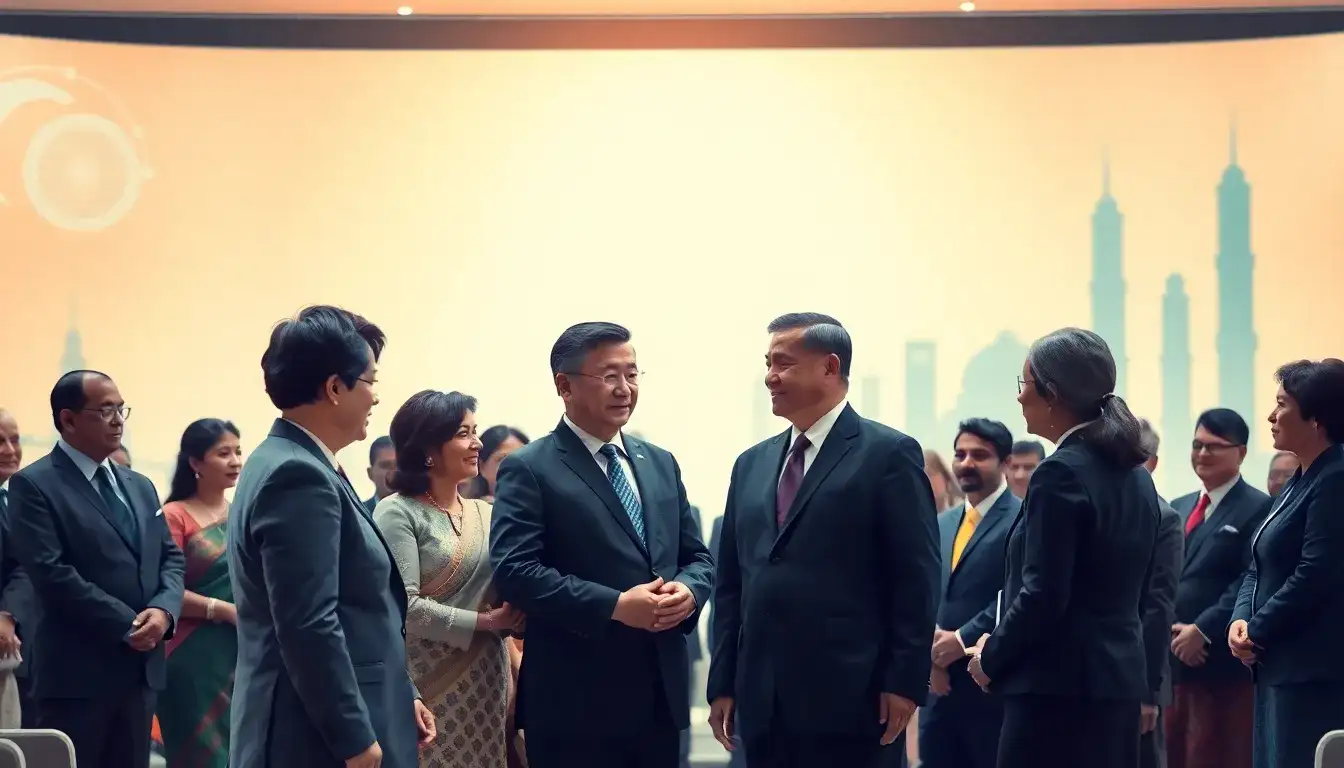
India is set to host an AI summit, with reports suggesting that a delegation from China will attend. This development is seen as a sign of the improving relations between the two nations. According to George Chen, a partner at the American strategic consulting firm Asia Group and co-head of digital business, the Chinese delegation will be led by a vice minister from the Ministry of Science and Technology. He noted that the Indian Embassy in Beijing has been proactive in coordinating visa arrangements for the attendees.
Despite the summit coinciding with the important Chinese traditional holiday, Spring Festival, it is expected that representatives from Chinese businesses will also be present. The summit is scheduled to take place from February 16 to 20 in New Delhi and marks the first time the event is being held in a Global South country. Its goal is to propose actionable policy recommendations aimed at long-term AI governance, rather than establishing short-term regulatory rules.
By the end of 2025, the Secretary of the Indian Ministry of Electronics and Information Technology, Krishnan, stated that India has officially invited China to participate in the summit. Currently, neither the Chinese nor Indian sides have confirmed their attendance. However, U.S. media reports indicate that the Asia Group has been in ongoing discussions with Chinese policymakers regarding AI regulation and policy development, marking the first confirmation of China’s participation in the event.
The Indian Minister of Railways, Communications, Electronics, and Information Technology, Ashwini Vaishnaw, recently announced that representatives from over 100 countries are expected to attend the summit, including more than 15 heads of state and government leaders. Notable attendees confirmed thus far include Microsoft founder Bill Gates, DeepMind CEO Demis Hassabis, Anthropic CEO Dario Amodei, Adobe CEO Shantanu Narayen, and Qualcomm President and CEO Cristiano Amon.
However, there has been significant interest regarding China’s participation, especially as Chinese AI models such as DeepSeek and Qwen have emerged as competitive alternatives with cost advantages over their U.S. counterparts, including GPT and Gemini. The Indian Express highlighted that both India and China are aiming to enhance their capabilities in AI amidst a global landscape where major economies are rapidly advancing in this field.
Analysts suggest that India hopes to elevate its status and diplomatic influence by inviting both China and the U.S., two AI powerhouses, to the summit. This move underscores India’s ambition to integrate into the core of global AI governance and position itself as a neutral yet key participant among major nations.
The American news website The American Bazaar reported on January 31 that the world is gradually moving toward an “AI order,” where only the U.S. and China possess the comprehensive systems necessary for achieving true AI sovereignty. This includes large-scale capital, advanced semiconductor ecosystems, extensive energy and data center capabilities, and a deep pool of scientific talent. The U.S. benefits from a rare level of synergy, with private capital, research universities, and tech companies working closely together, enabling them to invest hundreds of billions of dollars almost overnight. In contrast, China operates through state coordination, allocating resources and shaping markets, accepting some efficiency losses in pursuit of long-term strategic control.
India’s situation is paradoxical. The country is not lacking in talent; Indian engineers and scientists are prominent in many AI teams worldwide, often holding key positions in companies vying for AI sovereignty. However, AI sovereignty is not solely determined by talent, but rather by three critical components: capital, chips, and data centers. India currently lacks the robust capital foundation necessary for financing computational power, a mature domestic semiconductor manufacturing ecosystem, and the extensive data center infrastructure needed to compete with the U.S. and China. Without these foundations, talent may ultimately seek opportunities elsewhere. By strict definitions of AI sovereignty, India is not yet a contender—not due to missed opportunities in thought or technology, but because sovereignty involves more than just code; it encompasses everything that supports the functioning of that code.
Original article by NenPower, If reposted, please credit the source: https://nenpower.com/blog/china-to-send-delegation-led-by-vice-minister-to-upcoming-ai-summit-in-india/

