

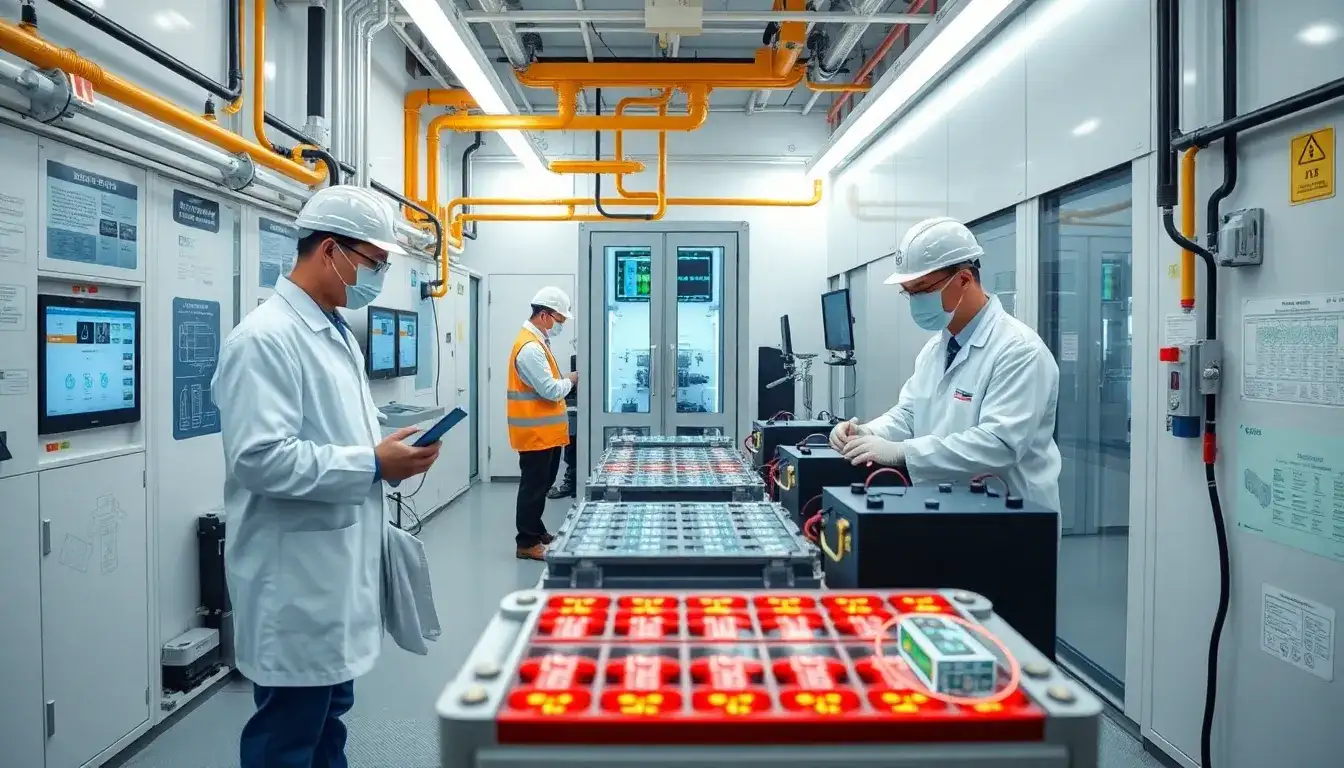
The most stringent battery safety regulations for new energy vehicles have arrived! The requirement for “no fire or explosion” has been established as a mandatory standard. On April 17, 2025, the Ministry of Industry and Information Technology released the compulsory national standard titled “Safety Requirements for Power Batteries Used in Electric Vehicles” (GB38031-2025), which is expected to be implemented in July 2026. This revised version includes several new safety testing items compared to the current 2020 version and marks the first time that “no fire or explosion” has been mandated, a move seen as a significant step towards addressing public concerns regarding battery safety.
Recent incidents involving electric vehicle battery fires have raised significant attention. For instance, on April 22, 2019, a Tesla vehicle caught fire in Shanghai, followed by a NIO ES8 in Xi'an. Other notable incidents include a BYD E5 fire in Wuhan on April 24, 2019, and a tragic accident involving a Tesla in Guangzhou on April 17, 2021, which resulted in a passenger's death. In another incident on March 15, 2023, a new energy vehicle began emitting smoke and subsequently caught fire at a charging station in Liupanshui, Guizhou. Furthermore, on March 29, 2025, a Xiaomi SU7 experienced a fire after a collision on the highway, leading to three fatalities.

According to the <b>2024 New Energy Vehicle Insurance Development Report</b>, data from January to November 2022 showed that 22.67% of vehicle fires occurred during the charging process, 16% while driving, and 38.67% while parked. Additionally, 9.33% of fires were caused by collisions, while other causes accounted for 13.33%. Analysis of fire incidents over recent years indicates that the time from visible flames to fire in the driver's cabin averages only 64 seconds. Dong Yang, chairman of the China Automotive Power Battery Industry Innovation Alliance, noted that while the fire rate for electric vehicles is lower than that of gasoline vehicles, the lack of experience in handling electric vehicle fires and the higher difficulty in extinguishing battery fires contribute to the heightened concern.

The primary causes of new energy vehicle fires warrant serious attention. A review of over 270 publicized cases of electric vehicle fires in 2023 showed that only about 10% were due to collisions, while more than 50% ignited during charging or when stationary. This phenomenon of "spontaneous combustion" during charging or while parked is more often discussed than fires resulting from traffic accidents. A detailed study conducted by the China Automotive Engineering Research Institute, in collaboration with the Tianjin Fire Research Institute, highlighted that the leading cause of battery-related fires is <b>thermal runaway</b>. This uncontrolled temperature rise can be triggered by improper charging practices, such as bottom scraping, prolonged water exposure, or collisions.

Previously, regulations mandated that all domestically produced electric vehicle batteries must allow at least five minutes for safe evacuation in the event of thermal runaway. The latest report from the Ministry of Industry and Information Technology indicates that current technology can ensure batteries do not ignite or explode after a thermal runaway event. While thermal runaway may not be completely preventable, ignition can be.

In May 2024, the Ministry of Industry and Information Technology released a draft for the <b>Safety Requirements for Power Batteries Used in Electric Vehicles</b>, further tightening safety standards for new energy vehicle batteries. The revised version has now been published and is expected to be implemented in July 2026.

What makes this <b>"most stringent safety regulation"</b> significant? According to the Ministry of Industry and Information Technology, the revised version includes updates to thermal diffusion tests, introduces bottom impact tests, and safety tests after fast-charging cycles, all of which now require batteries to meet the <b>"no fire or explosion"</b> condition after testing. Specifically, the revised thermal diffusion tests clarify temperature requirements, electrical status, observation time, and testing conditions. New methods include internal heating in addition to external heating and puncturing. The technical requirements have shifted from providing alarm signals for thermal events five minutes prior to fire or explosion to ensuring <b>"no fire or explosion"</b> (while still requiring alarms) and eliminating the previous evacuation time limits.

Additionally, smoke emissions must not harm occupants, aiming for absolute safety with <b>"no thermal runaway"</b>. The revised version also introduces bottom impact testing to assess battery protection against impacts, requiring no leakage, shell rupture, ignition, or explosion while meeting insulation resistance requirements. The fast-charging cycle safety test evaluates batteries charged from 20% to 80% state of charge (SOC) within 15 minutes, ensuring safety after 300 cycles of fast charging.

In February 2024, the National Automotive Standardization Technical Committee conducted a survey involving 36 vehicle and battery manufacturers, revealing that 78% of companies possess the technical capability to ensure their power batteries do not ignite or explode. Although this indicates significant progress, it does not imply that electric vehicles will be entirely free from fire hazards in the future. An official from an energy company noted that high-speed collisions could still lead to fires due to the ignition points of various components being reached.

A representative from a new energy innovation technology company emphasized that the new national standards focus on preventing internal battery thermal runaway from causing fires or explosions. However, ensuring that batteries do not ignite or explode after a collision requires collaborative efforts from both vehicle manufacturers and battery suppliers. The development of <b>non-thermal diffusion technology</b> will provide a solid foundation for enhancing safety for both passengers and vehicles in the event of collisions.
Original article by NenPower, If reposted, please credit the source: https://nenpower.com/blog/china-introduces-strict-new-safety-standards-for-electric-vehicle-batteries-mandating-no-fires-or-explosions/

