

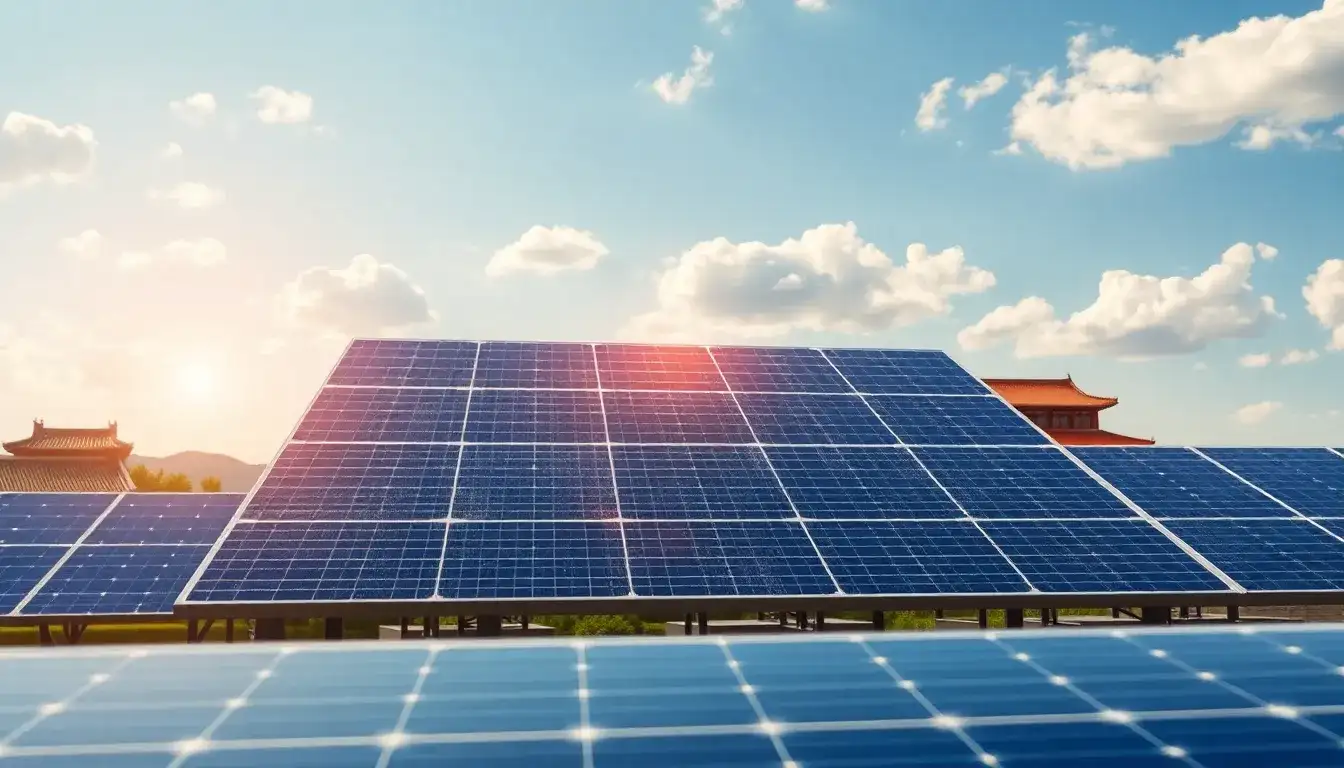
In June 2024, a research team led by Tan Hairen from Nanjing University published groundbreaking findings in Nature Energy, showcasing a new type of perovskite solar module that achieved a steady-state efficiency of 28.3%. This module also passed 3000 hours of industrial standard testing at 85°C and 85% humidity. This achievement marks the resolution of a 15-year stability issue that has plagued the academic community. As a result, the cost of photovoltaic power generation is expected to drop to 0.15 yuan
Breaking the “Double 85” Challenge
Perovskite materials theoretically offer an efficiency of 31% and a material cost that is only 1/20 that of crystalline silicon. However, they have long been hindered by two critical flaws:
- Humidity Sensitivity: Traditional perovskites decompose upon contact with water, leading to a decline in efficiency of over 50% within 24 hours in humid environments.
- Thermal Runaway: When temperatures exceed 60°C, ionic migration can cause structural collapse.
To overcome these challenges, the Tan Hairen team implemented three innovative solutions:
- Nano-Web Encapsulation Technology: A 0.2 nanometer5×10⁻⁶ g/m²·day, effectively giving the battery a “molecular-level bulletproof vest”.
- Self-Healing Lattice Design: By introducing formamidinium cesium ions, a “memory” crystal structure is created that can automatically restore itself after high-temperature lattice distortion.
- Quantum Dot Interface Passivation: Lead selenide quantum dots embedded in the charge transport layer reduce carrier recombination losses from 18% to 2.3%.
Certified by the Fraunhofer Institute in Germany, this module demonstrated an annual degradation rate of only 0.8% in Hainan Qionghai, outperforming the 1% industry standard for crystalline silicon modules.
The “Domino Effect” of the Supply Chain
Revolution in Equipment: GCL-Poly has established the world’s first GW-level production line for perovskite modules, utilizing a “vapor deposition + inkjet printing” process that achieves a production speed of 15 meters/minute, which is 120 times faster than traditional crystalline silicon pulling processes. The investment for their Suzhou factory is only 300 million yuan, 70% less than equivalent crystalline silicon production lines.
Material Replacement: Each square meter of perovskite module requires only 1.5 grams of lead, with a recycling rate of 99%. In contrast, crystalline silicon batteries consume 80 tons of silver per GW, while global silver production is only 25,000 tons annually. CITIC Securities estimates that if perovskite technology achieves a 30% penetration rate, global silver demand could drop by 18%.
Disruptive Application Scenarios: Flexible perovskite modules developed by Hangzhou Xinna Optoelectronics, with a thickness of just 0.3 millimeters, can bend to a radius of 3 centimeters. In tests conducted on the Inner Mongolia grasslands, “photovoltaic tents” generated enough electricity to meet the daily needs of nomadic families, with costs 60% lower than diesel generators.
The “Three-Body Effect” of the Energy Revolution
Reconstruction of Power Costs: According to models from the International Renewable Energy Agency (IRENA), when solar power prices fall below 0.2 yuan15 yuan1% to 45%.
Building Energy Self-Sufficiency: LONGi Green Energy’s “photovoltaic curtain wall + perovskite” solution enhances the Shanghai Tower’s annual electricity generation to 3.8 million kWh, fulfilling 32% of the building’s energy needs. New regulations from the Ministry of Housing and Urban-Rural Development mandate that starting in 2025, new public buildings must have a photovoltaic coverage rate of no less than 40%.
Explosion of Mobile Energy: A partnership between CATL and NIO resulted in a solar car roof that generates an average of 8 kWh4-square-meter50 kilometers. Tesla’s CEO Elon Musk acknowledged in a recent earnings call that “perovskite technology could redefine the rules for electric vehicle charging.”
A Pragmatic View of the “Technological Frenzy”
Despite the promising outlook, the commercialization of perovskite technology still faces three major challenges:
- Mass Production Consistency: Current GW-level production lines have an 85% yield rate, which is still below the 98% yield rate of crystalline silicon batteries.
- Indium Resource Bottleneck: The indium oxide needed for transparent conductive layers has a known global reserve of only 50,000 tons, sufficient for producing 2 TW of modules, or about 1/3 of the current global installed photovoltaic capacity.
- Recycling System Gaps: Existing photovoltaic recycling technologies are designed for crystalline silicon, and lead recovery processes for perovskite modules are still in the experimental phase. However, China’s Ministry of Science and Technology has initiated the “Photovoltaic 3.0” project, aiming to establish a perovskite recycling demonstration line by 2025 and develop alternative materials for indium.
Bringing Sunlight into Reality
While international giants like Oxford PV and Panasonic continue to struggle in laboratories, China has already taken the lead in the industrialization of perovskite technology. This revolution is not only about energy pricing; it will also transform humanity’s relationship with the sun—from “passively receiving sunlight” to “actively weaving sunlight.” In the near future, every window, car, and tent could become a micro power station, with the spark of this transformation shining brightly in Chinese scientists’ laboratories.
Original article by NenPower, If reposted, please credit the source: https://nenpower.com/blog/china-breaks-the-perovskite-barrier-a-new-era-for-the-photovoltaic-industry-approaches/

