

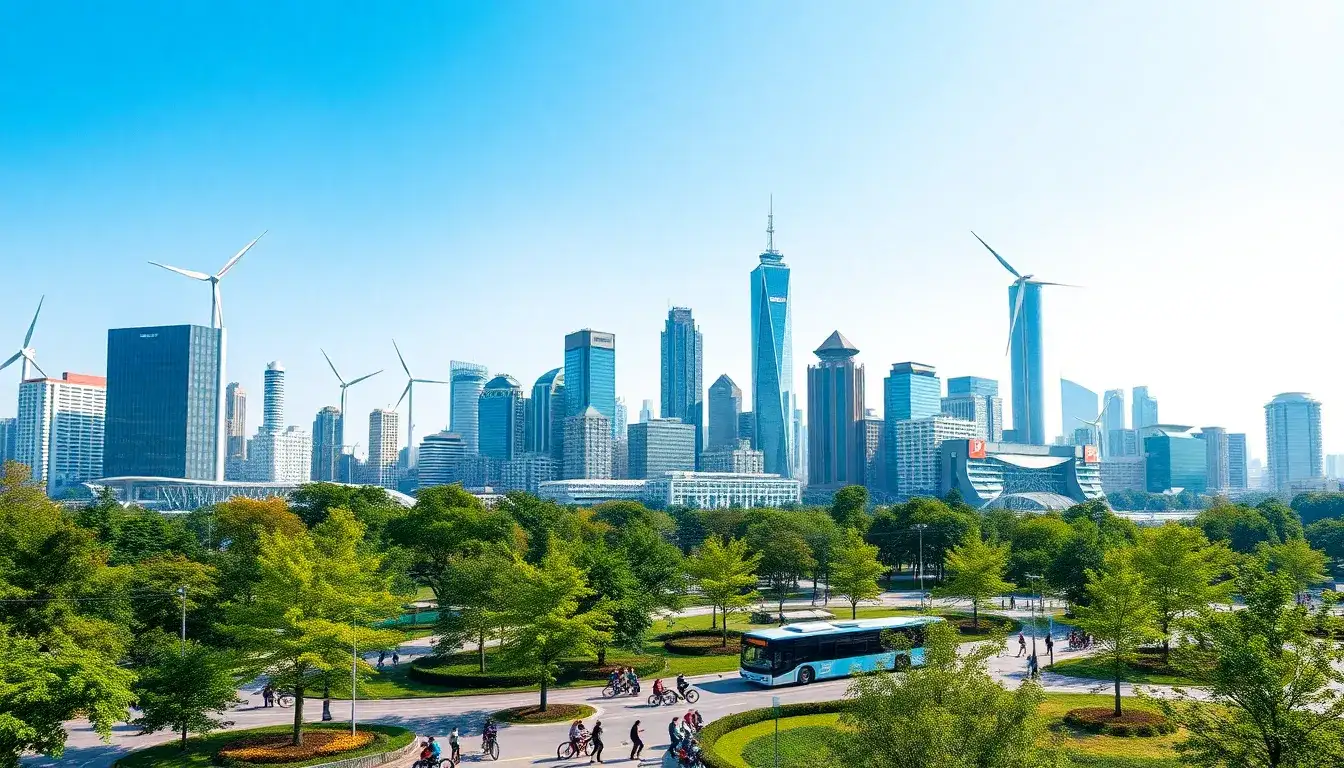
Changzhou: Consistently Exceptional
Some cities, though understated, are impossible to overlook. In the rapidly evolving new energy industry, Changzhou has firmly secured its position at the center stage. On average, a new energy power battery is produced every second, and a new energy vehicle rolls off the production line every 40 seconds. Changzhou accounts for one-fifth of the national production capacity of new energy power batteries, with one out of every ten electric vehicles exported from China originating from this city.
As the new energy sector thrives, Changzhou is also making strides in emerging fields such as low-altitude economy and synthetic biology, continually exploring new horizons. The city is integrating dispersed energy resources into microgrids, taking on a greater responsibility toward green energy. Following its achievement of becoming a “trillion-yuan city,” Changzhou shows no signs of slowing down, driven by a relentless momentum.
Recently, Changzhou released its latest industrial economic report for the first quarter, which indicates an 8.8% year-on-year growth in the value added by large-scale industries, ranking second in Jiangsu Province and first in Southern Jiangsu. The city’s industrial sales reached 487.17 billion yuan, reflecting an increase of 8.7% year-on-year, placing Changzhou fifth in Jiangsu and first in Southern Jiangsu.
Despite its relatively small area and population compared to other trillion-yuan cities, Changzhou consistently capitalizes on industrial trends and exhibits impressive growth potential. What is the secret behind this city’s remarkable development?
Speed: Racing Towards the Future
How fast can a city grow? The answer lies in its manufacturing capabilities. The domestically produced C919 large passenger aircraft, for instance, utilizes 12% carbon fiber composite materials, known for their low density and high strength, allowing for greater agility and extended flight range.
Changzhou is home to the Yangtze River Delta Carbon Fiber and Composite Materials Technology Innovation Center, where a core team has witnessed the entire development and application process of this critical technology. Additionally, the Qishuyan Locomotive Works, which began manufacturing locomotives in 1936, continues to thrive. The century-old China Railway Qishuyan Locomotive Co., Ltd. not only remains active in the diesel locomotive sector, producing the world’s most advanced diesel locomotives, but also strides forward on the path of green development, with its new energy locomotives becoming the preferred choice for updating outdated diesel models.
Notable enterprises such as Li Auto, BYD, CATL, and Zhongxin Innovation are all establishing a presence in Changzhou. The city has accurately tapped into the pulse of the times and technology, supporting the new energy industry alongside these companies. In a short span, the city’s speed of production has become evident—every second, the Jiangsu Times production line in Changzhou produces a power battery; every 40 seconds, Li Auto’s automated assembly line completes a new energy vehicle.
Currently, approximately one-fifth of the nation’s new energy power batteries are produced in Changzhou, with a remarkable 97% completeness of the local power battery supply chain, establishing the city as a crucial node in both national and global industrial chains.
Behind the rapid growth of Li Auto’s Changzhou base is a surge of innovation. In the 5-square-kilometer Changzhou Science and Education City, an average of one technology company is founded daily, one technology achievement is transformed, and four patents are authorized. The 2024 government work report marks the first mention of the “low-altitude economy,” and in 2023, when Changzhou joined the ranks of trillion-yuan cities, it unveiled an action plan for the low-altitude economy, aiming for an industry scale exceeding 30 billion yuan by 2026.
With its years of experience in smart equipment manufacturing, new materials, and new energy production, Changzhou is well-prepared for the emerging low-altitude economy. Batteries can be utilized not only in vehicles but also in aircraft. Leveraging its renowned power battery industry, Changzhou has swiftly emerged as a “dark horse” in the low-altitude economy.
In 2025, the government work report will introduce “biomanufacturing,” a technology heralded as the “third revolution in biotechnology” and one of the most disruptive frontier technologies of the 21st century. While discussions about this new concept are ongoing, Changzhou has already attracted over 70 major enterprises in the biotechnology sector, including 32 high-tech companies, 31 large enterprises, and 22 specialized and innovative enterprises, along with two publicly listed companies and two potential unicorns.
From new energy to low-altitude economy, and synthetic biology, the question arises: why does Changzhou consistently stay ahead of the curve and seize industrial opportunities? The answer lies in its patience and strategic foresight.
When CATL established its presence in Liyang, it was two years away from going public; Zhongxin Innovation was close to bankruptcy before being rescued by Jintan. Changzhou embraced both, allowing time for development and laying the groundwork for an integrated “generation-storage-distribution-use” industrial ecosystem.
Vision and patience are also reflected in the low-altitude economy and synthetic biology sectors. Changzhou began exploring low-altitude economy opportunities as early as 2015, planning the construction of a drone industrial park and a specialty town, as well as obtaining the only approved high-altitude 500-meter drone training airspace with a 3-kilometer radius in the country. Similarly, the synthetic biology industry in Changzhou has been in the works for over a decade.
Today’s speed is a result of Changzhou’s strategic framework—focusing not solely on immediate scale and profitability but rather on identifying trends in technology and the broader industrial chain to maximize value. The city understands its industries, is willing to invest, allows time for growth, and embraces failures. It trusts in the power of time and the strength of belief.
Breadth: A Neighboring Trillion
As Changzhou’s GDP surpassed one trillion yuan in 2023, it is noteworthy that it has the smallest population among cities in the trillion-yuan club. Among Jiangsu’s “Thirteen Taibao,” Changzhou ranks second to last in area. Yet, with only 4% of Jiangsu’s land, it contributes 8% of the province’s total economic output. Despite its size and population, Changzhou expands its breadth by enhancing connectivity and communications, leveraging its “small frame” for “great development” and generating “great energy” from “small resources.”
The closed industrial loop of Changzhou’s new energy “generation-storage-distribution-use” system reflects the city’s collaborative thinking. Rather than limiting its focus to finished products like electric vehicles and batteries, Changzhou has accelerated the construction of a new energy system, actively promoting the establishment of microgrid demonstration cities. Microgrids consist of small power generation and distribution systems, comprising distributed power sources, electrical loads, distribution facilities, monitoring, and protection devices. They function like “power banks,” storing green energy and off-peak electricity for use when needed.
Through optimized energy management and scheduling, microgrids significantly reduce energy costs and enhance efficiency, serving as a key strategy for achieving carbon neutrality. However, the development of microgrids requires interdisciplinary collaboration, encompassing solar energy, storage, renewable hydrogen production, and artificial intelligence. A single technological breakthrough is insufficient; a reconfiguration of the energy element connection is necessary. To facilitate this, Changzhou has launched the “I Want to Build a Microgrid” service platform, providing one-stop services from design and equipment selection to intelligent management, allowing enterprises to bypass technical integration challenges.
With this service platform’s support, 39 microgrid projects have been established in the city, with an additional 100 planned for this year. Previously, Changzhou’s energy system was characterized by a typical “island effect,” relying on centralized power grids for industrial electricity while communities and commercial entities had weak self-sufficiency in energy. By utilizing microgrids, Changzhou integrates dispersed solar, storage, and charging facilities into an interconnected energy ecosystem, breaking through the limitations of single power supply functionality and extending into a multidimensional “energy-industry-livelihood” framework.
Temperature: The Human Element in Urban Development
A modern industrial system resembles a forest ecosystem. Large enterprises are like towering trees, while small and medium-sized companies are akin to shrubs and moss. Together, they create a complete industrial ecology that enhances agglomeration effects, reduces supply chain response costs, and facilitates rapid movement of resources, ultimately forming a creative industrial cluster. Therefore, governments should not only “plant trees” but also “cultivate forests.”
Unlike many places, Changzhou not only focuses on “planting forests” but also pays attention to the “soil.” If industries are the forest, then people represent the soil. A city and its enterprises must have “warmth” to nurture a vibrant community, which in turn energizes industries.
In Changzhou, workers’ experiences begin with a culinary journey. Employees at companies like Hualida and Borui Electric rave about their cafeterias, which emphasize innovative and seasonal dishes as key performance indicators, showcasing a range of local delicacies to evoke nostalgia.
Many cities have talent apartments, but Changzhou adds its own twist. Co-working spaces foster brainstorming among young professionals, while shared kitchens allow friends to showcase their culinary skills. Facilities such as esports rooms, audio-visual rooms, gyms, and yoga studios enhance community engagement, complemented by outdoor sports fields. The Changzhou High-tech Zone’s Manbai Future Talent Community exemplifies this, with dedicated female and pet-friendly apartments.
Guided by “urban renewal, talent attraction, and asset revitalization,” Changzhou has systematically assessed its government and state-owned enterprises’ existing assets and invested in projects in smaller cities and areas with an urgent need for fresh talent. The government collaborates with private enterprises rather than taking complete control. Han Fugui, co-founder of Manbai Group and a millennial, believes that “people of the same age understand each other better.” This approach has led to a consistently high occupancy rate of around 98% in Changzhou’s first five-star talent apartment, with an average resident age of 26.3 years.
Since the launch of the “Dragon City Talent Program” in 2006, graduates from vocational schools have enjoyed benefits equivalent to those of bachelor’s degree holders. For ten consecutive years, the city has ranked first in Jiangsu for high-skilled talent per 10,000 workers. Changzhou was also the first in the province to assign family doctors to high-level talents and establish a government procurement system for innovative products from leading enterprises. The ongoing upgrades to the Dragon City Talent Program have attracted over 600,000 talents since 2019, averaging over 100,000 each year.
Old Changzhou residents associate memories with places like Hongmei Park. Since 2002, 26 parks, including Hongmei Park, have undergone upgrades and have been opened for free to the public, setting a precedent in Jiangsu. In the new era, Changzhou strives to create a “park city,” continually promoting “green space sharing” and hosting hundreds of cultural events like music festivals.
Changzhou’s warmth is a strong response to the principle of “a city built by the people, for the people.” This city embodies multiple narratives: the speed generated by industry and innovation, the breadth achieved through connectivity and collaboration, the precision focused through technology and craftsmanship, and a sense of happiness rooted in shared development.
With collective strength, nothing can be defeated; with shared wisdom, nothing remains unachievable. Thus, the city remains vibrant and dynamic. Urban development is not just a grand narrative but also a series of subtle efforts, warmth, and shared experiences among over 5 million residents, culminating in the extraordinary transformation of the city. As it steps onto the new stage of being a “trillion-yuan city,” it continues its forward march, ever eager to embrace the next challenge.
Original article by NenPower, If reposted, please credit the source: https://nenpower.com/blog/changzhou-a-city-of-innovation-and-green-energy-leadership/

