

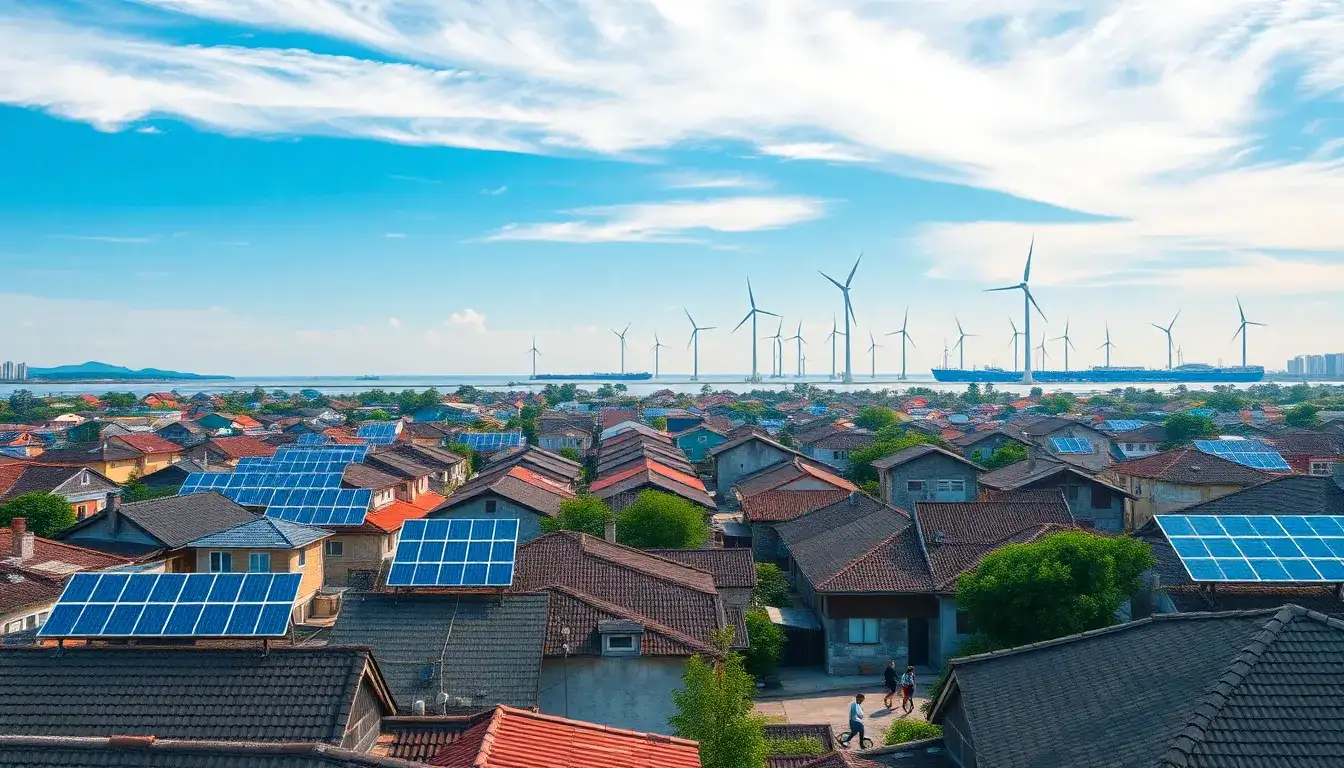
Recent announcements from the Guangdong Provincial Energy Bureau have identified areas experiencing challenges in integrating distributed photovoltaic (PV) systems into the grid for the third quarter of 2025. The report highlights that a total of 236 towns across 26 counties in seven cities are affected, including regions such as Shaoguan, Heyuan, Meizhou, Huizhou, Zhanjiang, Maoming, and Qingyuan. This follows an earlier report from the second quarter, which had identified 253 towns across 27 counties in eight cities facing similar restrictions.
As one of the provinces with high electricity consumption, Guangdong has attracted considerable attention this year, particularly under the context of Document No. 136. With the implementation of relevant policies, the direction for future investments in new energy within the province has become more defined. On one hand, the “Management Measures for the Development and Construction of Distributed Photovoltaic Power Generation” (draft for public consultation) explicitly states that there will be no further development of ground-mounted centralized solar power. Instead, it emphasizes support for the growth of rooftop solar projects. On the other hand, Document No. 136 indicates that centralized solar and onshore wind projects will not participate in the competitive bidding for grid electricity.
This implies that future developments in Guangdong’s new energy sector may focus primarily on offshore wind and distributed solar power, while the growth of centralized solar and onshore wind projects could face stringent limitations. However, the distributed management measures have broadened the definition of distributed solar projects, providing guidance for future development directions. For instance, photovoltaic projects that utilize agricultural land with existing agricultural buildings and connect to the public grid at a voltage level not exceeding 10 kV (or 20 kV) with a total installed capacity of up to 6 megawatts will be classified under general commercial distributed solar management. These projects must meet certain criteria, including not impacting the original purpose of the agricultural buildings and ensuring that at least 50% of the generated electricity is self-consumed annually.
Furthermore, aside from the aforementioned projects that utilize agricultural buildings, there are currently no mandatory self-consumption requirements for other general commercial distributed solar projects. The investment entities are encouraged to utilize existing power supply lines to determine the total installed capacity of their projects rationally. Compared to most provinces that require a self-consumption rate of at least 50% for distributed solar projects, Guangdong’s regulations are relatively lenient, allowing some room for small agricultural solar projects to grow. However, it is evident that, with the detailed implementation of Document No. 136 across various provinces, the number of regions that can effectively support investments in solar power stations is limited. Traditional power-heavy provinces, from Shandong to Guangdong, are facing an unfavorable policy direction regarding solar investments. In contrast, although Jiangsu has not yet released detailed guidelines, the industry’s interest in the province is rapidly increasing under the current circumstances.
The list of areas with integration challenges and the alert levels for low-voltage distribution networks have been published to guide the rational layout and orderly construction of distributed solar power, promoting coordinated development between energy sources and networks. For further details, stakeholders can reference the Guangdong Distributed Photovoltaic Capacity Query Platform.
Original article by NenPower, If reposted, please credit the source: https://nenpower.com/blog/challenges-in-renewable-energy-integration-for-236-towns-in-guangdong-focus-on-distributed-solar-and-offshore-wind-power/

