

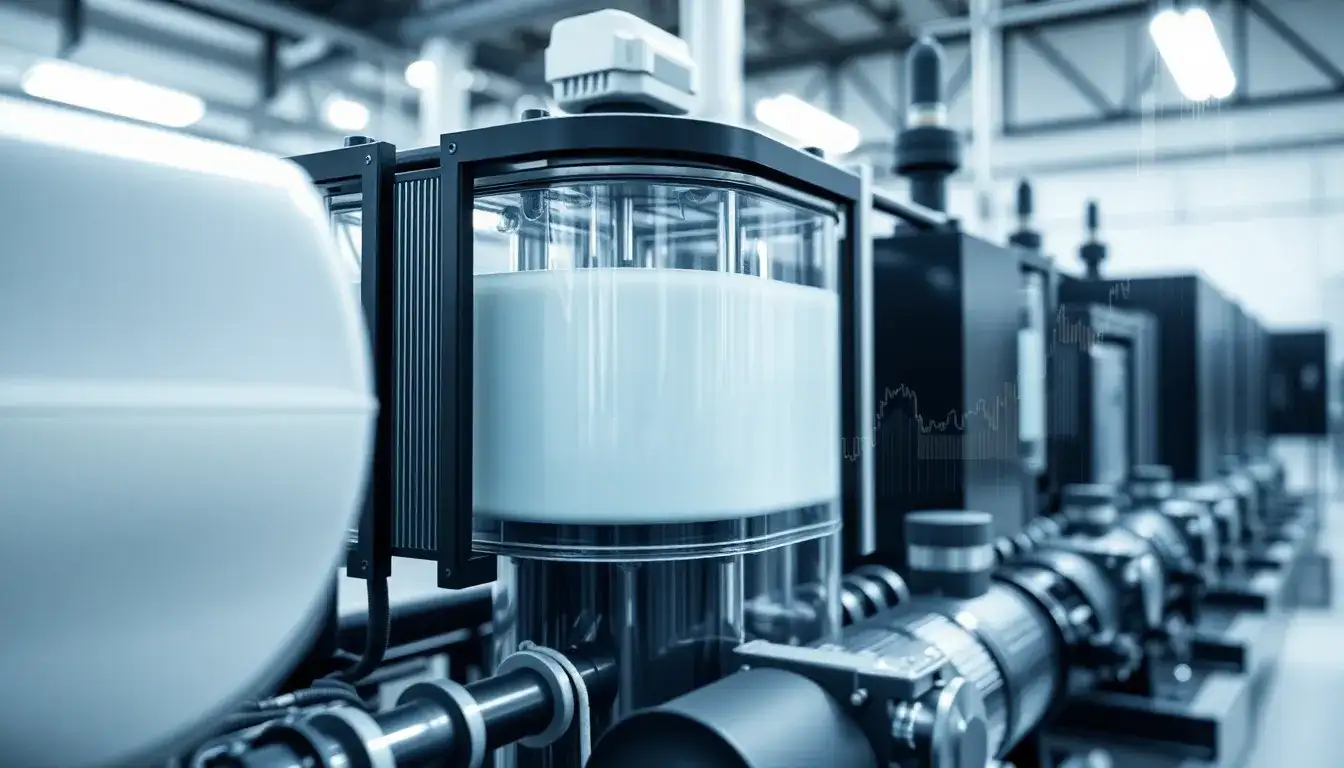
Flow batteries hold significant promise for large-scale, long-duration energy storage applications. However, the technology is still in its early stages of commercialization, facing challenges such as high costs that need to be addressed for wider adoption.
In the diverse landscape of energy storage technologies, flow batteries are increasingly gaining attention. For instance, a subsidiary of Zhongna Energy Technology Co., Ltd. recently signed an agreement with the government of Yulin City and industry partners to initiate a 500MW all-vanadium flow battery manufacturing project with a total investment of 970 million yuan.
Industry experts highlight the advantages of flow batteries, such as high safety and long cycle life, which make them well-suited for large-scale energy storage solutions. However, the technology still faces hurdles due to its limited market share and high costs that necessitate further optimization and development to accelerate commercial application.
The interest in new energy storage solutions has surged in recent years in China. According to data from the National Energy Administration, by the end of 2024, the cumulative installed capacity of newly built energy storage projects across the country reached 73.76 million kilowatts (or 168 million kilowatt-hours), with an average storage duration of approximately 2.3 hours, reflecting a 130% increase compared to the end of 2023. Lithium-ion batteries dominate the installed base, yet various innovative energy storage technologies continue to emerge, with flow batteries emerging as a new force.
In a recent joint initiative, the National Development and Reform Commission, the National Energy Administration, and the National Bureau of Statistics issued the Action Plan for Accelerating the Construction of a New Power System (2024-2027). This plan emphasizes the exploration of diverse energy storage technologies, including flow batteries, to meet varying demands for ramp-up rates, capacity, long-duration adjustment, economic viability, and safety across different application scenarios.
With significant support from multiple sectors, China’s flow battery energy storage market is experiencing rapid growth, prompting numerous companies to expedite their investments. In March, the Weili De 100MW/400MWh all-vanadium flow battery project broke ground in Leshan, Sichuan Province, with a total investment of 1.4 billion yuan. Earlier in February, two major projects in Yunnan Province, including a 500MW/2GWh flow battery system and a 300MW/1200MWh flow battery power station, commenced, totaling around 3.627 billion yuan in investment. In January, a comprehensive base project for flow batteries in Zhoukou City, valued at 8.08 billion yuan, began construction, with an expected annual output value of 17.26 billion yuan.
Experts suggest that with ongoing policy support and accelerated project implementation, flow batteries could play an increasingly vital role in renewable energy consumption and grid peak shaving, injecting new momentum into China’s energy transition. According to estimates from CITIC Securities, the installed capacity of all-vanadium flow batteries is projected to reach 0.53GW by 2025 and 1.07GW by 2027, corresponding to market potentials of 5.8 billion yuan and 10.9 billion yuan, respectively.
Flow batteries are characterized by their long cycle life, safety, and environmental friendliness, and they demonstrate significant advantages in storage duration. Projects utilizing flow batteries in China typically offer storage times of over 4 hours, with some extending up to 6 hours. An industry representative remarked, “All-vanadium flow batteries can cater to long-duration energy storage needs.” In contrast to short-duration storage, long-duration solutions effectively enhance renewable energy consumption capacity and improve grid flexibility, providing extended power reliability during seasonal fluctuations or extreme weather, which has garnered significant industry interest.
In February, the National Energy Administration released the 2025 Energy Work Guidance Opinion, emphasizing the need for innovation in new energy storage technologies, particularly long-duration solutions. Many in the industry believe that flow batteries could become a key player in this arena.
According to Wu Wei, an associate professor at Xiamen University’s China Energy Policy Research Institute, flow batteries can independently configure power and energy units, increasing the storage capacity of energy units, making them ideal for long-duration applications. The long cycle life of flow batteries minimizes concerns regarding battery degradation. Academician Zhao Tianshou from the Chinese Academy of Sciences has previously stated that flow batteries are an ideal long-duration storage technology due to their safety, reliability, and ease of scaling.
Despite the vast opportunities, the development of flow batteries still faces challenges. Current power and energy density metrics of flow batteries are not particularly impressive, indicating room for optimization. Moreover, compared to lithium-ion storage, the costs of flow batteries remain relatively high. For example, mainstream all-vanadium flow batteries, which utilize expensive vanadium metal, have a cost exceeding 2000 yuan per kilowatt-hour, making them less economically viable than other long-duration storage technologies like pumped hydro storage, which limits their widespread adoption.
According to industry insiders, currently, only a handful of companies can supply all-vanadium flow batteries domestically, which has not yet achieved a scale effect. As material costs decrease, the potential for flow batteries to develop further will be released. The reduction in flow battery costs depends significantly on the localization of key materials, as well as advancements in critical technologies to enhance battery current density and electrolyte utilization, ultimately lowering system costs.
It is also suggested that financial subsidies and tax incentives should be considered for early-stage high-cost technologies like flow batteries. Improving market mechanisms in the electricity and carbon markets, alongside innovations in business models such as shared energy storage, could aid in accelerating cost recovery for storage solutions. Wu Wei noted that the primary cost driver for flow batteries is the cost of metal materials, with vanadium electrolyte costs accounting for approximately 40% of the total cost of all-vanadium flow batteries. The future reduction in costs will largely rely on increasing the capacity of individual batteries and leveraging the economies of scale within the supply chain.
Zhao Tianshou emphasized that while flow battery technology still faces cost challenges, improving battery current density and electrolyte utilization can significantly reduce system costs and promote industrial application. In fact, the total life cycle costs of flow batteries have decreased in recent years. Between 2023 and 2024, the price of flow battery systems (4h) in China has dropped from 2.83 yuan/Wh to 2.42 yuan/Wh. High工产研储能研究所 (GGII) projects that by 2026, the price of flow batteries could fall below 2 yuan/Wh.
In conclusion, while there are hurdles to overcome, flow batteries represent a promising avenue for long-duration energy storage solutions, with potential for greater economic viability as technological advancements continue.
Original article by NenPower, If reposted, please credit the source: https://nenpower.com/blog/challenges-in-cost-reduction-hinder-the-commercialization-of-flow-batteries/

