

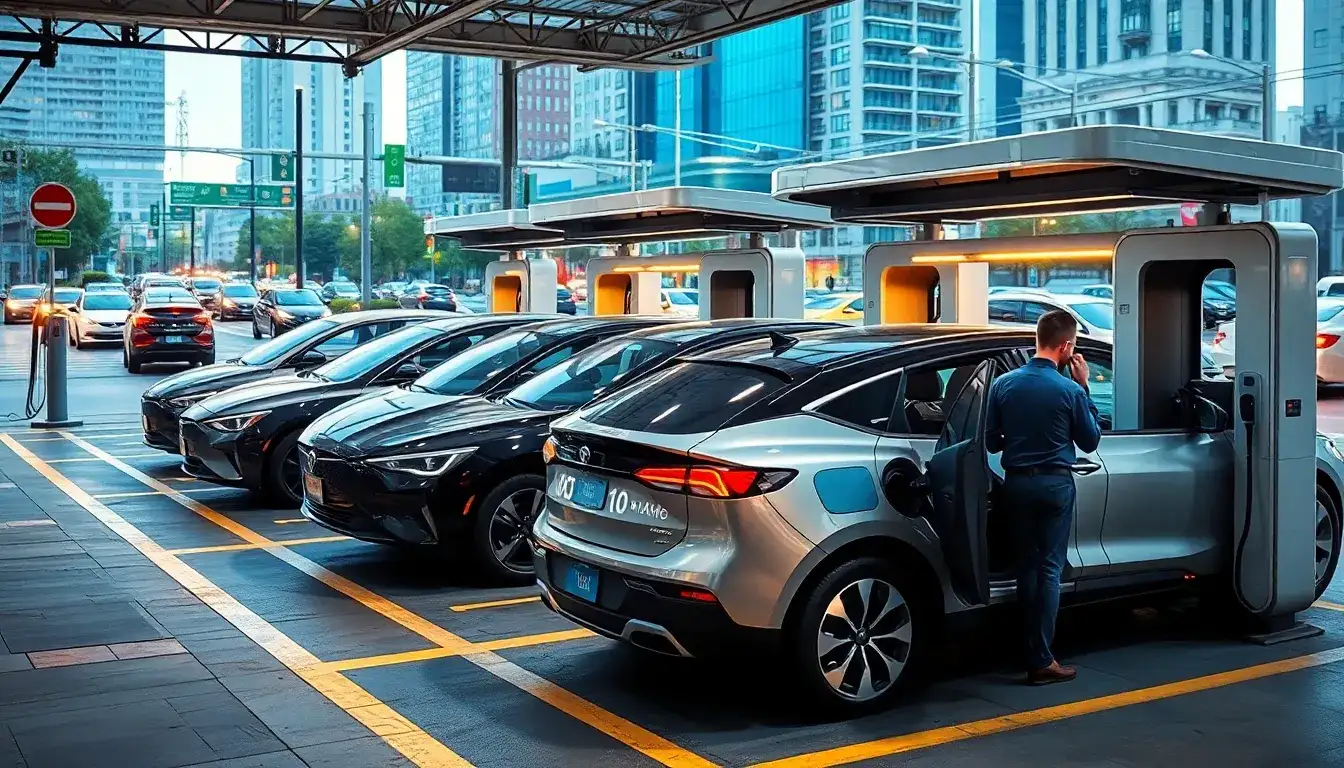
In recent years, the popularity of new energy vehicles (NEVs) has spurred diverse explorations into energy replenishment technologies, with the battery swapping model gaining significant attention due to its efficient refueling and vehicle-battery separation features. However, can this model overcome challenges such as high asset intensity, standardization issues, and profitability to achieve large-scale development?
The Advantages of Battery Swapping
The battery swapping model is reshaping the energy replenishment landscape for NEVs with its core advantage of “refueling in minutes.” By the end of 2024, China is expected to have 4,443 battery swapping stations. For instance, NIO has achieved county-wide battery swapping coverage in Zhejiang, with 443 stations serving 88 districts and counties, and a maximum daily service capacity of 600 swaps.
From a technical standpoint, CATL has introduced the “Chocolate Battery Swap Module,” which features standardized design for cross-brand and cross-model compatibility. Battery models 20 and 25 can be adapted to mainstream vehicles ranging from A0 to C class, allowing users to choose different range versions as needed. Additionally, third-generation battery swapping stations utilize laser radar and intelligent scheduling systems to operate without staff, reducing operational costs by 40%. The “vehicle-battery separation” model allows users to purchase only the vehicle body while renting the battery, which constitutes over 40% of the total vehicle cost. This can lower the purchase threshold by 60% to 70%, promoting the adoption of NEVs.
Battery swapping stations can also function as distributed energy storage units, charging during low electricity demand periods and discharging during peak times, thus alleviating pressure on the power grid. By 2024, renewable energy generation capacity in China has surpassed that of coal power (with over 40% share), highlighting the significant potential of battery swapping stations in the energy transition.
Core Challenges for Large-scale Development
The primary challenge to large-scale development is the high infrastructure and operational costs. The construction cost of a single battery swapping station has decreased from 3 million yuan for the first generation to 1.5 million yuan for the third generation, but they still require a battery inventory (with each station needing 14-30 batteries). For example, NIO has invested over 100 billion yuan in fixed assets for its 3,117 battery swapping stations, yet the average daily swaps per station reached only 30 in 2024, far below the breakeven point of 60. Moreover, battery depreciation, maintenance, and land rental costs further compress profit margins.
Another issue is the lack of standardization. Differing battery specifications and interface protocols among automakers make it difficult for swapping stations to serve multiple brands. While CATL’s “Chocolate Battery Swap Module” aims to offer compatibility with various models through modular design, practical implementation has been slow, adapting to only a limited number of partner models. Without unified standards, the utilization rate of battery swapping stations will remain constrained.
Additionally, the sustainability of business models is a concern. Swapping companies generally rely on capital investment. NIO’s cumulative losses exceeded 100 billion yuan by 2025, and the company has recently reduced free battery swapping benefits to alleviate pressure; meanwhile, Aodong New Energy’s swapping stations in Beijing are expected to take 3-4 years to reach breakeven. While the business-to-business (B2B) market (e.g., taxis) has shown viability (with Beijing Automotive’s swapping stations recouping investments in 2.5 years), consumer demand remains fragmented and places a higher premium on convenience.
Pathways to Breaking Through: Collaborative Policies, Technology, and Ecosystems
China has included battery swapping stations in its “new infrastructure” initiatives, and departments like the Ministry of Industry and Information Technology (MIIT) are implementing policies to encourage their development. The future requires mandatory standards to unify battery specifications and break down technological barriers among automakers. Technological innovations and cost reductions are also crucial; AI can monitor battery health, extend lifespan, and lower maintenance costs. Aodong New Energy is exploring the integration of battery swapping stations with energy storage to enhance revenue through electricity and carbon trading. CATL’s “Chocolate Battery Swap Module” and NIO’s multi-model compatibility solutions offer potential for standardization.
Building ecological alliances can help share costs and improve utilization rates, creating economies of scale. Recent collaborations between CATL and NIO signal accelerated industry consolidation. CATL plans to establish 1,000 battery swapping stations by 2025, with a long-term goal of 30,000 (close to the number of Sinopec gas stations). NIO is also opening its battery swapping network to third parties, inviting companies like Changan and Geely to join the alliance. Thus, the success of the battery swapping model hinges on coordinated efforts in cost control, standardization, and policy support. Large-scale development will require overcoming the “chicken-and-egg” dilemma—only with more automakers joining the alliance and more users opting for battery-swappable vehicles can a truly virtuous cycle be achieved.
Recent Developments in Battery Swapping
On March 29, 2025, during a speech at the China Electric Vehicle Hundred People’s Forum, Xin Guobin, Vice Minister of the MIIT, stated that the ministry will promote the development of the automotive industry and accelerate its transformation and upgrading. It will continue to implement activities to bring NEVs to rural areas and conduct pilot projects to fill gaps in charging and swapping facilities.
On March 28, NIO officially opened its 3,200th battery swapping station at the Jingning All-Region Tourism Service Center in Lishui, Zhejiang Province. This new station enables NIO to achieve county-wide battery swapping coverage across Zhejiang (excluding the island counties of Daishan and Shengsi). At the same time, NIO’s charging network has also achieved county-wide coverage, with charging piles available in all 90 districts and counties. Zhejiang now boasts the highest number of NIO battery swapping stations in the country, with 443 stations and 2,279 charging piles established.
On March 28, Beijing Automotive announced a plan to acquire 40 battery swapping stations for 129 million yuan through its wholly-owned subsidiary, Beijing Automotive Powertrain Co., which entered into an asset purchase agreement with Blue Valley Wisdom (Beijing) Energy Technology Co., a company indirectly controlled by BAIC Group.
On March 26, the first dedicated battery swapping station for ride-hailing taxis in Handan City, Hebei Province, broke ground. This project, developed in collaboration with Anhui Zeqing New Energy Technology Co. and Hebei Zeqing New Energy Technology Co., represents a significant step forward in new energy mobility for Handan and aims to inject new energy into the city as a model for new energy development. The partners plan to invest 100 million yuan to build a comprehensive system of 10 dedicated battery swapping stations and supporting service platforms.
On March 18, Aodong’s battery swapping stations completed a technology upgrade to support multi-brand vehicle swapping services. This upgrade focuses on “modular design + intelligent adaptation” technology, successfully addressing the challenge of cross-brand vehicle swapping. The Aodong Intelligent Travel technology team optimized the system to ensure compatibility with various models from Dongfeng Qichen, Hongqi, and several other partner automakers. The intelligent recognition system automatically matches vehicle requirements, accurately leveling the battery swapping platform, and utilizes high-precision radar to identify vehicle wheelbase, track width, and battery pack dimensions, achieving seamless integration. This innovation effectively eliminates barriers caused by structural differences among vehicle models, significantly enhancing swapping efficiency.
On March 17, NIO announced a strategic investment of up to 2.5 billion yuan from CATL. According to the signed strategic cooperation agreement, NIO and CATL will leverage their strengths in technology, management, platforms, and brand resources to create the world’s largest and most advanced battery swapping service network, covering all passenger vehicles and pushing for unified industry standards while deepening business collaboration.
Original article by NenPower, If reposted, please credit the source: https://nenpower.com/blog/challenges-and-opportunities-in-the-development-of-battery-swap-stations-for-electric-vehicles/

