

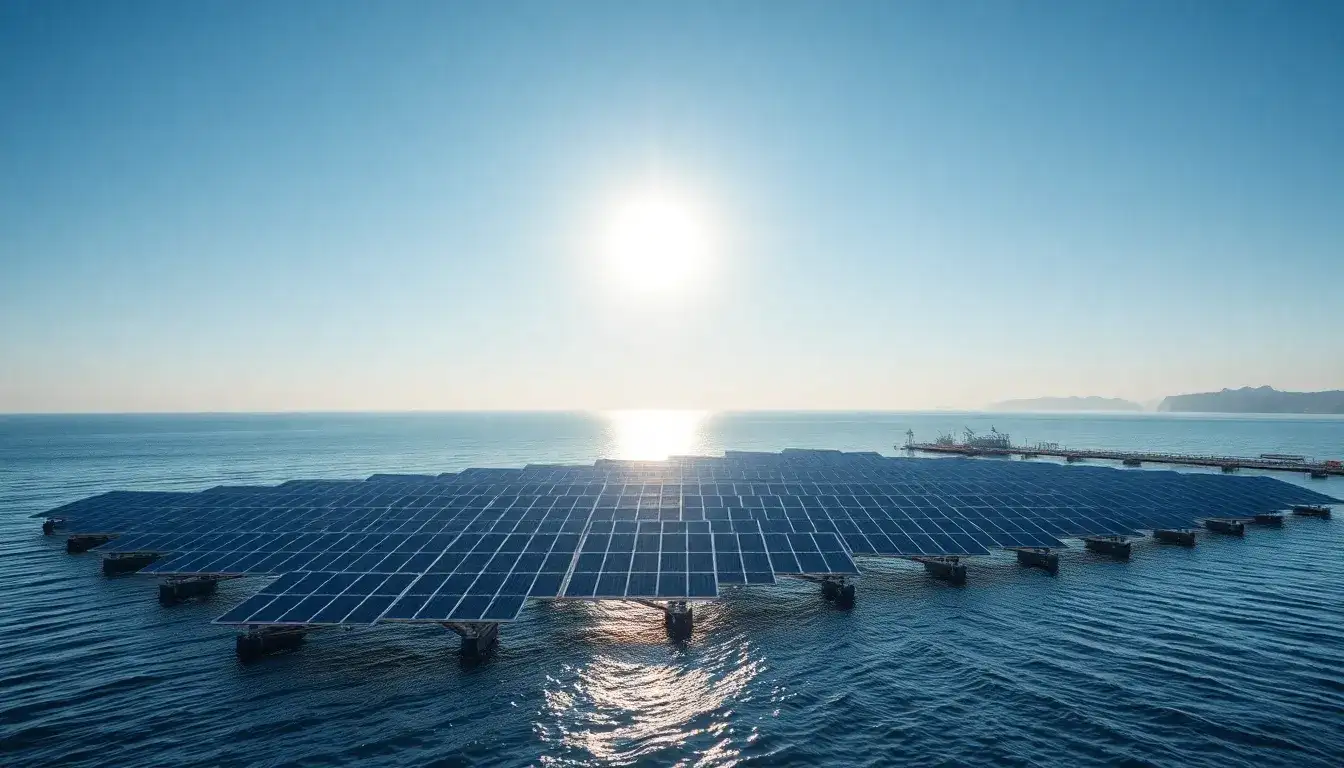
On May 27, the CGN Yantai Zhaoyuan 400 MW Offshore Photovoltaic Project successfully connected to the grid at full capacity. Set against the shimmering waters of Laizhou Bay, a blue matrix composed of 760,000 offshore photovoltaic modules is continuously delivering green energy. This project represents an innovative practice by China General Nuclear Power Corporation (CGN) to implement new development concepts and fulfill the “dual carbon” strategy. It features a series of innovative products, including self-developed bifacial double-glass offshore photovoltaic modules, and has established a replicable and promotable construction process for offshore photovoltaic projects, which is significant for the large-scale development of offshore photovoltaics in China.
The CGN Yantai Zhaoyuan project is designed to generate nearly 700 million kilowatt-hours of electricity annually. Located in the waters of Laizhou Bay, Zhaoyuan City, Shandong Province, the photovoltaic field is situated between 2 kilometers and 6.2 kilometers from the shore, covering a total area of 512.7 hectares. It connects to a 220 kV land boosting station through 16 sets of 35 kV collector lines. The project commenced construction on December 26, 2023, and is the deepest among the first ten offshore photovoltaic sites competitively selected in Shandong Province, with water depths ranging from 8.5 to 11 meters. According to a representative from CGN, the project integrates a green lifecycle concept from the design phase, with an expected average annual power generation of 694 million kilowatt-hours, equivalent to a reduction of approximately 208,700 tons of standard coal consumption and a decrease of about 535,800 tons of carbon dioxide emissions, comparable to reforesting 1,562 hectares. This showcases significant ecological and economic benefits.
Officials from the Shandong Provincial Energy Bureau noted that the province is vigorously advancing the development of new and renewable energy, promoting comprehensive planning and concurrent development on land and at sea. The full-capacity grid connection of the CGN Yantai Zhaoyuan 400 MW Offshore Photovoltaic Project is a vivid example of the province’s strategy to leverage marine resources and accelerate the green transformation of the energy sector. This initiative will effectively promote the transformation and upgrade of the regional energy structure, contributing positively to the establishment of a diverse and complementary energy supply system and helping to create a modern marine economy.
In addressing the unique challenges posed by the marine environment, which includes high salt spray, humidity, wind load, and ocean currents, CGN collaborated with partners across the industry to develop the first domestic heterojunction N-type bifacial double-glass modules suitable for marine conditions, achieving a photoelectric conversion efficiency of 22.86% and a bifaciality greater than 85%. Through this innovation, CGN has secured seven patents, including those for “Nano all-passivated contact crystalline silicon heterojunction bifacial solar cells and their manufacturing methods” and “a surface salt scale cleaning mechanism for offshore photovoltaic devices,” which significantly advance the technology of offshore photovoltaic modules.
The project comprises 121 power generation units, each consisting of 6 to 8 photovoltaic support units. The team employed an industry-first large-span bolt-ball steel grid + spiral tapered steel pipe pile technology to create a “super support” structure. Each support unit can carry a capacity of 590 kW, measuring 69.3 meters long and 37.3 meters wide, equivalent to the size of six standard basketball courts, with a load-bearing capacity of around 120 tons. Both the load capacity and dimensions of the support structure are the largest in the domestic photovoltaic industry. Moreover, safety checks through numerical wind tunnel simulations and pressure wind tunnel tests were conducted to ensure stability and safety in design. The nodes of the support bolts are covered with cold-wrapped mineral grease tape, enhancing the sealing and corrosion resistance.
On-site, the nearly 500 hectares of blue photovoltaic modules stretch to the horizon, supported by over 4,400 piles. The project has developed a construction process known as “multi-pile high-precision synchronous positioning” and has created the “Electric Construction Marine Equipment 001”, a new type of piling vessel, which is the first of its kind in the country designed for intelligent and efficient piling in offshore photovoltaic projects. The use of a dual precision positioning system combining BeiDou and GPS ensures that the positioning accuracy of the piles is within centimeters. The vessel is equipped with a wave compensation system to reduce vessel sway, ensuring the stability of the piled hammer’s position. With two cranes installed on either side, simultaneous piling operations can cover a radius of 40 meters. Compared to traditional offshore piling vessels, the efficiency of piling has improved by five times, while construction costs have decreased by over 50%. Additionally, the vessel’s stability allows it to undertake multiple tasks such as installing box transformers, laying cables, and installing racks, achieving a multi-functional capability.
Throughout the construction of the project, CGN adhered to the principle of “completing onshore processes on land rather than at sea,” maximizing the transition of offshore construction to onshore. The project team innovatively proposed key technical solutions such as onshore assembly of support units, a 15-degree tilt transfer at the wharf, and overall transportation and installation at sea. They also developed core construction equipment with independent intellectual property rights, including an aerial rotation device for large-span support units, a synchronous sliding electric flat car, and a self-elevating pile-top working platform, ensuring high efficiency, stability, and safety in the installation of support units. Notably, CGN has established a complete set of construction processes for offshore photovoltaic projects, accumulating systematic practical experience for similar projects nationwide. The project has undertaken several key technological innovations and research and development, resulting in over 70 patents, including more than 30 invention patents, and has published four SCI papers. CGN aims to systematically summarize the reproducible technical standards and management experiences to promote collaborative development in the national offshore photovoltaic industry through industry exchanges, enabling more regions and enterprises to benefit from shared development.
Original article by NenPower, If reposted, please credit the source: https://nenpower.com/blog/cgns-yantai-zhaoyuan-400-mw-offshore-solar-project-achieves-full-capacity-grid-connection/

