

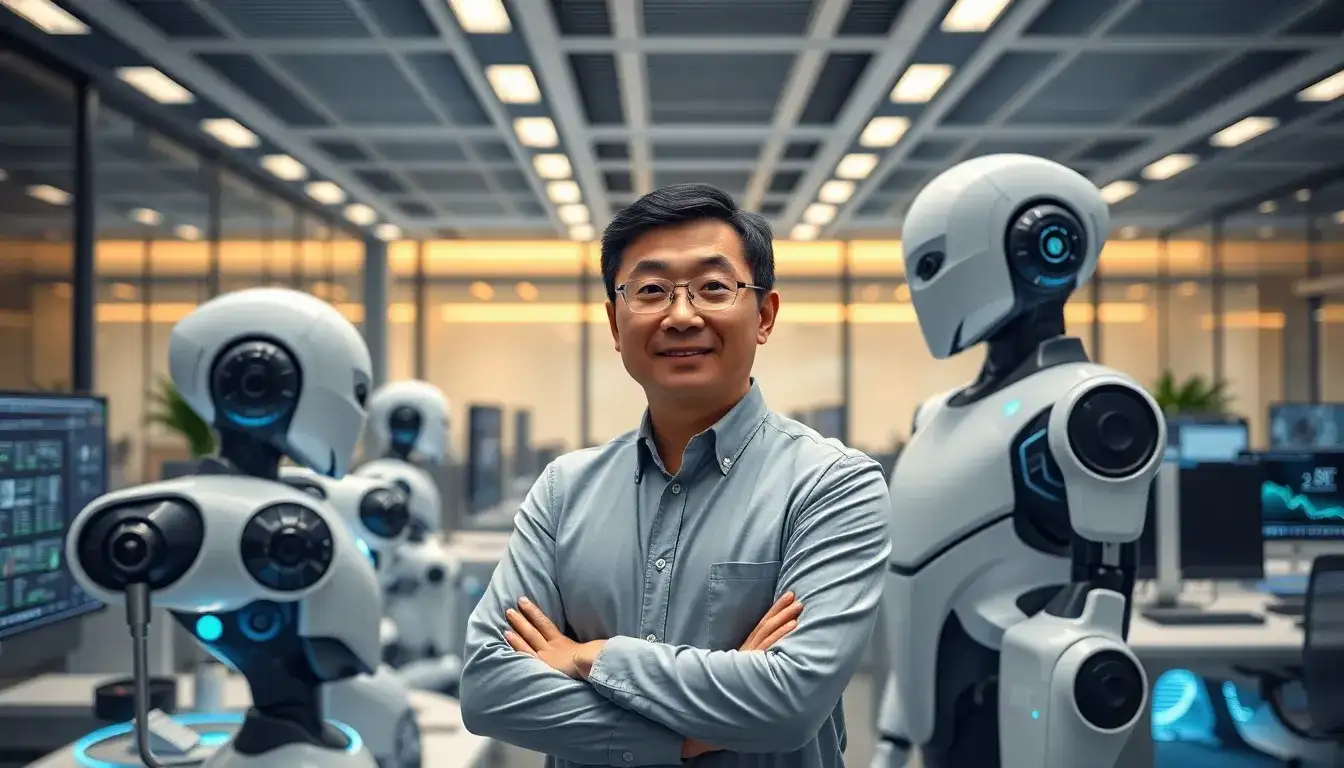
Chen Jianyu, CEO of Xingdong Jiyuan: Remembered for Robots that “Work Well” | 2026 Business Vision
Economic Observer February 14, 2026, 11:19 Beijing
2025 was a significant year for the embodied intelligence industry, and for Xingdong Jiyuan as well. I define this year as one of “simultaneous technological breakthroughs and commercial validation.” It marked a turning point where embodied intelligence transitioned from mere technological experimentation to actual deployment in real-world scenarios.
On one hand, Xingdong Jiyuan developed the ERA-42 end-to-end VLA embodied large model, enabling precise control over the entire body and dexterous hands of full-sized bipedal humanoid robots. We are now one of only four companies globally capable of achieving this. On the other hand, our total order volume surpassed 500 million yuan, with the largest single order in the logistics sector nearing 50 million yuan. Remarkably, overseas business accounted for 50% of our total, and nine out of the top ten technology giants by market capitalization became our clients.
The first true commercial order for Xingdong Jiyuan emerged in 2025 from an overseas research client interested in our Xingdong XHAND1 dexterous hand. The origin of this development was quite simple. At the beginning of 2025, when we launched the Xingdong XHAND1, I shared a post on social media highlighting our team’s breakthroughs in dexterous hand technology and products. Researchers from leading overseas institutions reached out, inquiring about purchasing our product. After testing, these institutions recognized our product’s performance and stability, leading to repeat orders, with some clients making multiple bulk purchases.
The core reason clients choose Xingdong Jiyuan is the real-world operational capability of the ERA-42 end-to-end model. In logistics sorting scenarios, our robots can perform intelligent scanning and sorting in unstructured environments with an efficiency surpassing 70% of human capability. They possess a strong generalization ability, allowing them to handle packages of varying shapes and materials without the need for pre-programming.
Currently, Xingdong Jiyuan has established standardized solutions in the warehousing and express logistics sectors. By 2026, we expect the efficiency of our robots in these scenarios to reach 90%. This critical 20% improvement will result from the collaborative optimization of hardware and software, iterative enhancements of the end-to-end VLA model, and the effective operation of our data ecosystem. The advantages of an end-to-end architecture include real-time feedback and control, which inherently boost operational efficiency.
In 2026, I hope that Xingdong Jiyuan can achieve a shipment level in the thousands, with ten thousand units set as a long-term goal. The biggest constraints currently facing the industry are not supply chain or delivery capabilities, but rather demand validation and product refinement. There are numerous ways to reduce the cost of robots; leveraging China’s manufacturing capabilities to lower hardware costs is not an issue. However, the primary objective is to ensure that our products operate effectively, as product validation is more challenging and critical than cost optimization.
There is a notion that 2026 will be a year of reshuffling for embodied intelligence companies, and I believe that Xingdong Jiyuan will be one of the few to endure until the end. To persist, three key capabilities are essential: first, the ability to develop models and algorithmic architecture, which determines the system’s potential; second, data and engineering capabilities, which influence how close we can get to that potential; and third, an integrated soft and hard stack capability that ensures deep coupling and optimization between the brain and the physical entity. Xingdong Jiyuan has already developed these capabilities.
2026 will be a pivotal year for embodied intelligence to transition from technological validation to commercial implementation. My prediction is that, barring any external “black swan” events, the enthusiasm for embodied intelligence will persist throughout 2026. This is driven by overall expectations from the external economy and investment markets as well as the accelerating pace of technological iteration, with many previously deemed impossible tasks being gradually accomplished.
Additionally, 2026 will witness the large-scale deployment of real products in specific scenarios, particularly in B2B environments such as industrial manufacturing and logistics warehousing. Humanoid robots will enter a substantive phase of commercialization in 2026. By the end of 2026, I hope that the industry remembers Xingdong Jiyuan for successfully applying embodied intelligence in real-world scenarios, evolving from simply “doing work” to “doing work well and doing more work.”
Original article by NenPower, If reposted, please credit the source: https://nenpower.com/blog/ceo-of-star-era-chen-jianyu-on-the-rise-of-robotics-and-future-business-vision-for-2026/

