

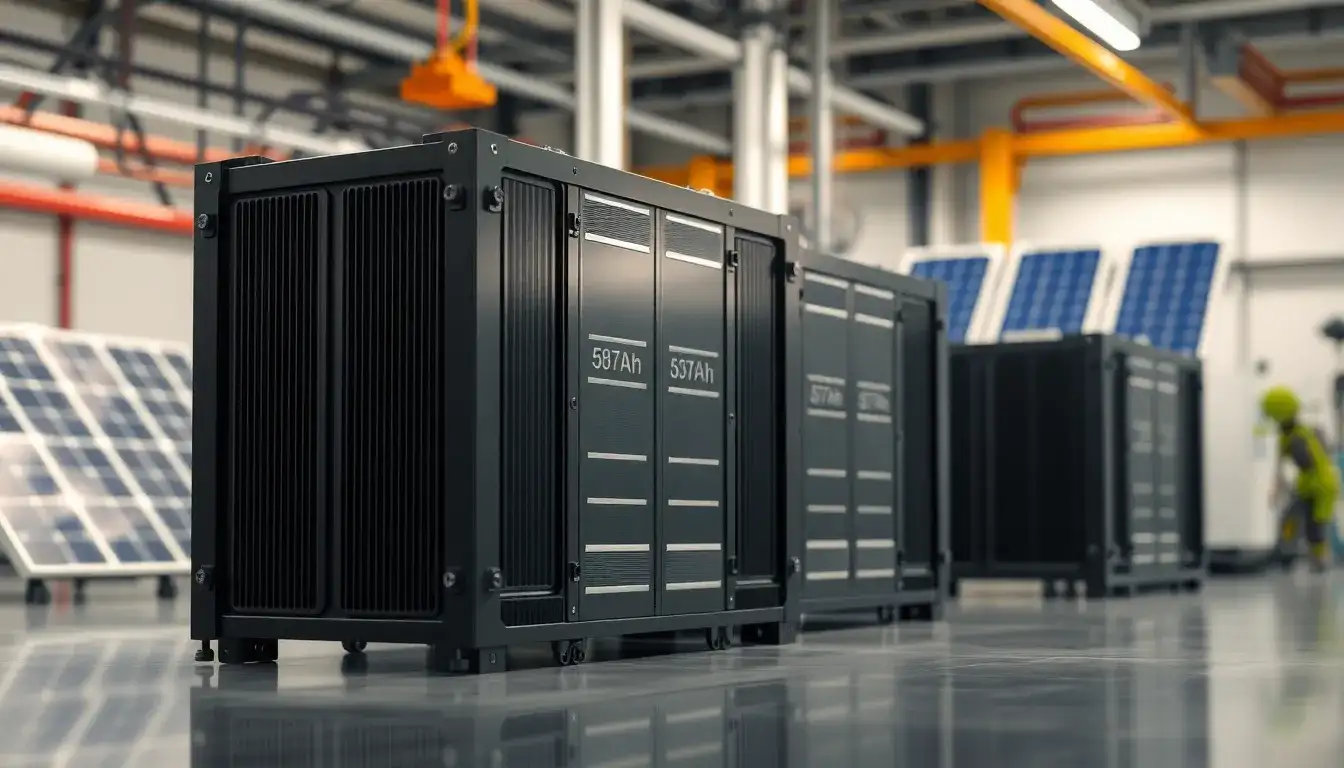
As the energy storage industry continues to thrive, every innovation in battery cell technology captures the market’s attention. CATL, a leader in the industry, showcased its 587Ah high-capacity battery cell integrated into the new energy storage system “Tianheng” at the 13th International Energy Storage Summit and Exhibition (ESIE 2025). This new battery cell has garnered significant interest.
Recently, Lin Jiubiao, the CTO of CATL’s domestic energy storage solutions, provided an in-depth analysis of the technology behind this battery cell and the trends within the industry. On April 9, 2024, CATL launched the world's first 6MWh+ high-capacity energy storage system—Tianheng. This system combines high safety, longevity, reliability, energy efficiency, and capacity, setting a new benchmark for large-scale development in the industry.

The latest Q1 report for 2025 revealed that CATL's total battery sales exceeded 120GWh, reflecting a year-on-year increase of 30%, with energy storage accounting for 20% of this total. These impressive figures demonstrate CATL's precise alignment of technological innovation with market demands and the ongoing success of its flagship products, such as the Tianheng energy storage system.

Currently, the energy storage market is witnessing a diverse range of battery cell specifications, with options exceeding 500Ah, 600Ah, and even 1000Ah. This variety provides developers of energy storage stations with numerous choices, but also complicates decision-making. Selecting the optimal battery cell specification from this array is one of the key challenges facing the energy storage industry.

As a pioneer and leader in the sector, CATL has leveraged its deep technical expertise and keen market insights to introduce the "587Ah" capacity concept based on its Tianheng system. This innovative capacity design is not merely a numerical advancement; it is the result of countless experiments, simulations, and optimizations by CATL's R&D team.

Lin Jiubiao emphasized that the selection of battery cell specifications in energy storage station construction is not an isolated decision. It requires a comprehensive consideration of overall system configuration and space utilization. Currently, domestic energy storage stations commonly utilize configurations of 100, 200, or 400MWh. The national standard also proposes safety zoning requirements, with each zone corresponding to 50MWh.

With this configuration in mind, a combination of eight Tianheng battery units, each with a capacity of 6.25MWh, meets the necessary requirements. From a battery cell design perspective, effective utilization of container space is a critical factor. CATL's batteries are designed around the standard 20-foot container, integrating with the mainstream 1500V PCS voltage and power levels. Through precise calculations and analyses, the dimensions of the 587Ah battery cell were finalized.

Defining a battery cell's dimensions requires careful consideration of its electrochemical properties and large-scale manufacturing capabilities. Key electrochemical characteristics include optimal internal resistance, maximum wetted height, and energy density of the chemical system. Manufacturing on a large scale also involves assessing production efficiency and yield rates.

This year has seen a sustained trend towards larger battery cells in the energy storage industry, with capacities of 500Ah+, 600Ah+, and even 1000Ah being introduced. However, pursuing larger capacities without regard for the safety, reliability, and longevity of battery cells is a misguided approach. According to Lin Jiubiao, larger battery cells necessitate higher standards for safety, lifespan, and process control, requiring a solid technical foundation.

It is important to note that larger battery cells do not always equate to better performance. Future research and development will focus on finding a "balanced path," optimizing the interplay between technical boundaries, energy density, and system integration. The 587Ah battery cell, featuring five core advantages—high safety, long lifespan, high reliability, high energy efficiency, and high integration—has become a model choice for the new generation of energy storage systems.

<b>High Safety:</b> Safety is the lifeline of energy storage systems; any safety incident can lead to significant losses. As battery cell capacity increases, so does the energy contained within, which heightens the challenges of thermal runaway. CATL prioritizes safety by enhancing the 587Ah cell's safety performance across multiple dimensions, including materials, manufacturing, and systems, ensuring intrinsic safety. This battery cell achieves an industry-leading energy density of 430Wh/L while boasting superior safety performance compared to smaller cells. Through the introduction of advanced safety technologies, such as safe electrolyte technology and high-heat-resistant membranes, the cell can withstand overcharging, thermal runaway, and puncture without igniting or exploding. It has already passed GB/T 36276 and GB 44240 testing. Currently, with improvements in both materials and structural stability, the 587Ah cell exhibits a 20% increase in thermal stability and a 10% reduction in thermal runaway heat generation, alleviating industry concerns regarding the safety of high-capacity cells.

<b>Long Lifespan:</b> The increase in cell size does not simply translate to a physical enlargement of its electrochemical properties. Uniform distribution of electrical, thermal, and mechanical forces is crucial for battery lifespan. CATL implements long-life, slow-decline technologies, ensuring that the investment yields extended longevity and greater returns. The 587Ah cell has been designed with its dimensions carefully considered to maintain stable pathways for electrons and ions throughout its life cycle, resulting in a 20% improvement in reliable charge and discharge capabilities over previous generations. The introduction of biomimetic SEI membrane technology reduces the consumption of active lithium, ensuring longevity and gradual decline, allowing the total throughput over its lifecycle to improve by 48% compared to prior models, enhancing the internal rate of return (IRR) by 2%-3%.

<b>High Reliability:</b> The increase in cell size also imposes stricter demands on production consistency and quality control. Efficiently and stably producing large battery cells is a significant challenge for manufacturers. All 587Ah cells are produced on the latest and most advanced production lines globally, leveraging extreme manufacturing capabilities to reduce defect rates from PPM to PB level, thus ensuring product quality.

<b>High Energy Efficiency:</b> Differences in energy efficiency are evident in every charge and discharge cycle, directly impacting the owner's profits. Leveraging CATL's robust R&D capabilities in materials, the 587Ah cell overcomes chemical and physical limitations. Through innovations in new materials, electrolytes, and electrode sheets, the cell's capacity has increased while maintaining long-term energy efficiency above 95%, alongside improved thermal management technologies that enhance overall efficiency by an additional 1% to 2%.

<b>High Integration:</b> Presently, a single GWh energy storage station, using existing solutions, requires over a million battery cells. As the scale of energy storage stations continues to expand, the challenges of monitoring and managing cell consistency will grow. Thanks to the ultra-high energy density of the 587Ah lithium iron phosphate battery, enhancements in capacity and integration technologies have significantly reduced the number of batteries required for the entire station, simplifying consistency management and increasing integration. This has resulted in a 20% reduction in equipment quantity, leading to notable optimizations in land use, construction volume, and operational complexity.

From the evolution of battery technology from 280Ah to 314Ah and now to 587Ah, CATL has consistently balanced performance boundaries with commercial value. Each generation of products has emerged as a mainstream representative in the market due to their exceptional design, performance, manufacturing quality, and rapid delivery capabilities. It can be said that CATL did not merely choose the 587Ah cell; rather, it has leveraged its profound technical strength and innovative spirit to launch this specification into the market and lead industry trends.

CATL is transforming its technological advantages into capabilities for building an industrial ecosystem. The introduction of the 587Ah cell not only signifies a product iteration but also indicates that the energy storage industry is shifting from a competition of specifications to a phase of optimizing the entire value chain.
Original article by NenPower, If reposted, please credit the source: https://nenpower.com/blog/catl-sets-new-standard-for-high-capacity-energy-storage-cells-with-587ah-innovation/

