

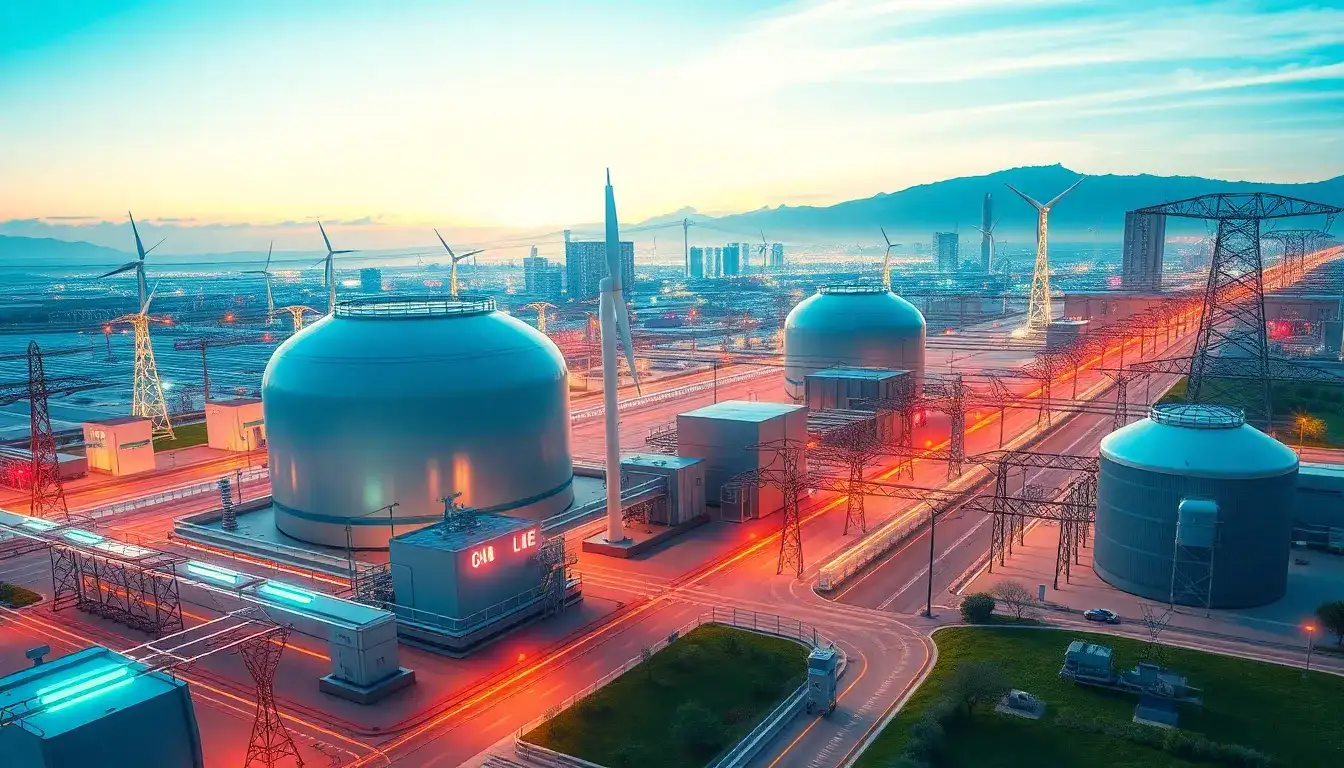
Yes, Liquid Air Energy Storage (LAES) systems can indeed be integrated with existing grid infrastructure. They are designed for grid-scale energy storage and provide flexibility and reliability to power grids, particularly in managing the intermittency of renewable energy sources.
How LAES Integrates with Grid Infrastructure
- Grid-Connected Applications: LAES systems operate by charging (liquefying air when electricity supply exceeds demand), storing the liquid air in insulated tanks, and discharging (re-gasifying and expanding air through turbines) to generate electricity when demand is high. This process aligns well with the grid’s supply-demand dynamics and pricing signals.
- Compatibility with Grid Services: LAES can provide multiple grid services such as managing intermittent renewable generation, energy arbitrage (buying electricity when cheap and selling when expensive), peak shaving, ancillary services (voltage support, reactive power), transmission constraint management, and inertia services.
- Use of Commercial Components: The technology can be built largely from commercially available components such as cryogenic tanks and turbines, facilitating easier integration with existing power plants and grid infrastructure without reliance on rare or expensive materials.
- Geographical Flexibility: Unlike technologies such as pumped hydro, which require specific terrain, LAES systems can be sited nearly anywhere—including urban or industrial areas close to the grid—making them convenient for integration into current power networks.
- Industrial Co-location: LAES plants benefit from proximity to industrial processes that produce waste heat or cold, which can enhance the system’s efficiency. Such integration with existing industrial infrastructure can also support grid reliability.
- Demonstrated Grid-Scale Projects: Highview Power, a leading company in LAES, has installed grid-scale demonstrators (e.g., a 15 MWh facility in Greater Manchester) connected to the grid, proving the practical viability and scalability of LAES systems in real-world grid environments.
- Efficiency and Sustainability: Integration of LAES with existing grids also supports carbon-neutral goals by offering clean energy storage without additional emissions; the only input/output media is ambient air and electricity, ensuring minimal environmental impact.
Summary Table
| Aspect | Description |
|---|---|
| Grid Services Support | Renewable integration, peak shaving, ancillary services |
| Components | Commercially available cryogenic tanks, turbines |
| Location Flexibility | Can be sited in various environments, including urban areas |
| Industrial Integration | Can use waste heat/cold from nearby industrial plants |
| Scalability | Suitable for large grid-scale energy storage |
| Environmental Impact | Clean operation using ambient air, no contaminants |
| Demonstrated Examples | 15 MWh grid-connected LAES facility in Manchester |
In conclusion, LAES technology is well-suited for integration into existing power grids due to its scalability, environmental benefits, and ability to provide vital grid services. It leverages proven components and flexible siting options, making it a promising solution for enhancing grid reliability and supporting renewable energy transitions.
Original article by NenPower, If reposted, please credit the source: https://nenpower.com/blog/can-laes-systems-be-integrated-with-existing-grid-infrastructure/

