

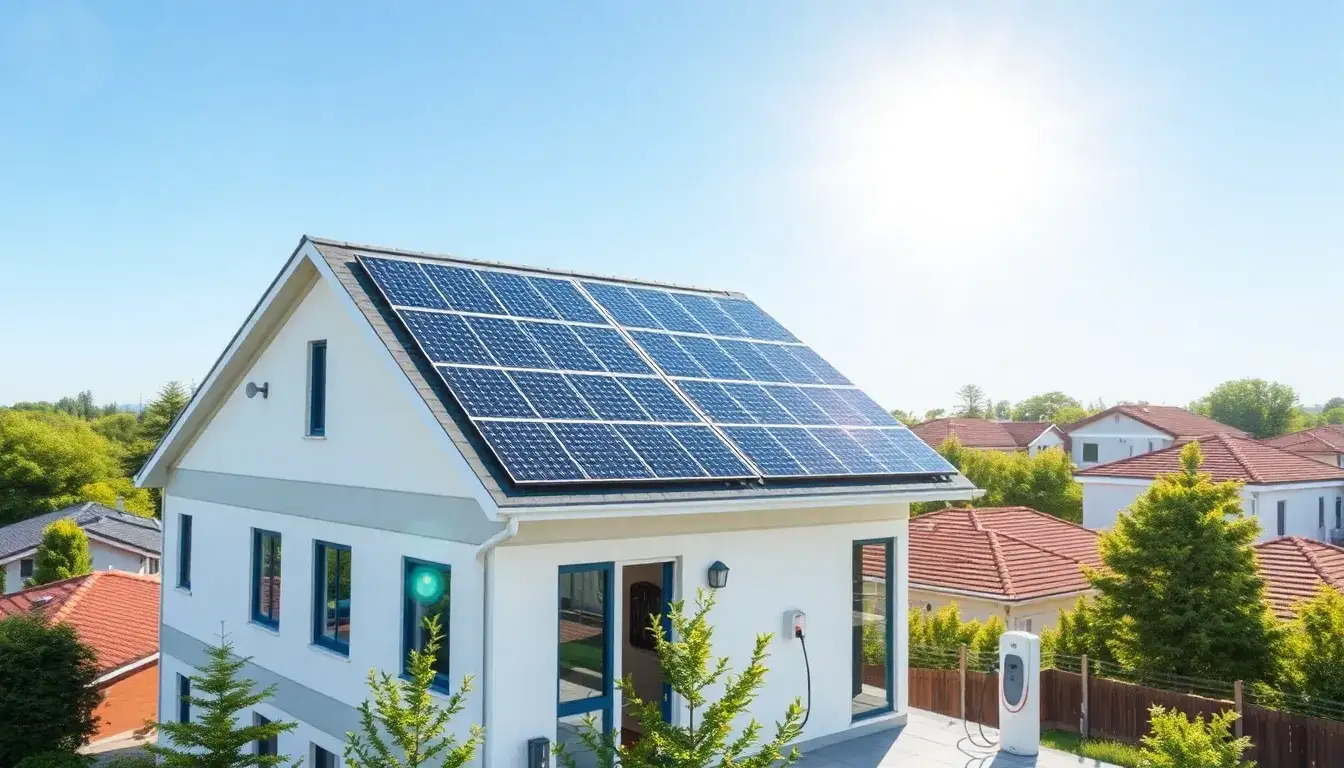
Bifacial solar panels can technically be used in residential rooftop installations, but they are generally not considered the most practical or efficient choice for typical home roofs. Here’s why:
Suitability of Bifacial Panels for Residential Rooftops
- Limited Gain on Rooftops: Bifacial panels generate extra power by capturing sunlight on both the front and rear sides, with the backside relying on reflected light from the surface beneath. On residential roofs, which are often dark-colored or non-reflective, the amount of reflected light is minimal, severely limiting the efficiency gain of bifacial panels compared to standard monofacial panels.
- Close Mounting to Roof Surface: Residential rooftop panels are usually mounted very close to the roof (about 10–15 cm above), which restricts light reaching the rear face. This close mounting reduces the advantage of the bifacial design, often resulting in only a marginal increase in energy output—sometimes just a few percent above monofacial panels.
- Roof Material and Reflectivity Effects: The roof color and material influence the reflected light that bifacial panels can use. Light-colored or reflective roofing materials (e.g., light-colored metal roofs or white surfaces) can somewhat improve performance, but most typical rooftops (e.g., asphalt shingles) offer poor reflectivity, limiting bifacial panel benefits.
- Installation Complexity and Cost: Bifacial panels often require specialized mounting systems that allow elevation and tilt to optimize light capture from below. These mounts can be more complex and costly compared to standard rooftop mounts, reducing cost-effectiveness. Additionally, bifacial panels often have higher upfront costs, which may not be justified by the slight gain on most rooftops.
Better Applications for Bifacial Panels
- Ground-mounted Systems: Bifacial panels perform best when elevated above reflective ground surfaces (e.g., light gravel, sand, snow), allowing the backside to capture substantial reflected sunlight. Ground mounts can optimize tilt and height for maximum albedo effect, increasing energy generation by up to 20% or more compared to monofacial panels.
- Commercial and Utility-scale Installations: Large-scale solar farms with elevated bifacial panels gain the most from this technology due to optimal spacing, orientation, and reflective surfaces.
- Alternative Residential Uses: Bifacial panels can be practical in residential settings for structures like carports, pergolas, or solar canopies, where both sides of the panel can be exposed to sunlight and reflected light, providing additional energy generation without roof constraints.
Durability and Other Considerations
- Increased Durability: Bifacial panels often have glass on both sides, making them more robust against environmental damage like hail or wind.
- Performance in Diffuse Light: They may perform slightly better during cloudy conditions or low light situations due to light capture from both sides.
- Local Conditions: Factors such as shading, monkey interference, or building codes may influence the choice between bifacial and monofacial panels.
Summary
| Aspect | Residential Rooftop Use of Bifacial Panels | Recommended Use Cases |
|---|---|---|
| Energy Gain | Minimal to modest (a few percent depending on roof reflectivity) | Significant (up to 20-27%) on ground mounts, commercial farms |
| Installation Complexity | Higher due to mounting requirements | Optimized mounting possible |
| Cost-Effectiveness | Less cost-effective due to small energy gains and higher price | More cost-effective in suitable ground-mounted scenarios |
| Durability | Enhanced durability due to dual-glass design | Same |
| Practicality | Limited, mostly similar or slightly better than monofacial panels | Ideal for carports, pergolas, ground mounts |
In conclusion, while bifacial solar panels can be installed on residential rooftops, they usually do not offer a significant performance advantage over traditional panels in this setting. They are better suited for ground-mounted systems or special residential applications like carports where their dual-sided light capture can be fully utilized. For most typical home rooftops, standard monofacial panels remain the more practical and cost-effective choice.
Original article by NenPower, If reposted, please credit the source: https://nenpower.com/blog/can-bifacial-solar-panels-be-used-in-residential-rooftop-installations/

