

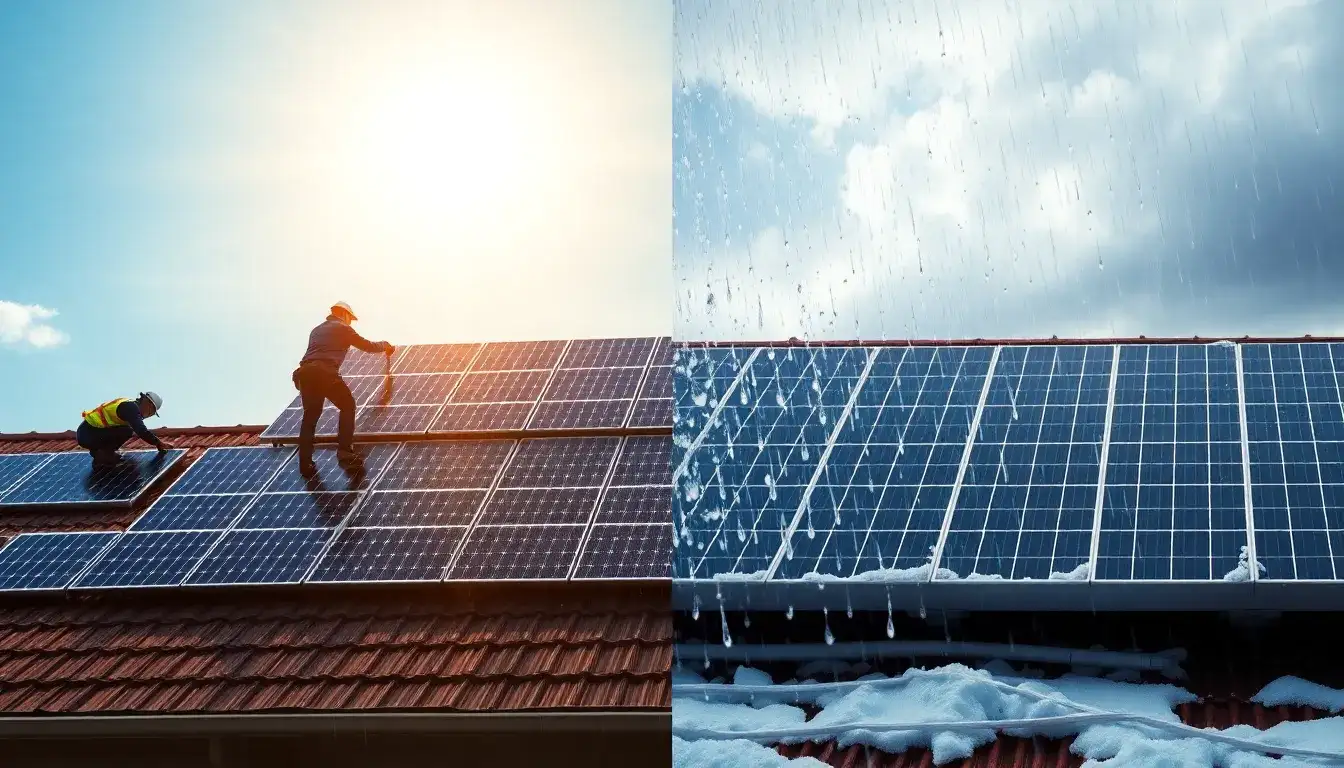
Bifacial solar panels can be installed in a variety of weather conditions, but their performance and installation considerations vary depending on the environment.
Installation Suitability in Different Weather Conditions
- Snowy and Sandy Areas: These locations are ideal for bifacial solar panels because their highly reflective surfaces increase sunlight on the panel’s rear side, boosting energy generation by 5% to 30% compared to traditional panels. Snow not only reflects sunlight but also, when allowed to fall through properly spaced panels, can help generate heat that aids performance.
- General Weather Conditions: While bifacial panels are versatile and can be installed on rooftops, ground mounts, or even floating systems, their setup is more complex than traditional panels. Proper height (about 42.5 inches above ground) and spacing (3-5 inches between rows) are necessary to avoid shading from snow or obstructions and to maximize light capture on both sides.
- Areas with Low Reflectivity or Dark Surfaces: These environments may limit bifacial panel performance due to insufficient reflected light reaching the back of the panels. Obstructions like trees or buildings casting shadows can also reduce output.
Weather-Related Installation Considerations
- Leave space beneath and between panel rows to prevent snow accumulation or blockage.
- Avoid blocking the backside of the panel with racks or inverters to allow maximum sunlight capture.
- Use adjustable or steeper angle racking to optimize sunlight exposure depending on seasonal sun angles and conditions.
Summary
Bifacial solar panels can indeed be installed in most weather conditions, but optimal performance depends on reflective ground surfaces, proper mounting height and spacing, and minimal shading. They perform best in snowy or sandy environments due to increased light reflection, while in low-reflectivity or shaded settings their efficiency gains might be limited. Installation complexity and maintenance should be considered in harsh weather areas to ensure long-term effective operation.
Thus, while not limited to any single weather type, bifacial solar panels require site-specific planning to accommodate environmental and weather-related factors for optimal energy production.
Original article by NenPower, If reposted, please credit the source: https://nenpower.com/blog/can-bifacial-solar-panels-be-installed-in-any-type-of-weather-condition/

