

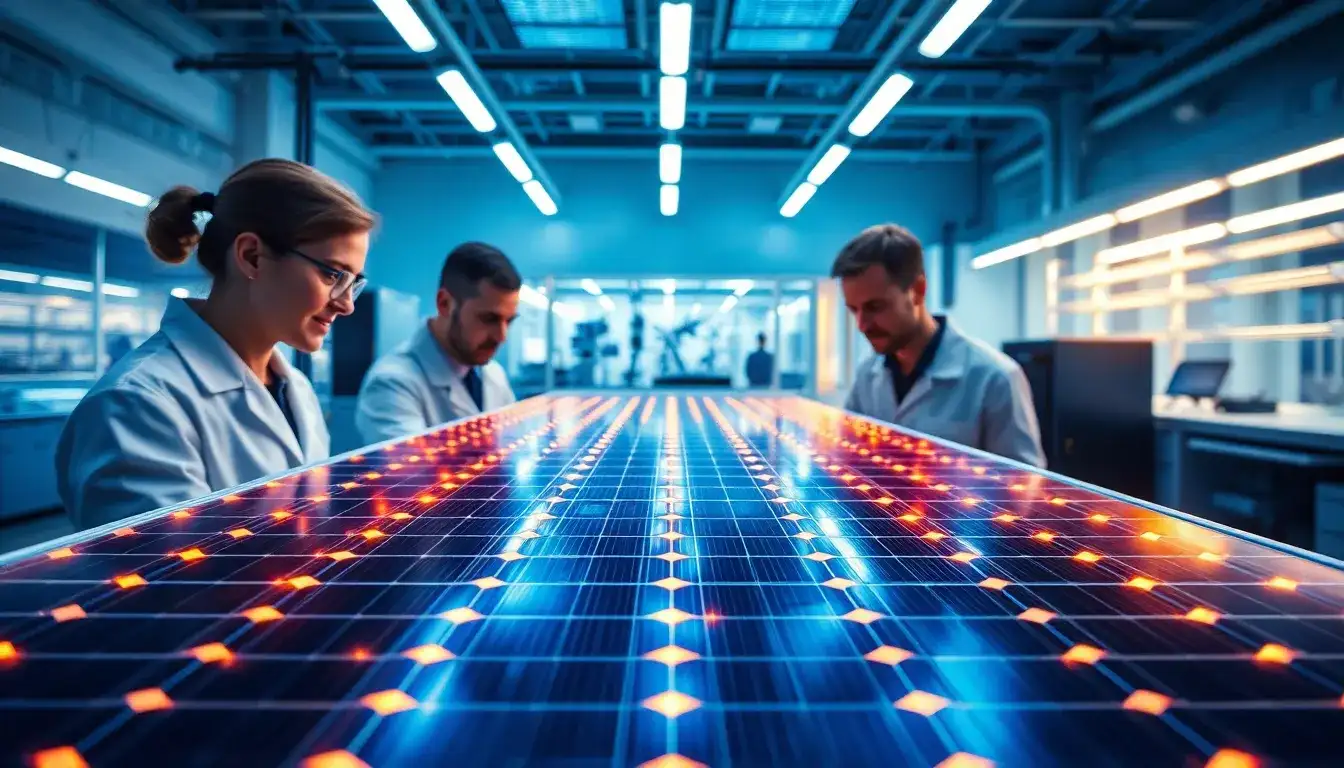
Cambridge University has recently made a groundbreaking advancement in the solar energy sector with the discovery of a material called P3TTM, which exhibits nearly 100% efficiency in converting sunlight into electricity. This innovative material demonstrates behavior previously attributed only to inorganic metal oxides, specifically the ‘Mott-Hubbard insulating behavior’. The research was published in Nature Materials and has generated excitement not only among physicists, who believe it fills a gap in quantum physics, but also among professionals in the photovoltaic industry, as it has the potential to revolutionize solar technology that has been in development for decades.
What makes this material so exceptional? To understand its significance, we first need to look at the challenges faced by traditional solar cells. Both the currently dominant silicon-based cells and the organic cells that gained popularity in recent years rely on two different materials working together. In silicon solar cells, one material acts as the ‘electron donor’ and another as the ‘electron acceptor’. When photons strike, electrons must move from the donor to the acceptor to generate an electric current. This process requires precise alignment and energy level matching, and any slight deviation can reduce the current efficiency, typically allowing only 60%-80% of charge collection.
Moreover, the production of these cells is complex, involving multiple layers of coatings, vacuum equipment, and high-temperature processes, which keep costs high. However, P3TTM operates differently—it can perform all functions using a single material. This organic semiconductor features ‘spin-free radicals’, meaning it contains unpaired electrons that act like ‘lonely bachelors’. When these molecules come together, their neighboring unpaired electrons can arrange in an orderly pattern, similar to neighbors agreeing on their living arrangements. This behavior, previously seen only in inorganic materials, allows for direct charge separation upon exposure to sunlight, resulting in nearly 100% charge collection efficiency without the need for additional materials.
Researcher Li Biwen from the Cavendish Laboratory explained it simply: “In typical organic materials, electrons are paired and do not interact; however, the electrons in P3TTM communicate and form an ordered arrangement. When sunlight hits, one electron can jump to an adjacent molecule, directly creating positive and negative charges without needing another material to cooperate.” This shift in electron behavior essentially eliminates the need for collaboration, greatly enhancing efficiency.
This breakthrough stemmed from a fortuitous collaboration between two leading teams at Cambridge. Professor Hugo Branstain’s chemistry group intended to synthesize P3TTM for organic LEDs, as the material emits red light, which is more suitable for display applications. However, upon testing by Sir Richard Friend’s physics team, they discovered that its photovoltaic performance was even more impressive than its light-emitting capabilities. While regular organic cells struggle to reach 80% charge collection, P3TTM comes close to 100% without requiring complicated interface designs; just a single coating is sufficient.
The two teams were thrilled. The chemistry group focused on modifying the molecular side chains to enhance their arrangement, triggering the Mott-Hubbard behavior. Meanwhile, the physics team validated the charge separation mechanism using various instruments, confirming this was not merely a random occurrence. Interestingly, Sir Richard Friend had previously conversed with Neville Mott, the pioneer of the ‘Mott insulator’ theory, highlighting the historical connection of this discovery to the foundations of quantum physics.
Can this ‘plastic battery’ truly replace silicon cells? The current data suggests it can address significant industry pain points. First, on cost: silicon cells require refined silicon, high-temperature sintering, and complex electrode structures, resulting in an estimated cost of $0.30 per watt. In contrast, P3TTM can be applied as a film using a solution at temperatures below 100°C, eliminating the need for vacuum equipment and reducing required factory space by half. The research team estimates that once mass production is achieved, costs could drop by 30%-50%, potentially bringing the price to under $0.15 per watt. This is crucial for solar power initiatives and electricity access in remote areas, where previously expensive equipment could be replaced by a few rolls of ‘plastic film’.
The performance of P3TTM is also promising, with a theoretical photovoltaic conversion efficiency of 25%, comparable to the leading monocrystalline silicon cells. Remarkably, its efficiency remains above 80% even in low light conditions, outperforming silicon cells, which typically only reach around 50% under similar circumstances. Additionally, P3TTM is lightweight, with a density only one-third that of silicon, allowing for applications on drone wings or wearable technology without compromising function.
Stability is another strong point. Traditional organic cells often degrade quickly due to exposure to sunlight and moisture, losing efficiency in a matter of months. However, P3TTM has shown resilience, maintaining over 80% efficiency after 1000 hours in an environment of 85°C and 85% humidity, meeting commercial standards for photovoltaic modules—far better than the early issues seen with perovskite cells.
While P3TTM does have challenges, such as a current synthesis yield of only 30%, akin to cooking a pot of rice that is only partially done, the goal is to increase this to over 70% for mass production. The research team is exploring protective coatings to address long-term outdoor exposure and light oxidation issues. However, these are engineering challenges rather than fundamental barriers, making them easier to tackle compared to the uneven crystallization issues faced by perovskite technology.
The future of photovoltaic technology is not limited to traditional large-scale installations. The focus has shifted to flexible, transparent, and integrated solutions, and P3TTM aligns perfectly with these trends. One immediate application is in wearable devices. Currently, smartwatches require daily charging, but embedding a layer of P3TTM film in the wristband could allow for solar charging while the wearer is outside, effectively doubling battery life. The Cambridge team has already developed a flexible prototype that can bend to a radius of 1 millimeter without sacrificing performance, proving more durable than current flexible perovskite components.
The material can also be incorporated into Building Integrated Photovoltaics (BIPV), where transparent films could be applied to glass facades of office buildings, generating power during the day for self-use and selling excess energy back to the grid at night. The visible light transmittance of over 50% means it won’t obstruct natural light, making it a more practical alternative to traditional dark photovoltaic glass. The European Union is already planning to invest €500 million by 2025 to establish pilot lines specifically for testing these ‘power-generating facades’.
P3TTM even has potential applications in space exploration. Previously, solar panels on satellites utilized gallium arsenide, which was heavy and expensive. P3TTM’s lightweight and radiation-resistant properties enable satellites to carry additional scientific equipment. NASA has already reached out to the Cambridge team for testing on small satellites.
The impact of this discovery on the photovoltaic industry could be even more significant than that of perovskite technology. The current organic photovoltaic supply chain includes various materials from electron donors (like PTB7) to acceptors (such as PCBM) and specialized interface modifiers, sustaining many businesses. P3TTM could replace all these with a single material, forcing some companies to either pivot to producing P3TTM derivatives or face extinction.
For silicon-based companies, the immediate threat may be minimal, but the long-term pressure is substantial. Estimates suggest that if P3TTM captures 15% of the market by 2030, the global demand for silicon could decrease by 1 million tons per year, posing challenges for aggressively expanding silicon manufacturers. Some silicon companies have already discreetly contacted Cambridge to explore the possibility of creating tandem solar cells that combine silicon and P3TTM to push efficiencies above 30%.
China has included P3TTM in its ’14th Five-Year Plan’ for new energy materials, encouraging collaboration between enterprises and universities for mass production. The EU’s ‘Horizon 2020’ initiative is also providing funding to gain a competitive edge in mastering core technologies. Market forecasts predict that by 2030, the market for P3TTM could reach $28 billion, with an annual growth rate exceeding 40%, making it more vibrant than the current perovskite market. However, achieving mass production remains a hurdle, as it currently costs hundreds of dollars to synthesize just one gram of P3TTM.
Professor Branstain stated, “We are not just improving old designs; we are writing a new chapter in textbooks.” This assertion is not exaggerated—previously, organic materials were deemed too ‘soft’ for high-end photovoltaic applications, but P3TTM has proven that with a solid understanding of quantum mechanics, organic materials can indeed take on significant roles. The journey from Mott’s 1937 insulator theory to the Cambridge team’s recent discovery in organic materials signifies nearly a century of theoretical evolution and the power of interdisciplinary collaboration.
The potential timeline suggests that P3TTM might achieve mass production before 2030. By then, clothing could charge itself, office windows could generate electricity, and children in remote areas could use solar energy for lighting—all stemming from that glowing film developed in a Cambridge laboratory, driven by a group of scientists challenging the notion of the ‘impossible’.
Original article by NenPower, If reposted, please credit the source: https://nenpower.com/blog/cambridge-university-unveils-revolutionary-p3ttm-solar-technology-with-near-100-efficiency-challenging-silicon-based-solar-cells/

