

CALISTOGA, Calif. – For the residents of this charming tourist town located at the northern edge of Napa Valley, the looming threat of wildfires is always a concern. The hillsides bear the scars from a devastating fire in 2020 that forced the entire town to evacuate, and the notorious 2017 Tubbs fire, which tragically claimed 22 lives in wine country, ignited just a few miles from downtown.
In the past, when fire danger necessitated shutting down transmission lines to prevent potential sparks, Calistoga relied on a bank of generators situated in a popular recreation area. These generators emitted thick clouds of diesel exhaust and produced a deafening noise that drove residents away.
However, Calistoga is now transitioning to an innovative system that combines two clean-energy technologies—hydrogen fuel cells and batteries—to provide enough power for the city for approximately two days. Experts believe this technology could serve not only as a reliable clean backup power source during emergencies but also as a sustainable solution to support the electric grid year-round.
As the system was undergoing final testing in late May, which included a dog park, ball fields, a community garden, and a bike trail, residents expressed their gratitude for the assurance of clean energy throughout the year. Lisa Gift, a city council member and resident, highlighted that Calistoga is already facing the impacts of climate change, which has led to more intense and frequent wildfires. “Continuing to depend on fossil fuels was simply not sustainable,” Gift stated. “That’s what excites me about this. It’s a clean and reliable energy solution that ensures the safety and resilience of our community.”
Energy Vault, a California-based energy storage company, constructed the new facility, which is set to become operational in early June. Once its application for full grid connection is approved, it may start exporting power to the electric grid as needed.
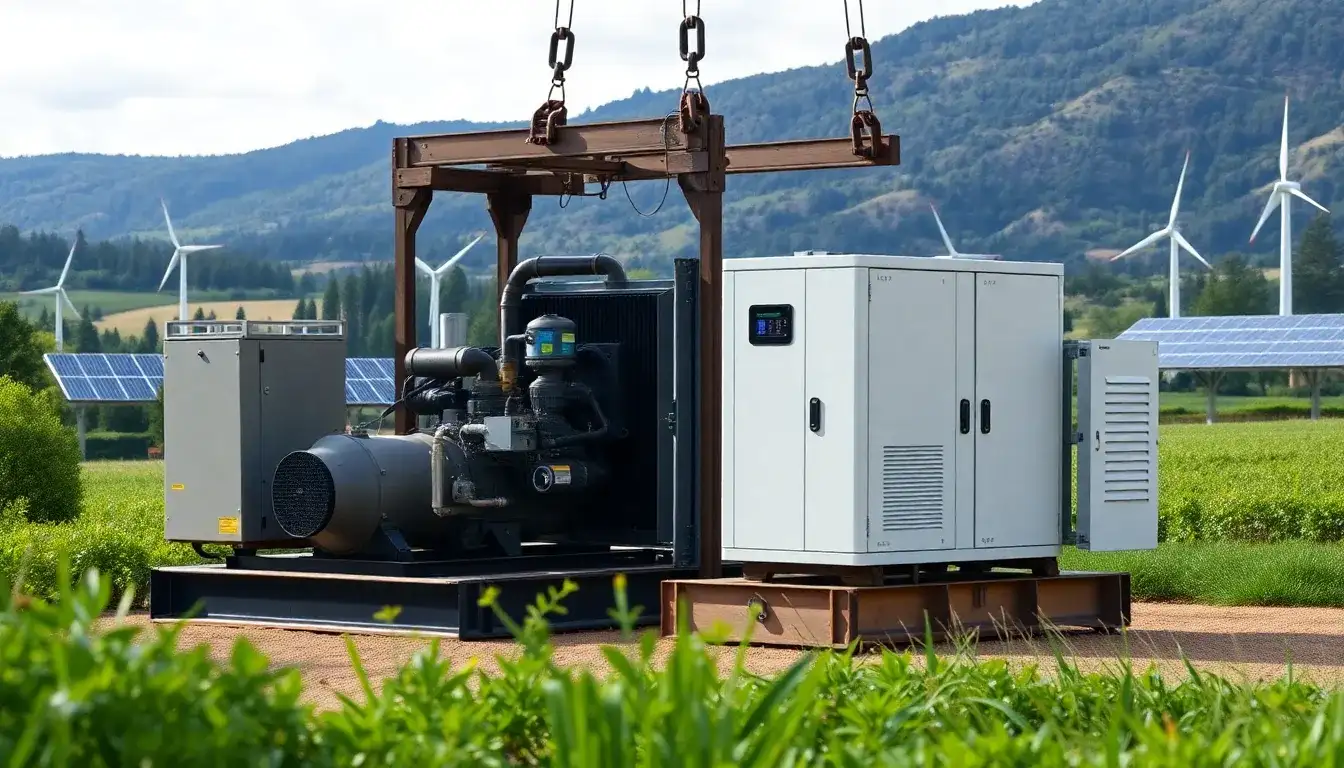
The installation is located near where Pacific Gas & Electric (PG&E) traditionally deployed nine mobile generators from late spring through fall. Behind a chain-link fence, six two-story hydrogen fuel cells manufactured by Plug Power stand ready for operation. During a recent exclusive tour by The Associated Press, water vapor was observed wafting from one of the fuel cells undergoing testing.
Shipping containers house two sets of Energy Vault’s lithium-ion batteries, while a robust double-walled steel tank that holds 80,000 gallons (302,833 liters) of extremely cold liquid hydrogen, which is converted to gas for fueling the cells, is enclosed by a cinder block wall.
California utilities, particularly PG&E, have faced significant financial penalties due to their role in igniting wildfires. To mitigate fire risks, PG&E began implementing power shutoffs in 2018, a year marked by some of the state’s deadliest and most destructive wildfires. During these outages, they transported diesel generators to about a dozen towns for backup power.
Calistoga, with a population of approximately 5,000, has experienced power shutoffs ten times. When the generators operated, they produced harmful nitrogen oxides, carbon dioxide, and soot. PG&E initially considered replacing Calistoga’s diesel generators with a natural gas option that would be less polluting, but ultimately chose Energy Vault’s entirely clean solution, according to Dave Canny, the utility’s vice president for the North Coast Region.
Robert Piconi, CEO of Energy Vault, mentioned that this technology could benefit other communities, military bases, and data centers, but potential clients wanted to observe its functionality first. “There’s a massive proof point with this project,” he emphasized. “I think it’ll have significant implications for how people view alternative, sustainable solutions.”
Plug Power, the fuel cell manufacturer, aims to make these types of products its primary focus within the next decade. Energy Vault has committed to acquiring clean hydrogen produced with minimal or zero greenhouse gas emissions to power the fuel cells in Calistoga. Janice Lin, founder and president of the Green Hydrogen Coalition, a nonprofit advocating for green hydrogen projects to combat climate change, praised the initiative: “This solution is just beautiful. No noise, no emissions. And it’s renewable. It’s eliminating diesel.”
The residents of Calistoga, who take pride in their small-town atmosphere, have expressed concerns about the safety of hydrogen, known for being flammable and potentially explosive. Fire Chief Jed Matcham admitted that the “very, very large tank” initially caught his attention. However, he collaborated with Energy Vault on emergency planning and training and is now comfortable with the safety protocols in place, which include alarms, detectors, and fire suppression systems for the batteries.
When PG&E next shuts off power to mitigate wildfire risks, the utility will notify Energy Vault when it is safe to restore electricity to Calistoga. The batteries will quickly discharge stored energy to the local microgrid, while the hydrogen fuel cells will take over to maintain a consistent power supply for an extended period. By working in unison—similar to a hybrid vehicle—the batteries and fuel cells are expected to sustain power for about 48 hours or more.
Clive Richardson, owner of the Calistoga Roastery, expressed relief at having a year-round clean energy solution for emergencies. “This will give us far more security than we had before,” he commented. “It’s fantastic that it’s come. Here we are, little ol’ Calistoga, and we’ve got the first-of-a-kind system that hopefully will be endorsed and replicated worldwide.”
Original article by NenPower, If reposted, please credit the source: https://nenpower.com/blog/calistoga-transitions-from-diesel-to-innovative-clean-power-backup-system-2/

