

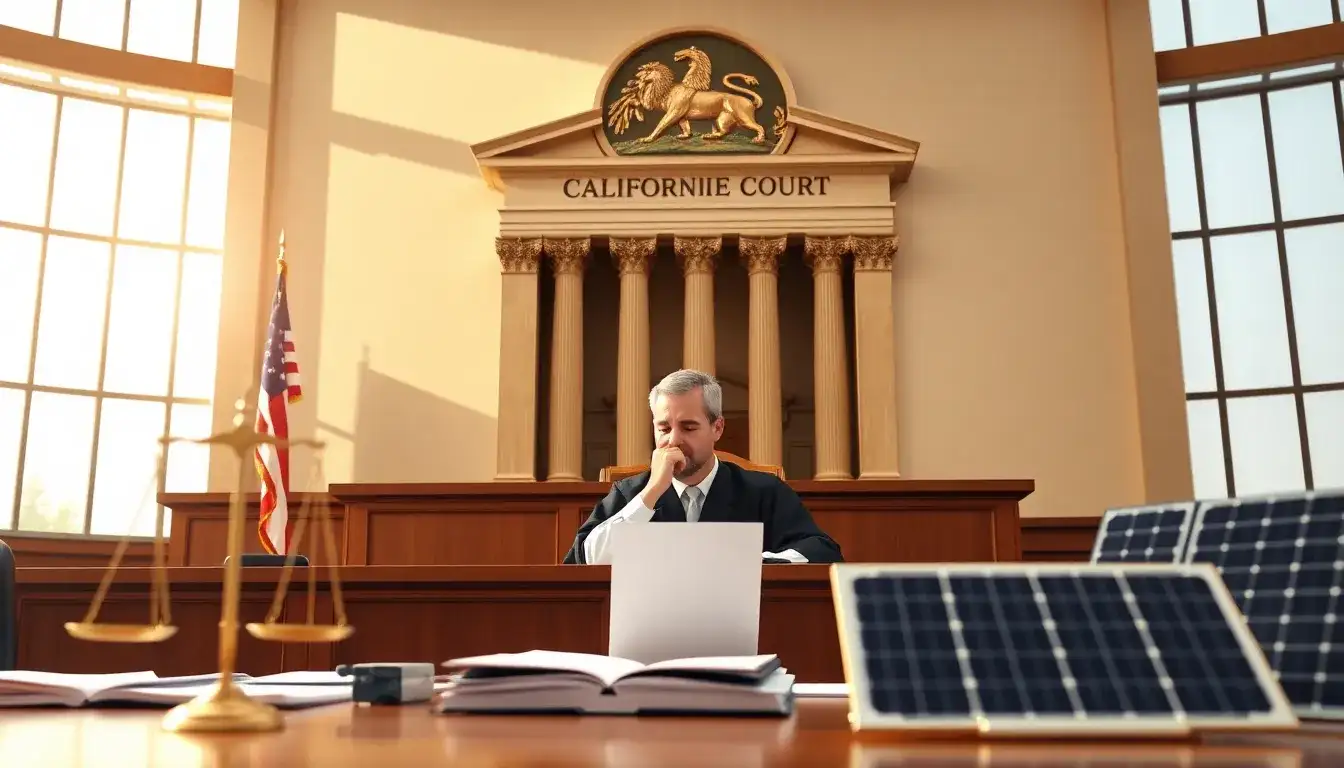
The California Supreme Court recently heard arguments in a case that could significantly impact the adoption of rooftop solar panels across the state. Environmental and consumer advocacy organizations are challenging a 2022 decision made by state regulators that reduced compensation rates for solar customers by approximately 75% for the excess energy they generate. This change was intended to protect non-solar customers from what regulators deemed unfair cost burdens, but it has resulted in a drastic decrease in new solar installations.
The case is being brought forward by three environmental groups: the Center for Biological Diversity, The Protect Our Communities Foundation, and the Environmental Working Group. They argue that the California Public Utilities Commission (CPUC) did not adequately consider the benefits to customers and disadvantaged communities when implementing these changes. In response, the CPUC maintains that its policy strives to balance affordable energy for all customers while promoting renewable energy options.
A ruling from the court is anticipated within the next month. During the hearing, Malinda Dickenson, a representative for the advocacy groups, stated that the commission “excludes reliability and resiliency benefits” in its decision, noting that “millions of customer generation facilities provide power on hot summer days and prevent blackouts.”
The compensation framework, known as “net energy metering,” was designed to encourage renewable energy adoption by offsetting the high costs associated with installing solar panels on residential rooftops. Under this system, solar customers connected to California’s three major investor-owned utilities—Pacific Gas & Electric, Southern California Edison, and San Diego Gas & Electric—could sell back excess energy they generated, which in turn reduced the utility’s need to procure energy from other sources.
The core issue at stake is the payment rate for this surplus energy. Previous versions of the program, “NEM 1.0” and “NEM 2.0,” allowed solar customers to receive the retail rate for their excess energy, which is the same price charged to other customers. The current iteration, “NEM 3.0,” has shifted to a model that compensates customers based on the “avoided cost,” reflecting the savings the utility achieves by not needing to purchase that energy.
This change was enacted after utility companies claimed the previous system caused a “cost shift” that unfairly burdened non-solar customers with maintenance costs for the electrical grid. The new policy applies only to customers who installed solar panels after mid-April 2023, while those who connected under the earlier systems will continue to receive the retail rate for the duration of their 20-year contracts.
The revisions sparked considerable backlash from the rooftop solar industry, ratepayers, and renewable energy advocates. The groups involved in the lawsuit first sought to have the CPUC reconsider the issue but were denied. A state appeals court later sided with the CPUC, prompting the groups to escalate the matter to the Supreme Court.
During the court proceedings, the environmental organizations dismissed the cost-shifting argument as a “red herring.” However, the CPUC maintained that the cost shift is a legitimate concern. While California law mandates a cost-benefit analysis for the net metering program, it does not specify a required methodology.
State statistics indicate a staggering 82% decrease in solar customer connection requests in 2023 compared to the previous year. Attorney Mica Moore, representing the CPUC, stated, “The commission made a factual finding that the former net metering system was unsustainable due to the burden it placed on customers without solar.”
The current policy has had a noticeable effect on the state’s solar sector, with industry experts predicting approximately 17,000 job losses within the first year. Recent reports indicate that new rooftop solar installations have plummeted by as much as 45% since April 2023. This decline poses a significant challenge to California’s goal of achieving 100% carbon-free energy by 2045, particularly since solar energy is expected to contribute more than half of that target.
Additionally, the California Assembly recently passed a bill aimed at altering existing contracts for solar customers, which could decrease the number of customers eligible for the old, higher compensation rates for surplus solar power. Currently, when a residential solar user sells their home, the new owner can continue receiving the rate established by the previous homeowner for about 20 years. If the bill passes in its current form, it would prevent new homeowners from retaining these older rates, a move that proponents argue is necessary for cost control, but critics warn could harm ratepayers.
Brad Heavner, executive director of the California Solar & Storage Association, expressed concern, stating, “If lawmakers are serious about controlling energy costs, they should address the real problem: runaway utility spending. Instead, they seem more interested in protecting utility profits and blaming solar users.”
Original article by NenPower, If reposted, please credit the source: https://nenpower.com/blog/california-supreme-court-considers-legality-of-rooftop-solar-payment-reductions/

