

How to Build a Path for Microgrids and Large Grids to “Run Towards Each Other”?
May 16, 2025
In recent years, with the continuous development of wind and solar resources, new energy has become the primary source of power generation in Jiangsu Province. This lays a solid foundation for local green and low-carbon development and enhances the competitiveness of manufacturing enterprises. Recently, the new time-of-use electricity pricing policy for industrial and commercial users in Jiangsu has sparked widespread interest, particularly on the topic of “How to leverage this new policy to save money for businesses?”
Various actions such as adjusting electricity usage habits and installing solar-storage facilities have emerged as companies seek to adapt to changing electricity prices. Constructing microgrids using nearby “green resources” has become a common choice among many enterprises. On May 12, 2025, Tongfu Microelectronics Co., Ltd. officially connected to the microgrid management platform in Nantong City. As one of the top 500 private enterprises, Tongfu Microelectronics has added a 10 MW energy storage project this year, building on an existing 2 MW solar installation. With the platform’s energy management and optimization controls, the company can save approximately 4.5 million yuan in electricity costs each year.
What is this platform and how does it help companies save money?
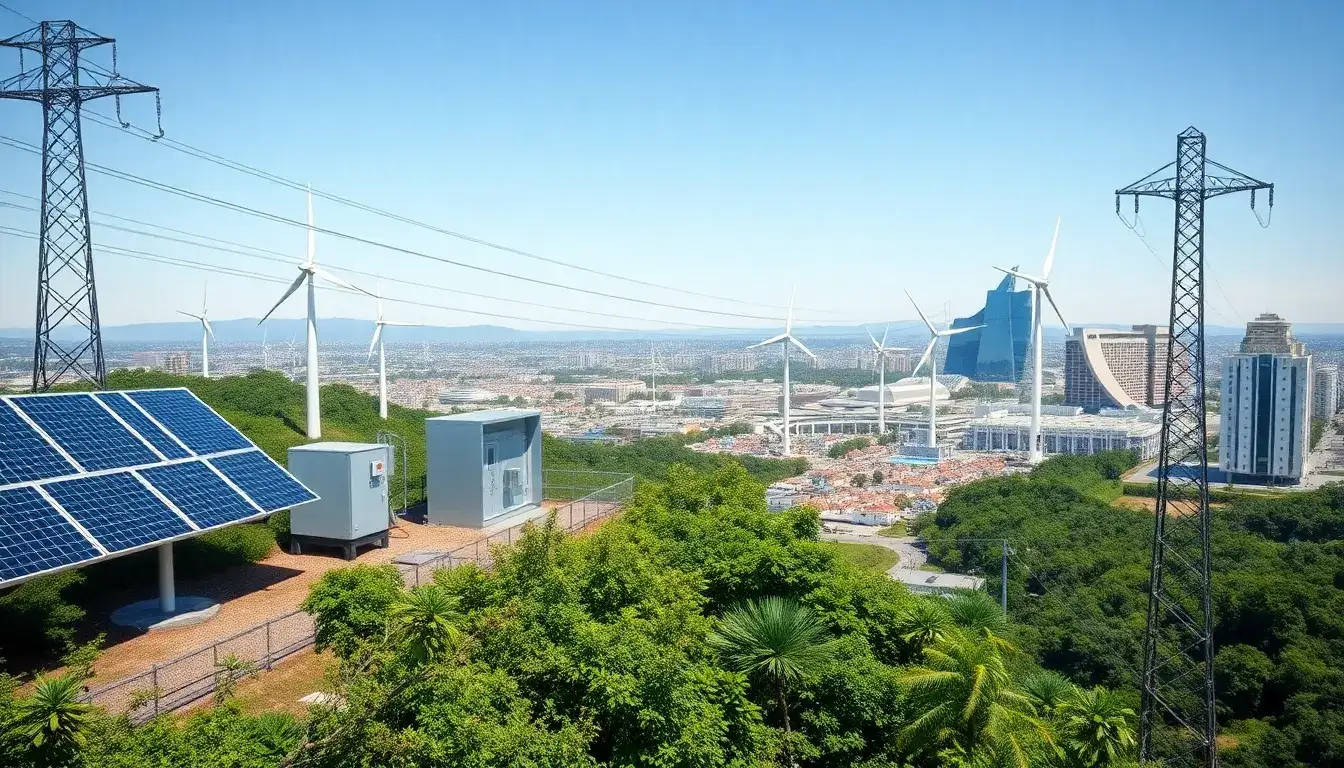
First, let’s clarify what a microgrid is. In simple terms, a microgrid is a small-scale power supply system that integrates distributed energy resources such as solar and energy storage, combined with distribution facilities and energy management systems. Ideally, it can operate independently, providing self-sufficient power. Microgrids also serve as the “capillaries” of the larger grid, providing support when needed and receiving assistance from the main grid during internal fluctuations or faults.
In recent years, numerous distributed energy resources, electric vehicles, and energy storage systems have connected to the distribution network, forming many “native microgrid” structures that incorporate generation, grid, load, and storage elements. To encourage companies to actively develop “smart” microgrid systems, Nantong City issued the “Implementation Plan for Near Zero Carbon Pilot Construction” in October 2024, promoting the aggregation and regulation of distributed solar, storage, and load.
In mid-April 2025, the microgrid management platform constructed by the State Grid Nantong Power Supply Company officially went live. This platform enables monitoring of microgrid users’ development and resource scale across the city, allowing real-time analysis of maximum adjustment capacities and assessment of renewable energy consumption rates and self-balancing rates. This is the first municipal-level microgrid management platform in Jiangsu that covers the entire chain of generation, grid, load, storage, and carbon management.
To maximize the benefits of microgrids as a new balancing resource—ensuring supply, enhancing safety, improving efficiency, reducing costs, and increasing sustainability—the State Grid Nantong Power Supply Company has extended its service chain to enterprises. Based on the microgrid management platform, a “customer-side management platform” for generation, grid, load, and storage has been developed. This tool helps clients overcome high investment costs and coordination difficulties when building individual energy management systems, facilitating easier development of microgrids and ensuring the safe and stable operation of the new power system.
“This customer-side platform acts like a free, dedicated ‘AI steward’ assigned by the power supply company. We only need to select the appropriate operational strategy in the system based on our actual production needs, and the system takes care of the rest,” said Wu Pinzhong, head of Tongfu Microelectronics’ plant operations.
A Two-Way Approach: Fostering Friendly Interaction Between Grid and Load
Nantong Chongtian Spinning Co., Ltd. is one of the first beneficiaries of this initiative. Its microgrid project integrates solar, storage, charging, and adjustable load, featuring 2.4 MW of solar power and 5,394 kW/16,182 kWh of energy storage. With the platform’s optimized dispatching, the company has achieved rolling forecasts of its factory load and energy storage adjustments, estimating that the project will save about 70 million yuan in electricity costs over the next 15 years.
The platform simulates various strategies based on different needs. “This ‘treasure platform’ also generates monthly energy analysis reports, including basic electricity fees, kilowatt-hour costs, trends in comparisons with industry peers, allowing us to better understand our energy efficiency levels,” said Wu Pei, the electrical manager at Chongtian Spinning.
With the accelerated development of the electricity spot market, interaction between the grid and load is becoming a new normal. Electricity customers are transitioning from passive acceptance of prices to active participation in market dynamics. On May 10, Wu Pei visited the Nantong Green and Low-Carbon Development Service Center to inquire, “I heard that participating in the electricity market can earn us money if we consume more power, especially with the new industrial and commercial time-of-use pricing policy in Jiangsu. How can we participate?”
“If you wish to participate in the midday valley-filling auxiliary service from 11 AM to 1 PM tomorrow, you can use the pre-set grid interaction strategy in the system to automatically determine your maximum capacity for participating in auxiliary services during that time. Once you input the response amount, it will calculate the potential earnings,” demonstrated a staff member. Wu Pei saw the results of the calculations, where a simulation of 11,130 kWh of adjustment yielded a profit of 6,336.32 yuan for just that one response. This data boosted his confidence in earning market dividends from grid interactions.
As a form of power system, microgrids can achieve overall load mobility, adjustability, and interruptibility through layered control strategies, making them a crucial regulatory resource. The more microgrids actively respond to price signals and adjust their energy consumption, the smoother the overall load curve for the larger grid will become. “This is also a situation we, as a power supply company, are pleased to see. It not only realizes a two-way approach between microgrids and the larger grid but also accelerates the scale and widespread development of microgrids,” stated Yuan Yi, deputy director of the marketing department of the State Grid Nantong Power Supply Company.
Creating Inclusive Services to Foster More Microgrids
This year, to tap into more “green resources” in the area, the State Grid Nantong Power Supply Company has launched a tiered diagnostic service for “electricity costs-load-energy use” aimed at all city electricity customers. By conducting analysis to identify potential microgrid clients, the company recommends configurations of solar, charging, and storage systems to facilitate the development of microgrid clients and the aggregation interaction of load resources. Additionally, an eight-indicator system covering construction fundamentals, microgrid characteristics, green and low-carbon metrics has been established on the microgrid management platform to monitor the development of microgrid projects from basic to advanced forms.
As of May 12, 2025, the Nantong microgrid platform has connected 13 microgrid projects, achieving full coverage across four typical scenarios: vehicle-grid interaction, intelligent manufacturing, building energy efficiency, and industrial parks. Cumulatively, it has integrated various resources totaling 239.79 MW, generating approximately 2.74 million kWh, with a renewable energy consumption rate of 97%, averaging an annual consumption of 25.44 million kWh of green electricity, and improving energy utilization efficiency by 5.23%. This significantly enhances the “green content” of high-quality development.
“In the coming months, nearly 50 more microgrid projects are expected to join our family. Among them, Hengke New Materials Co., Ltd., the largest project in the province, is set to connect to the platform at the end of this month. It features 72 MW of distributed solar and 40 MW/80 MWh of storage, serving as an important reserve during peak summer periods,” Yuan Yi added.
While the path for microgrid development is filled with challenges such as the lack of unified technical standards and insufficient adaptability in complex scenarios, through continuous exploration and innovation, we believe we will ultimately address issues related to the grid’s absorption of distributed energy and enhance resilience. This will provide greater support for optimizing the operation of a multi-energy structure, creating substantial economic and social value.
Original article by NenPower, If reposted, please credit the source: https://nenpower.com/blog/building-a-path-for-microgrids-and-the-main-grid-to-collaborate-effectively/

