

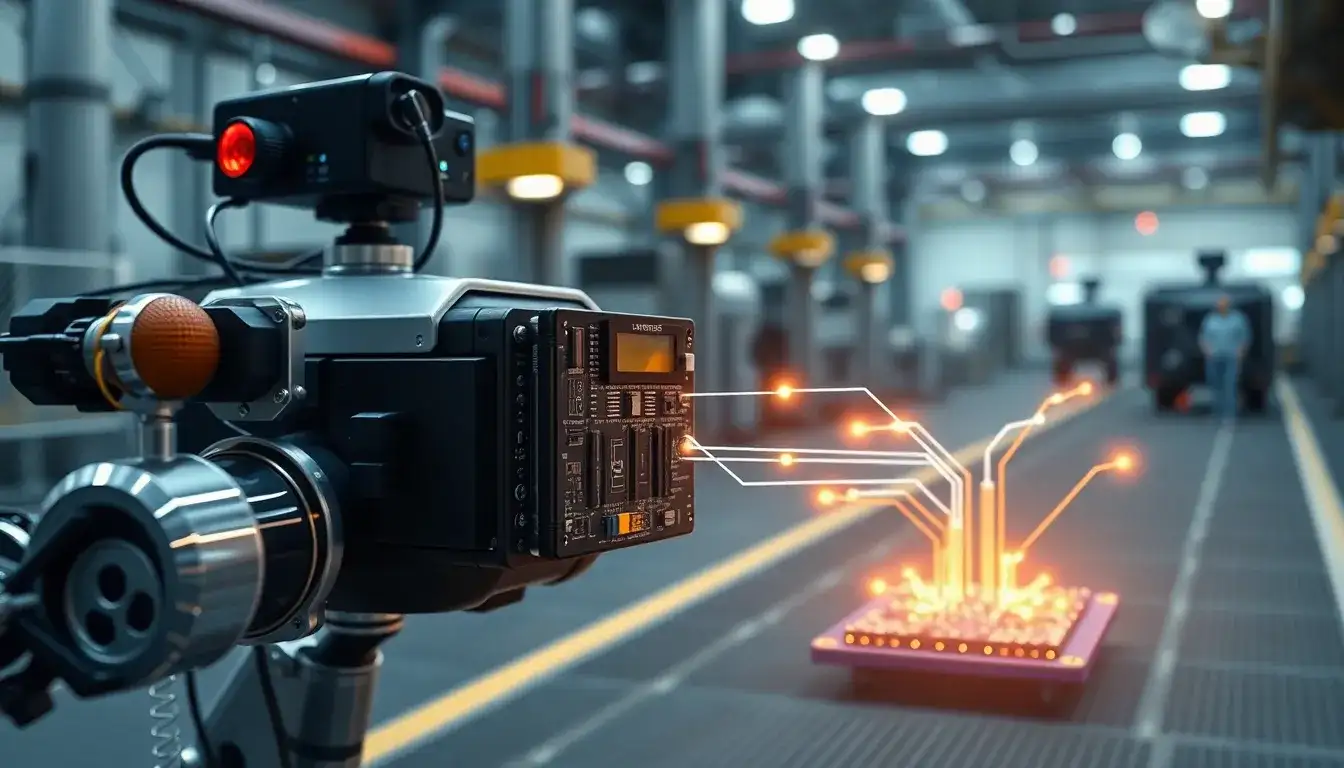
Bridging the Sensor Fusion Gap: How FPGAs Support Real-Time Robot Applications at the Edge
Automation stands as a fundamental pillar of modern industrial facilities, with robotic technology acting as a catalyst for its advancement. Currently, AI-driven robotics are rapidly evolving, leading to the deployment of larger and more sophisticated industrial solutions. However, as the scope and scale of automation systems expand in industrial settings, the tasks of collecting, aggregating, and analyzing sensor data become increasingly challenging.
With each additional sensor, the system is faced with more signals, data, and demands, which also increases risk. Larger, more complex designs with higher data processing volumes are more prone to errors, delays, latency, and security vulnerabilities. Although AI and machine learning (ML) models help streamline robot-driven operations, integrating them into these systems poses its own challenges.
As modern industrial automation systems grow in size, autonomy, and overall connectivity, the potential attack points for hackers have surged. To address the continuously evolving threat landscape, developers must scrutinize the underlying hardware that supports these increasingly distributed automation systems.
The Necessity of Sensor Fusion
The reliable operation of automated industrial facilities heavily relies on sensor fusion—integrating and processing data from various sensors, devices, and processes to contextualize signals for improved accuracy, visibility, and relevance. Sensor fusion helps optimize the value of analytical tools and the predictive insights they provide, ensuring minimal downtime while enhancing overall throughput and efficiency.
Professionals in the contemporary AI and robotics fields recognize that sensor fusion is crucial for extending advanced robotic systems to the edge. It is a key enabling factor for achieving real-time responsiveness, with 84% of industry professionals affirming that real-time responsiveness is critical or very important for system performance. When combined with precise motor control, functional safety, and security measures, sensor fusion addresses many of the key challenges faced in designing automated robotic systems.
Unfortunately, significant challenges remain during deployment. For instance, regarding the fusion of camera and LiDAR sensors: while 75.7% of surveyed industry leaders favor this sensor fusion solution, only 67.5% of companies have successfully deployed camera-LiDAR fusion systems. This gap reflects the numerous technical barriers still hindering the efficient proliferation of robotic automation.
Current Challenges
Regardless of the specific sensors and AI models involved, engineers face the daunting task of supporting advanced automated robotic applications with numerous components. Three major technical barriers to implementation that engineers have yet to fully overcome include:
- Integration: Industrial robotic systems are highly complex, requiring connections among various advanced sensors executing different tasks. Ensuring compatibility and usability across these components necessitates chip-level flexible input/output (I/O) and high performance, which poses a significant challenge for many general-purpose components. While today’s processors utilize advanced technology nodes to reduce transistor sizes, enhance performance, and lower chip costs, this also leads to increased I/O limitations and compatibility issues with traditional connection requirements.
- Digital Twin and Calibration: Many industrial facilities rely on systems that automate high-precision, critical tasks to minimize human error. Any desynchronization or connection disruption can yield negative consequences. This necessitates that each robot’s internal parameters and physical actions are precisely matched to their digital models. Unfortunately, various environmental factors can affect a robot’s operational accuracy, thus requiring continuous monitoring and calibration maintenance.
- Cost and Power Consumption: The initial investment and ongoing operational costs associated with building AI-enabled intelligent robots hinder the widespread adoption of this technology. The specialized sensors needed to support these systems are costly, and additional expenses related to energy consumption, computational requirements, and model training pose further obstacles. Autonomous robots also face the challenge of optimizing power consumption while meeting high computational demands to extend operational time.
To facilitate the widespread adoption of AI-assisted robotic technology, designers must find ways to simplify and optimize sensor-based edge architectures without compromising speed, computational power, or efficiency. This process must begin at the foundational architecture level, utilizing specialized components like field-programmable gate arrays (FPGAs) to explore new solutions for building edge devices.
How FPGAs Support Sensor Fusion
FPGAs have proven to be powerful tools for designing and deploying high-performance robotic solutions. They offer the low latency, synchronization, and deterministic performance needed for sensor fusion processing while achieving low power levels that conventional processors struggle to match. Furthermore, FPGAs fulfill core requirements such as functional safety, security measures, and design flexibility, all within a compact and energy-efficient form factor. However, these features are just the tip of the iceberg regarding their potential value in facilitating the large-scale deployment of AI-driven robotic automation.
With their unique composite capabilities, FPGAs provide high-quality solutions to the main challenges of sensor fusion. The core advantage of these chips lies in their parallel processing capabilities, allowing them to execute multiple tasks simultaneously. By handling signal processing, alignment, sensor fusion, and integrating computer vision with edge AI concurrently, FPGA chips can offload some tasks from the main computing components, reducing system latency and processing pressure while expanding operational capabilities. This feature significantly accelerates the processing speed of various critical tasks, enhancing the precision and decision-making efficiency of robotic systems, ultimately enabling more reliable, stable, precise, and efficient real-time operations.
FPGAs also address the I/O-computational power contradiction mentioned earlier by providing highly customizable I/O and flexible protocol support. This interoperability allows them to connect seamlessly with a wide array of sensors and actuators adhering to common standards like Ethernet, SPI, LVDS, CAN, MIPI, JESD-204B, and GPIO. By minimizing latency and delivering deterministic low-power processing capabilities while managing the workloads of sensor fusion, computer vision, and physical AI, these chips help resolve common computational and power consumption issues, thereby enhancing overall system performance and expanding operational capabilities.
These semiconductors not only offer flexibility in the design phase but can also be updated after deployment, addressing a frequently overlooked obstacle: changing future demands. Their reprogrammable nature further extends the potential for advancing robotic automation technology into new phases, enabling systems to undergo iterative upgrades to adapt to emerging needs while extending the effective lifespan of devices.
The Present and Future
As the demand for real-time data processing and decision-making continues to grow, simplifying the integration and management of sensor data will be crucial for the successful implementation of robotic automation and system risk management. FPGAs lay a solid foundation for these efforts, providing designers with the flexibility needed to optimize sensor fusion solutions while redefining the roles that intelligent robots can play in current and future industrial production.
When combined with other advanced components, FPGAs will help lead the next generation of robotics and automation deployments, continuing to provide flexible support as the field matures. They demonstrate that despite numerous challenges, intelligent, automated, and real-time industrial robotic solutions are within reach.
Original article by NenPower, If reposted, please credit the source: https://nenpower.com/blog/bridging-the-sensor-fusion-gap-how-fpgas-enhance-real-time-robotics-at-the-edge/

