

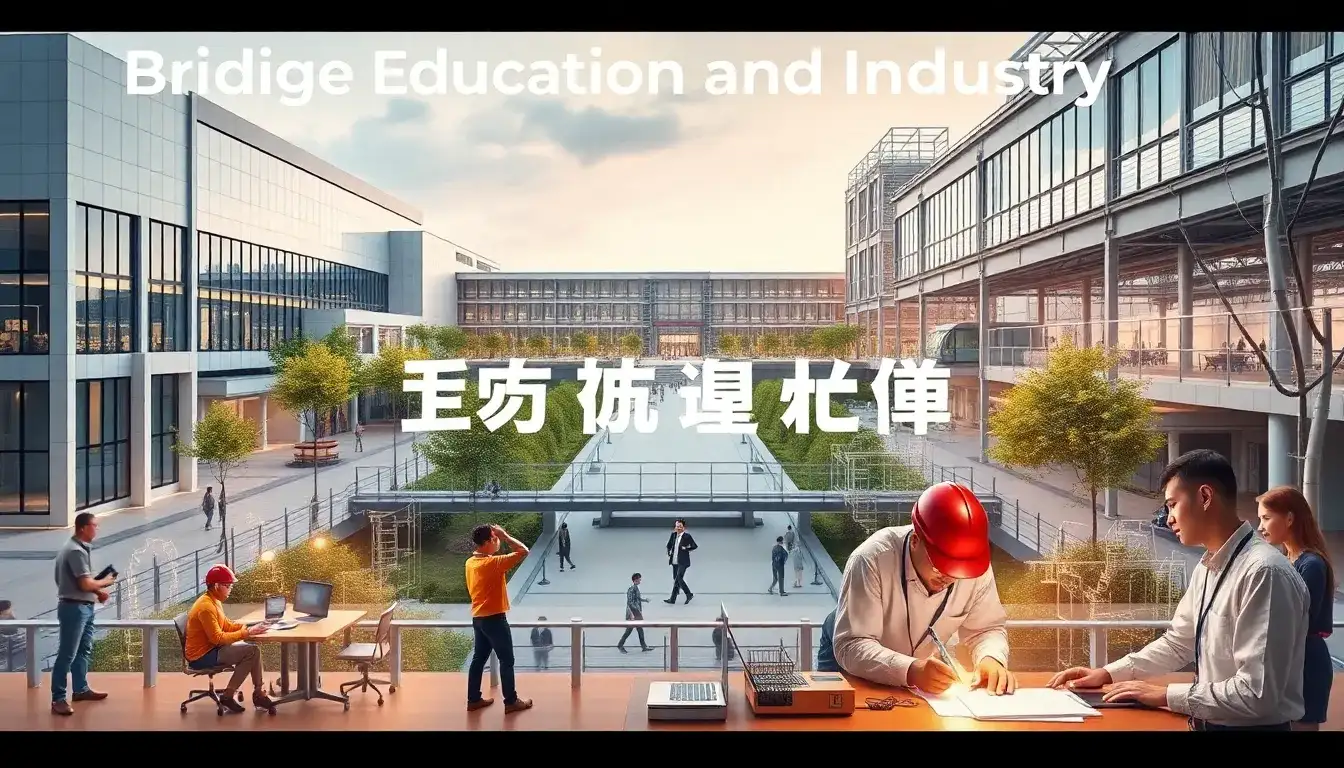
Focusing on Industry Needs to Make “Graduation Equals Employment” a Reality
As the first public vocational education institution in Shandong Province, Zibo Vocational Technical University is building a new ecosystem of vocational education that promotes collaboration between schools and enterprises. Here, students are often “reserved” by companies even before graduation, teachers are addressing key industry technologies, and practical training seamlessly connects with production lines. This evolving model serves as a vivid example of how vocational colleges can contribute to regional development.
During a recent visit to the university’s Industrial Robot Application Talent Training Center, several students were observed repeatedly adjusting the program of a six-axis robot to precisely control its gripping force and movement trajectory. This “Industrial Robot System Integration Comprehensive Training” course is co-taught by industry mentors and school instructors, simulating real production line troubleshooting and optimization needs.
As a pioneering institution, Zibo Vocational Technical University has deepened the integration of education, talent, industry, and innovation—what they refer to as the “four-chain integration.” This approach continuously injects new vitality into Zibo, an old industrial base. Here, students are frequently pre-hired before graduation, and the seamless connection between training classrooms and production lines exemplifies the commitment of vocational colleges to regional service.
Talent Development in Sync with Industry Pulse
“Our program offerings must closely align with industry demands; falling behind means losing relevance,” stated Zhang Shuli, director of the university’s admissions office. The school has established a dynamic matching database between “programs and industries,” conducting systematic optimizations of its offerings every five years. Over the past five years, Zibo Vocational Technical University has introduced 12 emerging programs, such as artificial intelligence and big data, while discontinuing 11 outdated ones that no longer align with industry needs.
For example, to align with Shandong Province’s “Ten Strong Industries” and Zibo’s “Four Strong Industries,” the university has prioritized the development of professional groups in fields like new energy vehicles and Internet of Things engineering. The automotive engineering program collaborates with companies like Li Auto and China National Heavy Duty Truck Group, incorporating cutting-edge courses in new energy battery testing and smart networking technologies to ensure that students’ learning stays in sync with industry advancements.
“Our program development is not done in isolation; we always focus on production lines and industry chains,” explained Liu Wei, secretary of the university’s party committee. Through a logical chain of “demand perception, supply reconstruction, cross-border collaboration, and closed-loop governance,” the university has achieved resonance between program offerings and regional industrial upgrades. Currently, Zibo Vocational Technical University has developed a “363+” program cluster system, comprehensively covering high-end chemicals, new energy, and intelligent manufacturing sectors.
Today, the concept of “enrollment equals employment, graduation equals job readiness” has become a reality at Zibo Vocational Technical University. The university collaborates with 966 enterprises to offer 91 order classes and apprenticeship programs, with companies participating in curriculum development and embedding job standards. In the Li Auto order class, students are largely “reserved” by their junior year, with starting salaries generally exceeding 6,000 yuan. Graduates from the Wanhua Chemical order class were awarded the title of “Wanhua Craftsman” in 2024.
The core of these order classes is their “customized” nature. Zibo Vocational Technical University translates companies’ skill requirements and process flows into modular courses, exposing students to real work scenarios from their first year. The university’s Lunan Pharmaceutical College implements a dual identity system for instructors and employees, alongside a dual incentive mechanism of teaching awards and scholarships, ensuring that talent cultivation aligns closely with job requirements.
Bringing “Factories” into the Campus
“Training is not child’s play; it is real combat training,” emphasized Zhang Mingkui, a teacher at the university’s Intelligent Manufacturing College. The school has invested 300 million yuan to establish 42 enterprise-level training centers, including workshops for new energy vehicles and smart sorting laboratories, most of which are equipped with technology provided directly by partner companies. At the BAIC New Energy Industry College, the enterprise not only supplies the latest vehicle models for teaching but also dispatches 12 technical experts to the school to lead students in actual projects such as developing battery management systems.
At the JD Modern Industry College, students participate directly in the entire process of e-commerce promotions such as “618” and “Double Eleven,” with service sales exceeding 8 million yuan in 2024. The enthusiastic student conducting a live sale of fresh-cut flowers from Yunnan is not a platform host but a student from the university’s Business Administration College. Zibo Vocational Technical University has formed a deep partnership with Huahai Helian (Yunnan) Trading Co., Ltd. to establish a live-streaming training base for fresh-cut flowers, expecting annual sales to surpass 5 million yuan. This “factory-in-school” model allows students to gain real job experience while still in school, ensuring they are job-ready upon graduation.
Additionally, Zibo Vocational Technical University has established vocational education centers in Cambodia and Russia to train over 700 local technical professionals for Zibo enterprises expanding abroad. The university also leads the formation of four cross-regional industry-education integration communities.
From One-Way Support to Mutual Empowerment
Zibo Vocational Technical University has established a research and development system driven by demand and characterized by school-enterprise collaboration, creating interdisciplinary teams to address technical pain points for businesses. For instance, a control system for unmanned zirconia tunnel kilns developed by Professor Zhu Mutian’s team has automated the entire ceramic firing process, reducing energy consumption for local ceramic companies by 20%. The “Intelligent Traffic Signal Coordination System” implemented in Zibo’s urban area improved intersection traffic efficiency by 23%.
The model of “companies posing challenges and schools collaboratively solving them” has made research at the university more grounded. Over the past three years, Zibo Vocational Technical University has overcome more than 30 key technical challenges, serving 145 companies with research funding exceeding 30 million yuan. Equipment such as the “Ceramic Hand Mold Automatic Polishing Machine” and “Surgical Knife Grinding Robot,” developed by Teacher Sun Chuanbing‘s team, have already been put into production at companies like Zibo Longjia Industry and Trade and Xinhua Medical.
To ensure sustainable collaboration, Zibo Vocational Technical University has established a long-term mechanism based on four dimensions: policy, benefits, organization, and talent. This includes implementing a “school-enterprise collaboration filing system” to unify internship standards and setting up a special incentive fund to encourage enterprise participation, along with creating a provincial industry-education integration information platform for real-time supply and demand matching.
The ultimate effectiveness of industry-education integration is reflected in the quality of student employment. The university’s specialized programs exhibit three high characteristics: high relevance (with automotive engineering and IoT programs achieving a 92% relevance rate), significant starting salary advantages (with the average starting salary for undergraduate pharmaceutical engineering graduates at 6,500 yuan), and rapid promotion rates (with 37% of mechanical manufacturing graduates becoming technical supervisors within three years). Over the past five years, Zibo Vocational Technical University has trained more than 40,000 skilled professionals. From classrooms to production lines, and from technical breakthroughs to international cooperation, Zibo Vocational Technical University has demonstrated through practice that industry-education integration is a critical pathway for vocational education to serve regional development. This institution, rooted in an old industrial base, is crafting a vibrant model of coexistence and mutual prosperity between vocational education and industrial economy through precise program planning, realistic training scenarios, and deep school-enterprise collaboration.
Original article by NenPower, If reposted, please credit the source: https://nenpower.com/blog/bridging-education-and-industry-how-zibo-vocational-technical-university-ensures-graduates-are-job-ready/

