

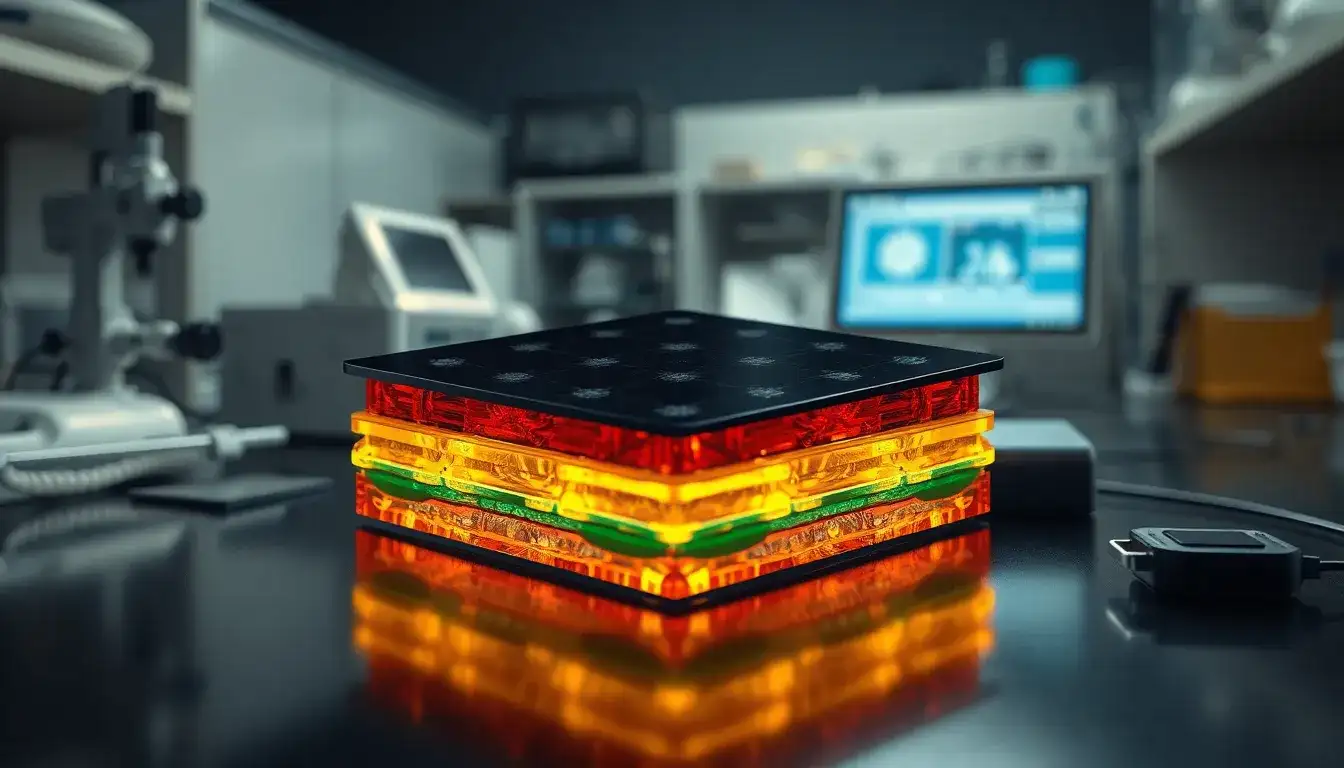
New All-Organic Solar Cells Achieve 8.7% Photovoltaic Conversion Efficiency
May 7, 2025 – A collaborative effort between Kanazawa University in Japan and Queen’s University in Kingston, Canada, has led to the development of a new all-organic solar cell that boasts a photovoltaic conversion efficiency of 8.7%. This marks a significant improvement over prior research.
The press release from Kanazawa University highlights that traditional silicon-based solar panels contain harmful metals, resulting in high disposal costs after their life cycle ends. In contrast, all-organic solar cells are made entirely from organic materials without any toxic metals, significantly reducing environmental costs and showing promise as a viable technology in the energy sector. However, all-organic solar cells are still in the research phase, with previous efficiencies peaking at about 4%, which is considerably lower than silicon solar cells (which can achieve efficiencies of up to 27%) and perovskite solar cells (with efficiencies up to 26%). The recent advancements by the Kanazawa-led research team in boosting the efficiency to 8.7% represent a substantial step toward practical application.
The low efficiency of all-organic solar cells has primarily stemmed from two challenges. First, producing high-conductivity organic electrode materials typically requires the addition of strong acids or bases and high-temperature processing above 150 degrees Celsius, which can damage the organic substrate of the cell. Second, during the manufacturing of multi-layer solar cell devices, it is challenging to stack thin films layer by layer without damaging the underlying structure, especially when using solution processes, which risk dissolving lower layers or compromising film uniformity.
To overcome these issues, the research team developed new electrode materials and manufacturing techniques. They created a novel transparent electrode material based on the conductive polymer PEDOT:PSS. This new material demonstrates sufficient conductivity for use as a solar cell electrode and can be produced at 80 degrees Celsius without the need for acids or bases. Additionally, the team introduced a “carbon nanotube electrode lamination method,” where electrodes are fabricated separately and then adhered to the device, thus avoiding the risks associated with traditional solution processing that can damage underlying organic films.
These findings have been published in the journal Advanced Functional Materials. The team plans to further enhance the conductivity of organic electrodes and the photovoltaic conversion efficiency of the cells in future research, while also striving to develop lower-cost materials and manufacturing processes. If successful, the new all-organic solar cells could become widely adopted due to their broad applicability and easy recyclability.
Original article by NenPower, If reposted, please credit the source: https://nenpower.com/blog/breakthrough-in-organic-solar-cells-achieves-8-7-photovoltaic-efficiency/

