

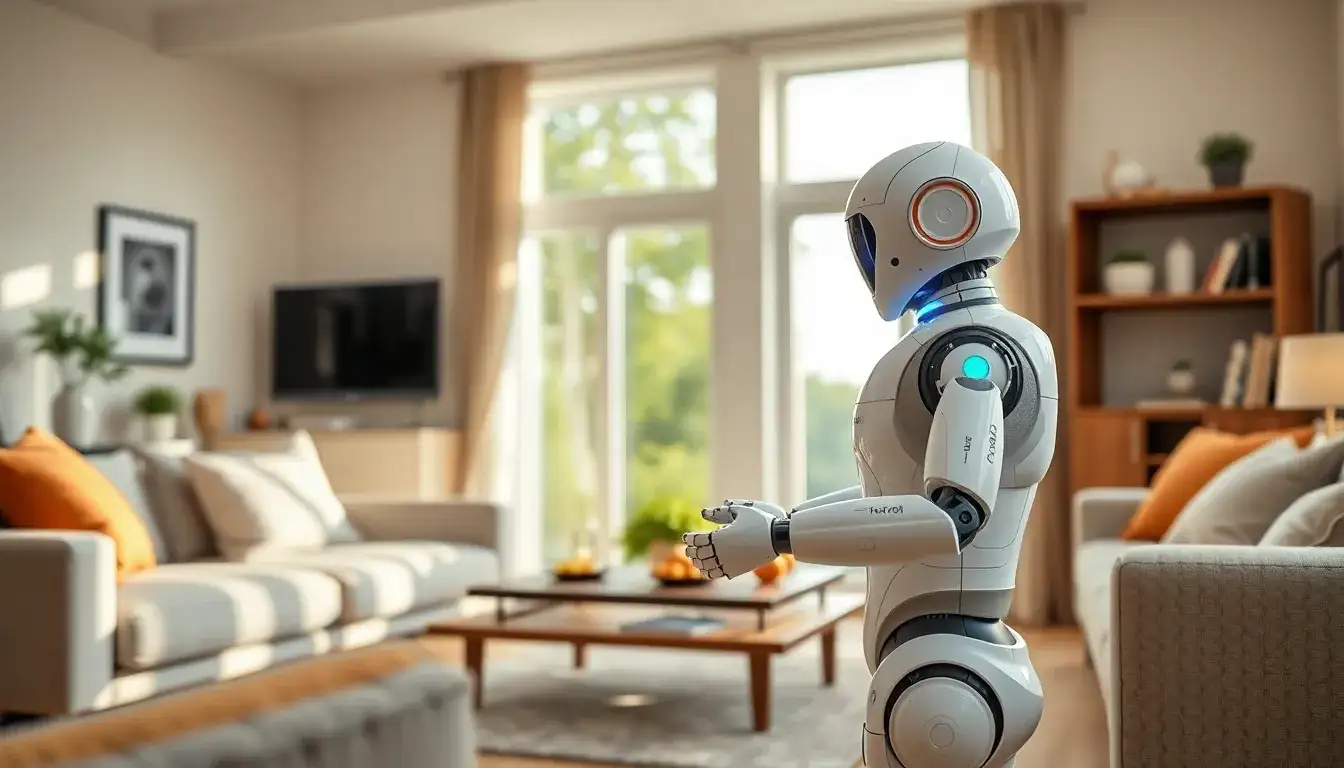
Significant Breakthrough in Domestic Robotics Research! This advancement will directly facilitate the practical application of robotics.
On February 13, it was reported that a team led by Professor Dong Hao from Peking University achieved a crucial breakthrough. They not only established a scientific standard for assessing a robot’s “spatial awareness” but also developed a new navigation model that allows robots to genuinely comprehend space.
Have you ever imagined telling your home robot, “Go behind the low stool to the right of the coffee table and bring me my cup,” and having it understand and execute the command like a family member? The reality is that while today’s robots can recognize objects like “coffee table” and “low stool,” they struggle with simple directional terms such as “right,” “behind,” or “go around.” Essentially, they are still “directionally challenged,” unable to grasp spatial relationships in our daily speech, which limits their ability to move flexibly.
According to engineers, the issue isn’t overly complex. “You can think of past robot operations as them only learning to ‘recognize objects’ without understanding ‘navigation.’ It’s like teaching a child to identify a table or a chair without explaining what ‘left,’ ‘far,’ or ‘upstairs’ means.” Robots can identify objects but fail to perceive the distances, orientations, and height relationships between them, making it difficult for them to adjust their routes while moving. Thus, when given commands like “stop between the two sofas” or “circle around the dining table,” they become confused.
To equip robots with a “spatial brain,” the research project named NavSpace has been jointly completed by Peking University and the Qi Yuan team, demonstrating excellent performance in real-world tests. In simple terms, this technology grants robots a spatial cognitive ability similar to that of the human brain—enabling them not only to see objects but also to assess their positional relationships, distances, and directional changes while continuously thinking and adjusting during movement.
Spatial awareness may seem like basic common sense for humans, but for robots, it’s a significant leap from “zero to one.” Currently, most navigation models rely on recognizing object names (semantics) but lack a profound understanding of spatial attributes such as distance, direction, hierarchy, and structure, resulting in poor execution of related commands.
To systematically evaluate and enhance this capability, the developers created the NavSpace assessment benchmark—the industry’s first navigation test set focused on “spatial intelligence.” It includes six categories and over 1,200 navigation commands that need to be performed in a simulated 3D environment, covering vertical perception, precise movement, perspective shifts, spatial relationships, environmental states, and spatial structure. NavSpace serves as a specialized “spatial cognition” exam for robots, challenging them to engage in continuous dynamic spatial reasoning rather than simply recognizing single-frame images.
Based on this framework, the team proposed the SNav model, which innovatively developed an automatic instruction and data enhancement pipeline for spatial intelligence. This system can automatically generate a vast number of training samples encompassing six spatial capabilities from existing data, efficiently injecting spatial perception and reasoning abilities into the model. Reports indicate that SNav has surpassed existing models across all categories of the NavSpace benchmark, demonstrating the effectiveness of this approach. Furthermore, in real-world tests conducted with the AgiBotLingxiD1 quadruped robot, SNav successfully executed various complex spatial commands, validating its transferability from simulation to reality.
Additionally, robots equipped with this model have been able to understand and follow complex commands such as “go to the low stool” and “go to the nearest sofa on the second floor” in real environments like offices and campuses, achieving success rates far exceeding previous models. This indicates a shift from robots being seen as “laboratory toys” to becoming “life assistants.”
This breakthrough will directly promote the integration of intelligent service robots into real-world scenarios. In home settings, cleaning robots can accurately navigate along walls and around furniture without getting stuck; housekeeping robots can understand commands like “go to the left side of the third drawer in the bedroom wardrobe” to help retrieve or store items. In elder care, robots can safely assist seniors to designated locations while being aware of their surroundings to avoid collisions or falls. In hotels and shopping malls, guide robots can accurately lead individuals to “the second counter behind the escalator,” while delivery robots can bring items to specific corners of designated rooms. In industrial logistics, handling robots can flexibly understand commands like “place it on the top shelf to the left,” enhancing warehouse efficiency.
Original article by NenPower, If reposted, please credit the source: https://nenpower.com/blog/breakthrough-in-domestic-robotics-research-paves-the-way-for-practical-applications/

