

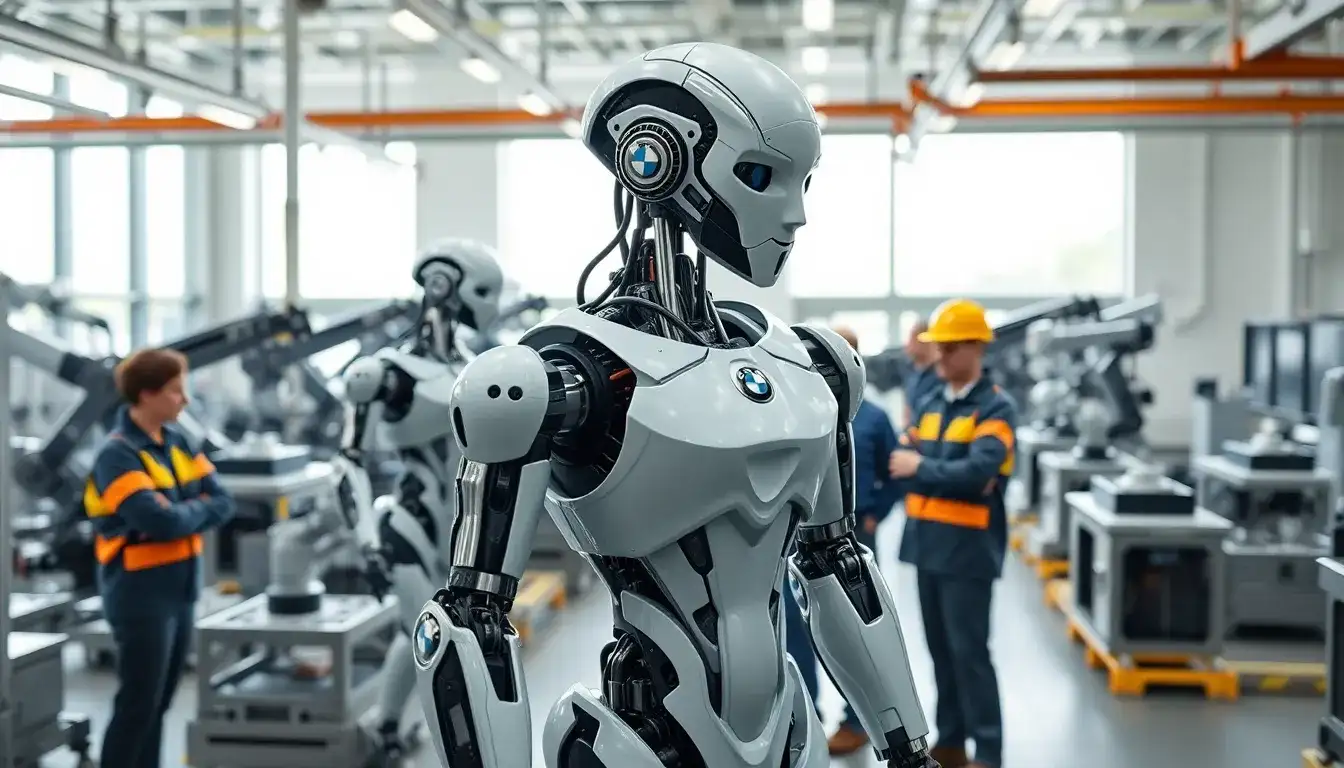
BMW has launched its first pilot project for mass production of humanoid robots in Europe at its Leipzig plant, around March 3, 2026. This initiative aims to integrate Physical AI technology into the existing production processes for vehicles, high-voltage batteries, and components. The project is a collaboration between BMW Group and Hexagon Robotics from Switzerland, utilizing the AEON humanoid robot that was unveiled in June 2025. The first round of field tests was completed in December 2025, with a second round scheduled for April 2026, in preparation for the official pilot phase set to commence in the summer. The focus of this pilot is on validating multifunctional scenarios.
The AEON robot features a humanoid design that allows for flexible attachment of various end-effectors and scanning tools, as well as dynamic movement on wheels. During the testing and subsequent pilot phases, the robot will be implemented in high-voltage battery assembly lines and component manufacturing processes. BMW Group has positioned the humanoid robot as a complement to existing automation systems, primarily taking on repetitive tasks that involve high ergonomic loads or present safety risks, thereby improving working conditions for employees.
This European pilot builds on BMW Group’s achievement in 2025, where it completed the world’s first mass application of humanoid robots at its Spartanburg plant in the United States. The pilot project involved a collaboration with Figure AI, deploying the Figure 02 robot in the body shop welding processes to handle high-precision placement of steel components. Over a ten-month period, this robot supported the production of more than 30,000 BMW X3 vehicles, moving over 90,000 components, taking approximately 1.2 million steps, and operating for about 1,250 hours. The project demonstrated that humanoid robots can reliably perform tasks with millimeter-level precision in a real production line environment and achieve a rapid transition from lab training to continuous operation on the production line.
BMW Group emphasizes that a unified information technology architecture and data model are essential for the effective implementation of artificial intelligence in production. The company has consolidated previously fragmented data silos into a standardized, real-time accessible unified data platform, enabling digital AI agents to autonomously execute tasks in complex environments and continuously learn. The synergy between digital AI agents and physical robots forms Physical AI, marking a shift towards intelligent autonomous decision-making in production systems. Digitalization and artificial intelligence are core pillars of the BMW iFACTORY strategy, supporting a sustainable, flexible, and competitive manufacturing system.
Milan Nedeljkovic, a member of the BMW Group Production Management Board, stated: “Digitalization enhances our production competitiveness in Europe and globally. The combination of engineering expertise and artificial intelligence opens up new possibilities in the manufacturing sector.” Michael Nikolaides, Senior Vice President of Production Network and Supply Chain Management, added: “Our goal is to be a technology leader by integrating new technologies into production at an early stage. The pilot project helps us test and deepen the application of Physical AI under real industrial conditions.”
Original article by NenPower, If reposted, please credit the source: https://nenpower.com/blog/bmw-launches-pilot-project-for-mass-production-of-humanoid-robots-in-europe/

