

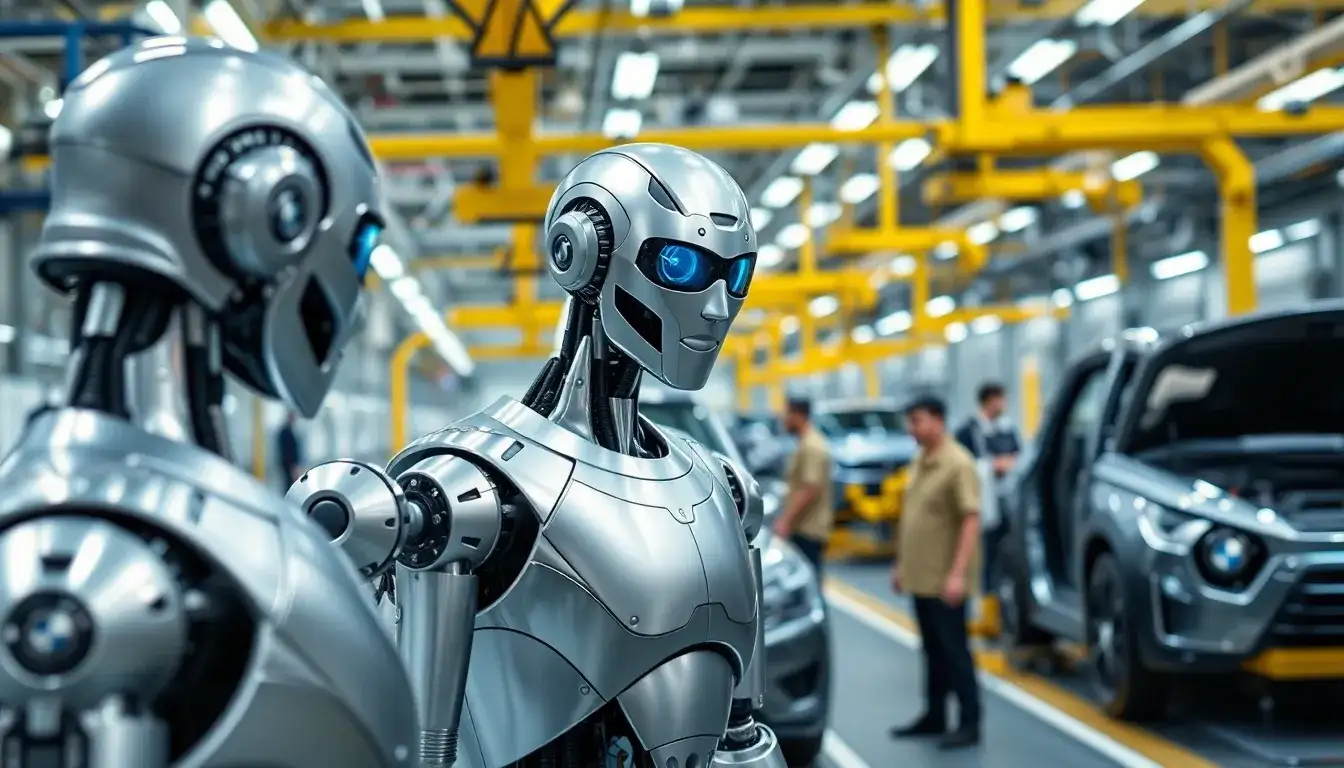
Great news for AI and robotics: Internationally renowned company, Hexagon, is leading the charge in embodied intelligence and brain-machine interfaces. On February 28, 2026, BMW announced that it will introduce humanoid robots at its Leipzig factory, marking the first time such technology will be implemented at a European production site.
These new humanoid robots will assist in assembly line operations and high-voltage battery manufacturing. Testing is scheduled for April, with a full launch expected in the summer. Milan Nedeljkovi, BMW’s production chief, stated that integrating humanoid robots into existing automotive manufacturing processes will “open up new possibilities for production.”
The upcoming robot, named AEON, is a physical robot platform developed by Swiss company Hexagon. It is designed to take on tasks that human workers would prefer to avoid. For instance, on the assembly line for electric vehicle batteries, workers often need to wear cumbersome protective gear while performing repetitive, precision-demanding tasks hundreds of times an hour. AEON is intended to alleviate these burdens.
BMW has made it clear that the goal of deploying humanoid robots is to complement existing automation technologies, reduce the physical strain on human employees, and improve working conditions. This indicates that the project’s primary focus is on handling high-intensity and high-risk tasks.
AEON stands at 1.65 meters tall, weighs 60 kilograms, and can move at a maximum speed of 2.4 m/s. It can autonomously change its battery to ensure continuous operation for up to four hours and has a strong load capacity, able to carry up to 15 kilograms while maintaining stability with a load of 8 kilograms.
One of AEON’s most practical features is its quickly interchangeable “hands.” With the ability to rapidly swap out different end-effectors and its wheeled dynamic mobility, AEON can navigate complex assembly lines effectively, a feat that fixed robotic arms cannot achieve.
Over in the United States, BMW’s Spartanburg factory has already demonstrated the capabilities of humanoid robots. The humanoid robot, Figure 02, operated continuously for ten months, participating in the production of over 30,000 BMW X3 vehicles. During this period, it accomplished 90,000 precise transfers of components, with over 1,250 hours of operational time.
Precision is key; BMW noted that these robots achieved millimeter-level accuracy in component installation. While this level of precision is merely the baseline for automotive manufacturing, it highlights the potential of humanoid robots.
Building on the success in the U.S., BMW is now bringing this technology back to its European headquarters, bolstered by the real-world data from its American operations. The introduction of humanoid robots is not merely about replacing human workers but rather enhancing the existing automation framework.
BMW envisions humanoid robots as a means to introduce flexibility into production processes. Unlike traditional automation systems, which are often fixed and specialized, humanoid robots can adapt to human-designed workstations and environments. This flexibility allows factories to adjust production lines without significant hardware modifications, greatly enhancing production responsiveness.
As such, frontline workers need not fear the influx of humanoid robots. BMW emphasizes that the ultimate goal is to optimize workforce distribution, reduce physical strain on employees, and continually improve working conditions. The future factory may see human workers freed from monotonous, dangerous tasks, allowing them to focus on strategy, monitoring processes, maintaining equipment, and enhancing creativity.
Michael Strbel, the head of BMW’s process management, revealed deeper considerations: “Our goal is to become a technology leader and integrate new technologies into production at an early stage. Pilot projects help us test and develop the application of physical artificial intelligence in real industrial conditions.”
Currently, many components and specific processes rely on external suppliers. If humanoid robots can handle these complex tasks, BMW can internalize more manufacturing processes, reducing costs and improving control over supply chains and product quality. In this context, humanoid robots are bridging the gap between “automation” and “intelligence.”
BMW’s actions are part of a broader global trend in the automotive industry, where an intense competition over humanoid robots is underway. Just days before BMW’s announcement, Toyota declared it would introduce humanoid robots at its Canadian factory.
Moreover, companies are positioning themselves strategically in this evolving landscape. Hyundai has acquired Boston Dynamics and showcased its Atlas robot’s potential for factory applications, planning to deploy it in the U.S. for component sorting by 2028. Tesla is aggressively pursuing this area with its Optimus robot, set to begin mass production by the end of 2026 and aiming to keep costs under $20,000 while producing over 1 million units annually.
In China, the competition is equally fierce. Xpeng Motors is establishing the industry’s first full-chain humanoid robot production base, aiming for mass production of its IRON robot by 2026. Chery’s Moke robot has already moved into traffic policing roles, while Li Auto is fully committed to humanoid robotics, and GAC has announced plans for small-scale production of its fourth-generation humanoid robot, GoMate Mini, starting in 2026.
In conclusion, while advancements in humanoid robotics are promising, it is clear that these technologies are still maturing. The AEON robot at BMW’s Leipzig factory may currently be performing repetitive tasks, but its existence symbolizes a significant leap toward the future of manufacturing. Pioneers like BMW are shaping the next generation of production tools in demanding industrial environments, highlighting the importance of mastering manufacturing solutions in the next decade.
The future of manufacturing may indeed be more efficient, safer, and more humane.
Original article by NenPower, If reposted, please credit the source: https://nenpower.com/blog/bmw-introduces-humanoid-robots-in-leipzig-plant-to-enhance-automation-and-worker-safety/

