

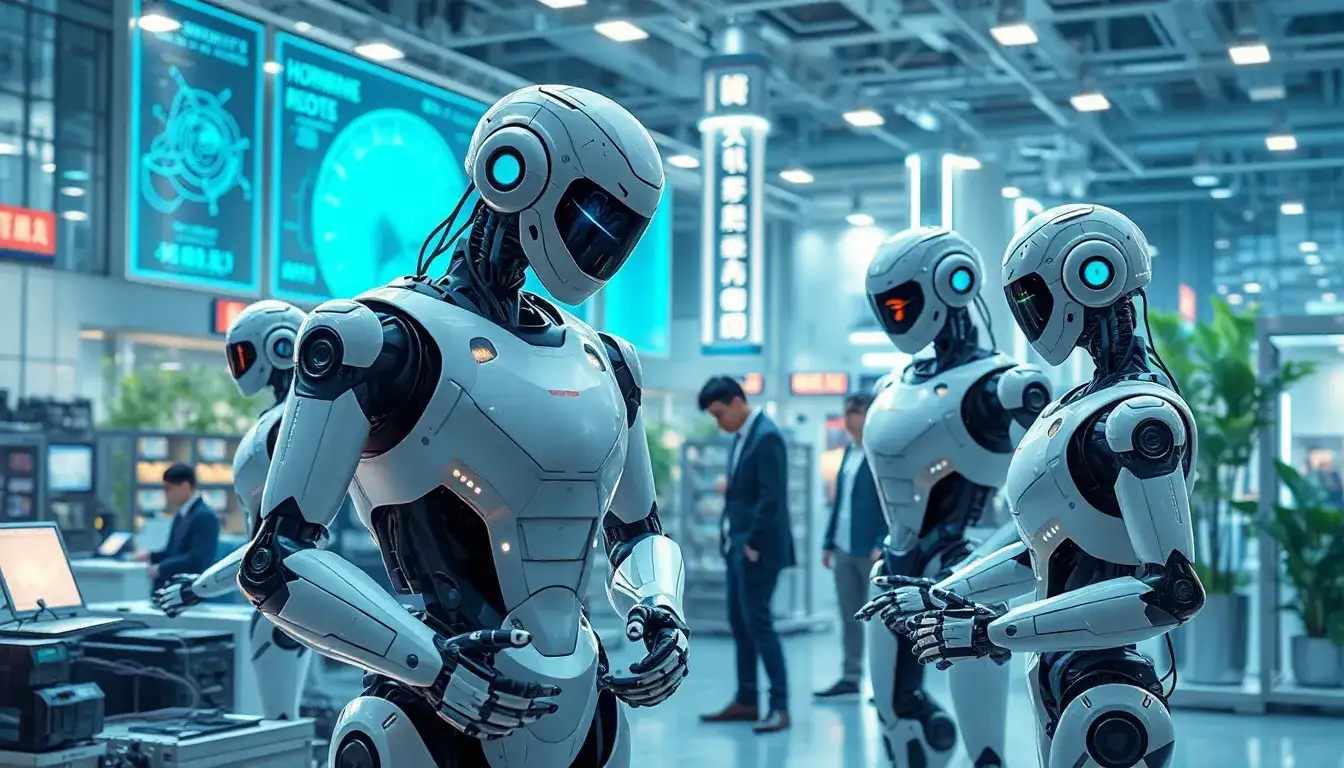
During the recently concluded Spring Festival holiday, robots showcased their remarkable capabilities, particularly those from Beijing’s “smart manufacturing” sector. Notably, at the CCTV Spring Festival Gala, Songyan Power presented an impressive array of products, including four precisely walking humanoid robots and a bionic humanoid robot, which collaborated seamlessly with artist Cai Ming to create a stunning visual feast that blended technology and art. Additionally, the Galaxy General’s embodied large model robot not only appeared in a dance performance but also participated in the New Year’s microfilm “The Night I Remember Most.” In a complex live broadcast environment, these robots utilized environmental perception and real-time interaction technology to naturally engage with actors like Shen Teng and Ma Li, responding precisely to the rhythm of the narrative and improvisational interactions, thus breaking away from traditional pre-set performance modes. The level of intelligence displayed was truly impressive.
Moreover, during the Spring Festival, robots made their way to Beijing’s unique temple fairs, creating an engaging “technological New Year” atmosphere. The 2026 Haidian New Spring Science and Technology Temple Fair featured 43 embodied robot exhibits, including 34 humanoid robots, along with numerous exciting interactive experiences in cutting-edge technologies such as AI large models, digital humans, VR, and AIGC. At the bustling 2026 Dadu New Spring Temple Fair held at the National Conference Center Phase II, the same robots from the Spring Festival Gala made a collective appearance, amplifying the sense of technological innovation. The lively traditional temple fair met with a talented robot ensemble, creating a fascinating blend of traditional customs and cutting-edge technology, providing a unique cultural feast for citizens over the seven-day event.
Since the beginning of 2026, Beijing’s robot industry has been receiving continuous good news. The company Accelerated Evolution reported signing over a thousand global orders for humanoid robots in 2025, with total sales exceeding one hundred million; the first embodied intelligent super factory in the Beijing-Tianjin-Hebei region has begun construction in Beijing; and the Beijing Humanoid Robot Innovation Center has launched a new generation of general-purpose robotic platform, Embodied Tiangong 3.0, with operational precision controlled to the millimeter level.
At the recent Beijing Two Sessions, robots once again emerged as a hot topic. The 2026 Beijing government work report emphasized that Beijing will promote key projects such as green advanced energy, new energy vehicles, robots, and commercial aerospace across the entire ecological chain. The recently released “Report on the Implementation of Beijing’s 2025 National Economic and Social Development Plan and the 2026 Plan” also mentioned that this year, Beijing will implement an accelerated development program for humanoid robots, establish a national training base for humanoid robots, and launch “robot + ” application scenarios.
Why does Beijing place such great importance on the development of its robot industry? Dr. Tao Yong, an associate professor and doctoral advisor at Beihang University, explained that from a macro perspective, the robot industry is a strategic emerging sector that encompasses high technology, high added value, and strong leadership. Especially humanoid robots, serving as a “comprehensive platform” for multidisciplinary integration and high-tech convergence, are becoming a technological focal point fiercely contested by major developed countries worldwide. They not only represent the forefront of technology but also signify the prospect of large-scale applications in industrial manufacturing and commercial services, marking one of the critical directions for future industrial development.
Moreover, focusing on Beijing itself, vigorously developing the robot industry is essential for its role as an “international technology innovation center.” Beijing possesses significant advantages in research and development, talent, and high-end platforms. By selecting the high-threshold, capital-intensive robot industry as a breakthrough point, it can efficiently utilize the city’s innovation resources while driving industrial chain collaboration and manufacturing capacity upgrades in neighboring regions like Tianjin and Hebei through the “R&D in Beijing” model, aligning well with the capital’s urban functional positioning.
Additionally, Beijing has unique advantages in developing its robot industry. Its technological and industrial innovation capabilities are nationally leading. The city is home to a cluster of top domestic universities and research institutions, including Tsinghua University, Peking University, Beihang University, Beijing Institute of Technology, Beijing University of Posts and Telecommunications, and the Institute of Automation at the Chinese Academy of Sciences, which house first-class industrial standards and service platforms. Various innovation entities are diversifying their technological routes, conducting research on prototype bodies, control systems, generalized control, reinforcement learning algorithms, main control systems, software and hardware development tools, and bionic facial technology, showcasing leading innovation capabilities and activity levels in the country.
According to Professor Fang Bin of Beijing University of Posts and Telecommunications, Beijing benefits from outstanding scenario advantages in its robot industry. As a massive international metropolis, Beijing possesses rich and complex application scenarios in areas such as smart cities, healthcare, intelligent manufacturing, and emergency safety, providing real testing environments and iterative feedback for robot technology that can accelerate its maturity.
Beijing has established the world’s first humanoid robot half-marathon and successfully hosted the inaugural World Humanoid Robot Games. The Humanoid Robot Innovation Center’s “Tiangong” and “Tianyi” have begun applying in industrial manufacturing, special operations, logistics sorting, and commercial guidance scenarios. The Galaxy General’s Gaibot robot has found applications in Meituan’s unmanned pharmacies and retail environments. Accelerated Evolution’s robots have become a platform product for robot football competitions, widely used in related events both domestically and internationally.
Fang Bin noted that Beijing’s efficient closed-loop of “technology research and development – scenario verification – industrial enhancement” is likely to create a “flywheel effect” that gradually positions Beijing as a leader in technology and ecology within the domestic and even international robot industry.
In recent years, Beijing’s robot industry has rapidly “evolved,” achieving advancements from “catching up” to “running alongside” and even “leading.” How can Beijing further enhance its global competitiveness in the robot industry?
Dr. Tao Yong believes that continuous technical breakthroughs are necessary to lead frontier technologies; encouraging research outcomes from universities and institutions to emerge from labs and supporting entrepreneurial initiatives from faculty and students is essential. Leveraging the policy advantages of national-level parks like Zhongguancun Science Park can transform research “momentum” into industrial “dynamics”; taking advantage of Beijing’s strengths in standard and policy formulation is crucial for exploring the establishment of standard systems and norms in the humanoid robot field; and proactive layouts in data security, privacy protection, and ethics are needed to achieve orderly, healthy, and sustainable development.
Fang Bin highlighted that Beijing plays multiple roles in the robot industry, such as being a “source of technological innovation, incubator for startups, and fertile ground for pilot tests.” In the future, Beijing must build and strengthen a collaborative ecosystem for industrial promotion involving government, industry, academia, research, application, and finance. This includes supporting the establishment of shared pilot bases and testing certification centers to reduce intermediate costs for companies transitioning from R&D to commercialization, encouraging the integration of design and R&D processes in Beijing with manufacturing resources from Tianjin and Hebei to build a regionally coordinated industrial chain, and developing long-term patient capital tailored to the robot industry while cultivating professional technical managers, productization guidance, and market integration services to accelerate the transition of technology to market.
Original article by NenPower, If reposted, please credit the source: https://nenpower.com/blog/beijings-robotics-industry-accelerates-evolution-through-technological-breakthroughs-and-ecosystem-development/

