Beijing Accelerates the Definition of Humanoid Robot Future
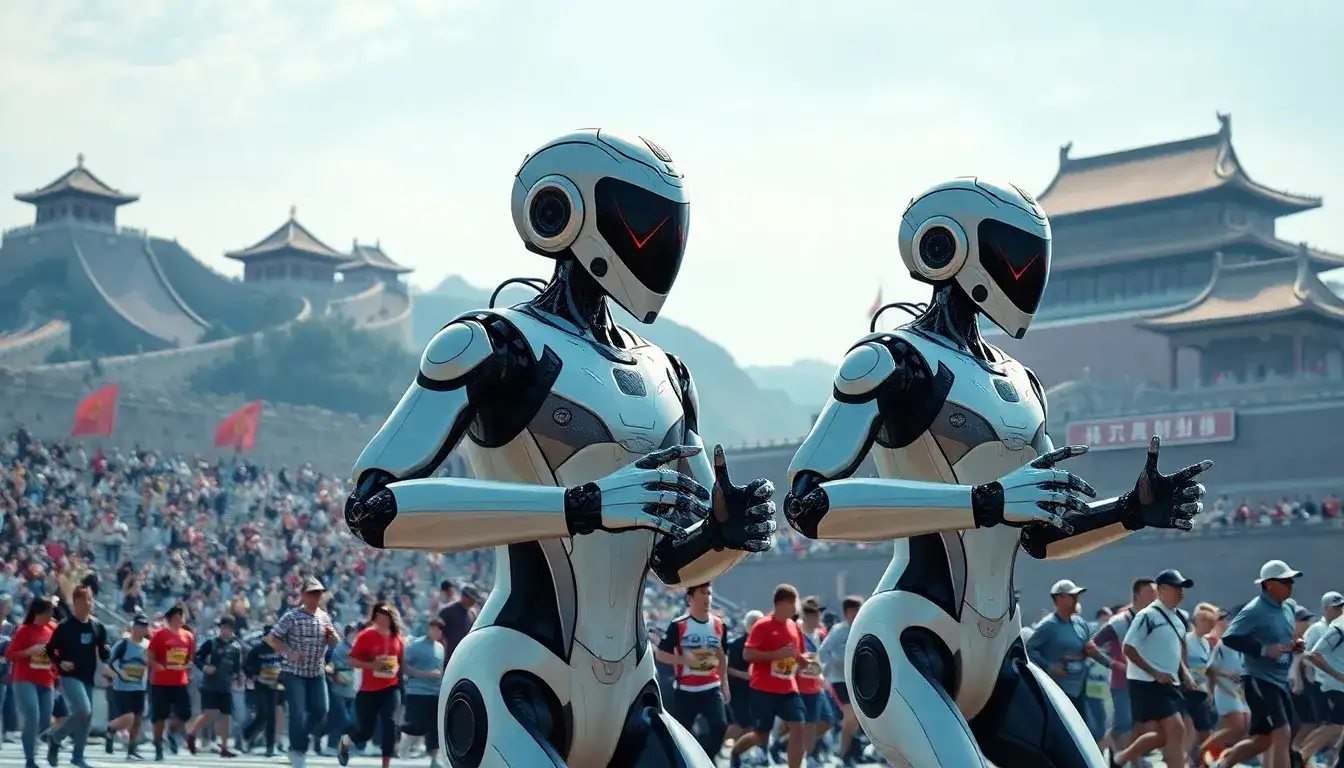
April 19, 2026 marks the date for the 2026 Beijing Humanoid Robot Half Marathon, which will kick off in Yizhuang. Humanoid robots are rapidly transitioning from laboratory settings to real-world applications. During a press conference held by the Beijing Municipal Government Information Office, it was announced that this year’s event has undergone a significant upgrade, featuring over 100 teams and more than 300 robots competing together, showcasing the latest advancements in Beijing’s humanoid robot industry from technological breakthroughs to practical implementations.
Event Upgrade: Over 100 Teams Competing
The second edition of the Humanoid Robot Half Marathon is co-hosted by the Beijing Municipal Government, China Central Television, China Electronics Society, and the World Robot Cooperation Organization. Since the registration opened on March 3, 76 organizations from 13 provinces, municipalities, and autonomous regions across the country have registered, with over 100 teams participating, including more than 80 corporate teams and over 20 teams from universities and training camps, representing 26 brands and over 300 humanoid robots.
Liu Weiliang, Deputy Director of the Beijing Economic and Information Technology Bureau, stated, “This year’s event has seen a comprehensive leap in scale, participation, and technological capabilities.” The number of participating teams has increased nearly fivefold, expanding from 5 provinces to 13 (including Hong Kong), with 20 universities involved, making it ten times larger than the first edition. Furthermore, 38% of participating teams are using autonomous navigation, marking a crucial technological advancement. A total of 26 robot brands will be showcased, covering the mainstream brands in the market.
According to Li Quan, Deputy Director of the Beijing Economic and Technological Development Zone Management Committee, this event will promote a deep integration of technological innovation and practical applications. All participating robots will be equipped with specialized shoulder badges that integrate Beidou positioning technology, enabling centimeter-level precise positioning and real-time trajectory feedback. For the first time, the event will introduce the “Robot Service Officer” feature, allowing robots to take on roles such as pacekeepers, performance officers, cleaning officers, and food officers, creating an immersive experience of human-robot coexistence.
Refined Competition Rules
The competition rules have been further refined. The event features two modes of participation: autonomous navigation and remote control. Both types will compete on the same track, with mixed timing and unified rankings. Teams utilizing autonomous navigation must complete the entire race independently, with human intervention allowed only under specific conditions confirmed by judges. Along the route, there will be seven supply stations and emergency response points to facilitate battery changes and robot swaps. For timing, remote-controlled teams will have their net time multiplied by a factor of 1.2 to encourage the development of autonomous navigation technology.
Industry Growth: Beijing Accounts for 40% of National Robot Financing
Over the past year, Beijing has leveraged its position as an international technology innovation center by being the first to host a humanoid robot “conference and competition.” With rapid advancements in large models and embodied intelligence technologies, the comprehensive capabilities of humanoid robots have significantly improved. Beijing continues to push forward with technical research, ecosystem building, and practical applications by launching supportive policies for initial trials of robots and key component development, as well as establishing a government investment fund with a total scale of 100 billion yuan. From January 2025 to the present, 23 humanoid robot manufacturers and component companies in Beijing have secured 19.24 billion yuan in financing, accounting for 41% of the national total.
Additionally, Beijing is fostering collaborative innovation among industry, academia, and research by supporting the construction of the Beijing Humanoid Robot Innovation Center, focusing on common technology research, embodied intelligence data, pilot testing, and public industrial services. The center has released core technological achievements such as the multimodal large model and the RoboMIND dataset. The city is also expanding application scenarios and attracting top international institutions for collaboration through platforms like the humanoid robot “conference and competition” and the robotics conference.
Currently, Beijing is on par with world-class companies in fields such as general robotics and embodied intelligence models, with slight advantages in robot running speed, structural strength, and the generalization ability of embodied intelligence models. In terms of innovation, robot companies have successfully achieved intricate movements, such as threading a needle and dynamically hitting a tennis ball. “From showcasing talent on stage to addressing real needs, humanoid robots are gradually becoming part of our daily production and life,” said Liu Weiliang.
Ecological Layout: Comprehensive Innovation Environment as Strong Support
“This year is crucial for accelerating the application of humanoid robots and achieving mass production,” stated Liu Weiliang. Beijing aims to focus on the construction of innovation platforms, expansion of application scenarios, and cultivation of the industrial ecosystem to create a vibrant and continuously evolving industrial environment.
Beijing will establish a national-level innovation platform, promote the upgrade and iteration of the Beijing Humanoid Robot Innovation Center, and build public research and development platforms such as embodied intelligence data training centers and pilot testing platforms to lower the barriers for companies in algorithm iteration and prototype validation. The plan includes two robot industrial parks, one in the south and one in the north, providing comprehensive spatial support from research and development to pilot testing and mass production.
Furthermore, the city will set up more “model rooms” in sectors like automotive manufacturing, biomedicine, and smart cities, offering risk compensation for innovative products through the “initial trial and first use” policy. It will promote the application of complete machines through financing leasing and strengthen the functions of robot 4S stores. Events such as the humanoid robot “conference and competition” and football leagues will position Beijing as a launchpad and testing ground for global innovative achievements.
In the industrial chain, under the framework of coordinated development between Beijing, Tianjin, and Hebei, there is a focus on nurturing “hidden champions” and “specialized, refined, unique” enterprises in core components and specialized chips. Leveraging industry funds, a comprehensive financial service ecosystem will be formed to support the entire cycle from funding assistance to public offerings and service empowerment.
“Beijing boasts the densest concentration of universities and research institutions, the most active venture capital, the richest market demand, and the most inclusive experimental environment,” Liu Weiliang remarked. “We welcome robot entrepreneurs and business leaders from both home and abroad to come to Beijing, jointly define the future of humanoid robots, turn science fiction into reality, and make innovation benefit the world.”
Original article by NenPower, If reposted, please credit the source: https://nenpower.com/blog/beijing-accelerates-the-future-of-humanoid-robotics-with-upcoming-marathon-event/