

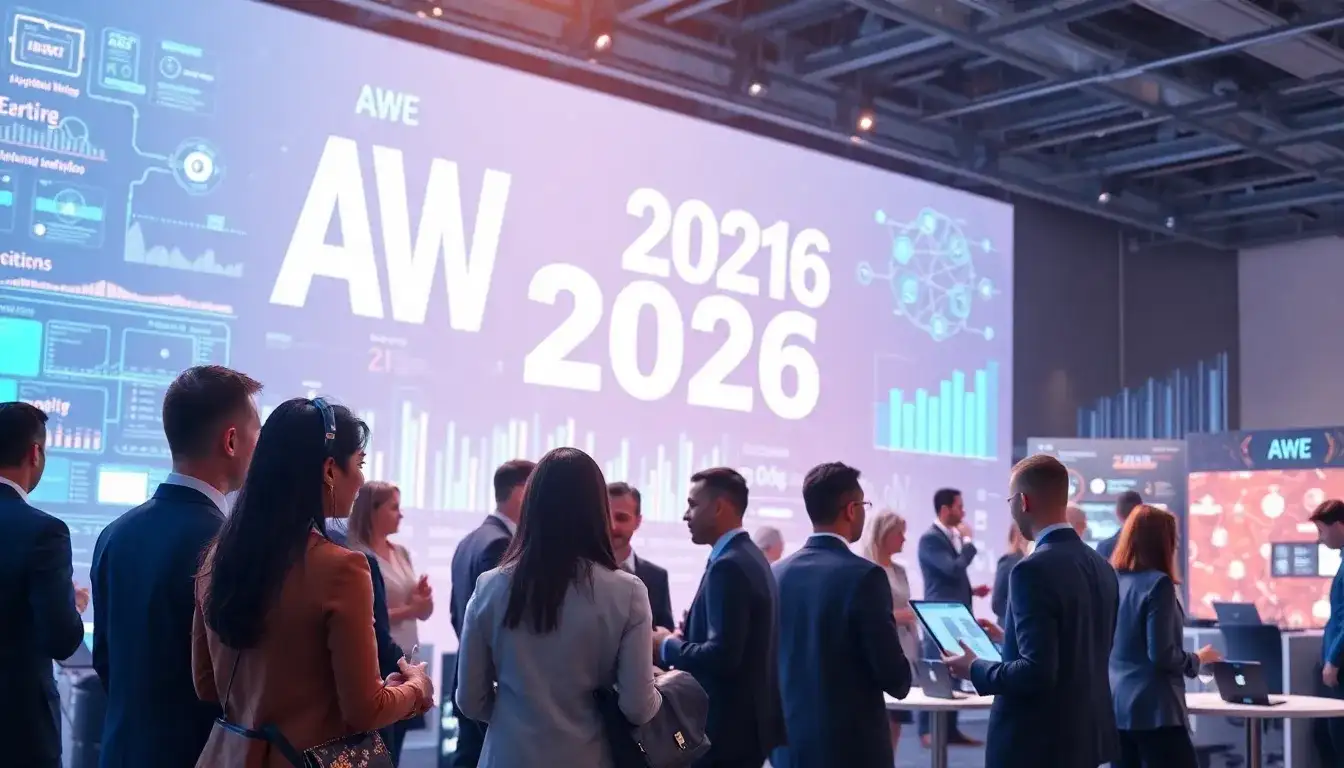
AWE 2026 Overview: Integration of AI Across Industries Reveals Four Emerging Trends
On March 12, 2026, the 2026 AWE China Home Appliances and Consumer Electronics Expo kicked off in Shanghai, marking a significant event in the domestic tech scene right after the 6G and flagship phone buzz at MWC 2026. This year’s AWE set a new record in scale, covering over 170,000 square meters and featuring thousands of exhibitors, including major players like Haier, Huawei, Hisense, TCL, Sony, LG, Bosch, Siemens, and BYD. The exhibition spanned 13 halls, showcasing a comprehensive range of sectors from home appliances and consumer electronics to robotics, AI chips, and smart mobility.
In a departure from previous years’ focus on individual product iterations, AWE 2026 introduced a “dual zone” model, connecting the Shanghai New International Expo Center with the Oriental Hub International Business Cooperation Zone. Centered around the theme of “AI Technology: Smart Future,” the expo transformed into a real-life testing ground for AI in everyday life, with over 1,200 companies represented.
While MWC highlighted the future of 6G and mobile devices, AWE 2026 sought to address a more relatable question: What transformative changes occur in the consumer electronics and home appliance industries when AI enters our homes, kitchens, living rooms, and transportation? We will analyze the industry insights hidden within this exhibition from three perspectives: new products, technical discussions, and industry trends.
Forum Highlights: Emphasizing Practicality over AI Showmanship
The AWE summit kicked off with a focus on practical applications of AI rather than grand visions. Ren Xuean, the Secretary of the Party Leadership Group at the Central Radio and Television Station, emphasized that the core of industry upgrades is deeply connected to the real-world implementation of AI and ecosystem transitions. He stated that AI innovation must align with mainstream demands, balancing technology and ecosystem considerations to ensure China’s consumer electronics sector maintains its global standing.
Addressing AI device forms, XREAL founder Xu Chi posited that AR glasses are the most natural terminal for AI. He predicted that the ultimate form of AI will be embodied agents, with hardware serving merely as the carrier. Xu acknowledged that the industry still faces significant challenges, such as hardware miniaturization and ecosystem unification. However, he expressed optimism that Chinese companies, leveraging supply chain advantages, could dominate the global AI glasses market, making AR the surprise standout of this AWE.
During the roundtable discussions, representatives from various companies shared practical insights. Baidu Group Vice President Li Ying stressed that “scenario + AI + hardware” is crucial for breakthrough innovations, warning against the pitfalls of pursuing intelligent features that do not address user pain points. She mentioned that Baidu aims to transition AI from a “passive responder” to an “active service” model through its OpenClaw framework. Anker Innovations China’s President Miao Wei pointed out that AI is reshaping product logic, with consumers transitioning from “buying products” to “buying capabilities,” marking a new direction in consumer behavior.
New Products on Display: AI Expands Across All Scenarios
The consensus reached at the forum was evident in the tangible products showcased at the exhibition. AWE 2026’s AI innovations went beyond simple functional upgrades, encompassing smart homes, consumer electronics, transportation, and embodied robotics. Highlights included AI shrimp farming, humanoid robot competitions, and high-end smartphone experiences. Platforms like JD and Tmall also created unconventional experiential setups, with each new product illustrating how “AI empowers life.” The core shift lies in the transition of AI in home environments from passive execution to proactive perception and autonomous decision-making.
Smart Homes: Transitioning from Remote Control to Proactive Thinking
Traditional appliances have officially entered the era of AI-enabled proactive perception. The new products from leading brands focus on practical applications of AI technology. Haier showcased significant advancements in smart home technology, highlighting the evolution from device intelligence to “spatial intelligence” and “system intelligence.” The industry has progressed through stages of network control, device interconnectivity, and scenario-based appliances; AI technology, exemplified by large models, is now a key driving force in transforming homes from a collection of devices to a cohesive “intelligent system.”
Haier’s core framework for a smart home can be summarized as “eyes, hands, and brain.” The AI Eye 2.0 acts as the “eye” of the system, greatly enhancing visual recognition capabilities, enabling appliances to accurately understand the physical world. For example, refrigerators can automatically identify and manage food freshness, while cooking appliances can monitor and adjust cooking states autonomously. Air conditioners can detect human presence for optimal airflow adjustments, marking a complete transition from “passive response” to “active participation.”
As for the system’s “hands,” Haier introduced three types of household robots designed to alleviate manual labor. These include the Haier home robot for managing food retrieval and meal preparation, a cleaning robot capable of 3D space organization and wet/dry cleaning, and a companion robot specifically designed for seniors, equipped with fall detection, medication reminders, and health companionship. Together, these solutions cover daily household chores and companionship needs.
Haier’s upgraded Intelligent Home Brain utilizes UhomeOS and specialized large models to understand user needs and plan task flows efficiently. By constructing a 3D digital twin of the home, user interactions become more intuitive, and the system can better coordinate various appliances based on spatial data for optimal functionality. Haier is continuously extending the boundaries of smart homes beyond individual households to encompass a broader lifestyle ecosystem, aiming to create a complete system connecting people, vehicles, homes, communities, and cities.
Gree showcased its AI cooling technology under the theme of “True AI Love,” featuring the AI Cool King air conditioning unit, which acts as an intelligent hub for seamless multi-device interactions and maintains functionality even when offline. The Star5 AI central air conditioner employs self-learning capabilities for optimized multi-room parameters and user habit predictions, demonstrating the transition of large model applications from single functions to comprehensive experiences. Other brands like LG, Siemens, and Boss Appliances also presented AI-enabled dishwashers and digital kitchen appliances, transforming how household tasks are approached, where appliances are now capable of anticipating needs rather than merely executing commands.
Consumer Electronics: AR Glasses Take Center Stage
AR glasses emerged as the star of AWE 2026, with the XREAL One Pro AR glasses utilizing a self-developed X1 chip to reduce latency to under 3ms and providing a 556-inch equivalent display at a 10-meter distance, effectively addressing motion sickness issues. In collaboration with Google, Project Aura aims to shift AI from “screen intelligence” to “spatial intelligence.” Additionally, the launch of the world’s smallest full-color MicroLED AR glasses signifies a move from concept to mass production.
The smartphone sector also unveiled exciting developments, with Pursuing Technology debuting the AURORA high-end smartphone, featuring a magnetic attachment lens system that rivals professional cameras. They announced a massive investment in R&D to enhance AI systems and imaging technology, challenging the monopoly of traditional smartphone manufacturers. Furthermore, AI-enabled pet gadgets, smart headphones, and panoramic cameras all showcased upgraded AI perception capabilities for enhanced user experiences.
Huawei’s terminal products covered a range of scenarios, including HarmonyOS for office use, health monitoring, smart home integration, and entertainment. The Harmony operating system enables seamless collaboration among devices like smartphones, car systems, and central control screens, allowing users to pre-set their home environment before arriving and check home security status via the Smart Life app. As of March 2026, over 47 million devices equipped with HarmonyOS version 5 or higher have been deployed, with more than 3,200 brands and over 400 product categories in the ecosystem.
Smart Mobility: Integrating Transportation and Home Life
The boundary between home appliances and mobility has been completely blurred, with the “people-vehicle-home” ecosystem becoming standard. Ninebot, the first exhibitor in the smart short-distance travel sector, unveiled a comprehensive lineup of smart mobility products, including the MAX G3 electric scooter, balance bikes, go-karts, and electric vehicles, demonstrating their technological achievements in algorithms, motor control, and smart interactions. This marks a transition of short-distance transportation products from mere tools to essential lifestyle components.
BYD showcased brands like Tengshi and Fangchengbao, presenting rapid charging technology, the “God’s Eye” driver assistance system, and comprehensive ecosystem services for vehicle-to-home and phone-to-vehicle connectivity. At the expo, BYD demonstrated remote control of smart home appliances through their car system, allowing users to pre-set their home environment for seamless transitions between travel and home life.
Tesla displayed the Cybertruck, renowned for its “five-star safety” rating, featuring a 48V low-voltage architecture and steer-by-wire technology, capable of withstanding impacts at 112 km/h. Tesla also showcased the upcoming third-generation humanoid robot, Tesla Bot, and the Model Y L, along with V4 supercharging stations, illustrating their comprehensive strategy from mobility to embodied intelligence.
Pursuing Technology’s “Starry Sky Plan” made a significant debut with the release of the Nebula NEXT 01X SUV concept and the Nebula NEXT 01 supercar, which boasts a total output power of 1,877 horsepower. This showcases their ambition to create a full-scene ecosystem that integrates “people, vehicles, homes, and the environment.” The automotive segment aims to establish intelligent driving and cockpit systems in collaboration with smart terminals, all categories of intelligent appliances, energy chips, and urban low-altitude economies, seamlessly connecting smart homes with intelligent mobility.
Embodied Robotics: Moving from Labs to Homes
AWE 2026 established an Innovation Technology Zone, featuring humanoid and home service robots. The boxing match between humanoid robots from Yushu Technology became a highlight of the event, while JD’s booth, featuring the “Robot Mecha Alliance,” attracted significant crowds. The field of embodied intelligence is reaching a turning point, with advancements in cleaning appliances as major players like Ecovacs, Tineco, Roborock, and Lek Electric showcased new technologies. Yushu Technology and Magic Atom demonstrated robots capable of high-precision motion control, with some products having achieved over one hundred million commercial deliveries.
Yushu Technology introduced the R1 JoyInside humanoid robot, capable of fluent voice interaction and designed for family companionship. The BaoBao robot from Jingzhi Technology can switch between humanoid and dog-like forms. The Zeroth Mini M1 companion robot focuses on elderly care with fall detection and AI-based medical inquiries. Additionally, the dual-wheeled sweeping robot from Roborock can navigate stairs and slopes, equipped with self-developed AI navigation algorithms and multimodal perception systems. This allows it to recognize various surfaces, obstacles, and spatial structures, addressing traditional robotic vacuum issues such as getting stuck or missing spots.
Magic Atom and Yushu Technology demonstrated humanoid robots that can comprehend natural language commands, such as “please take the cup from the table to the kitchen,” autonomously planning pathways and executing tasks. The AI cooking robot from Fotile integrates large models and visual recognition, enabling it to identify ingredients, recommend recipes, and adjust cooking conditions, making it accessible even for novice cooks. The TCL companion robot combines large model interaction capabilities, allowing for emotional recognition, multi-turn dialogue, and personalized memory, transforming robots from mere tools to family members.
Fundamental Breakthroughs and Trends: Chinese Manufacturing at the Forefront
Behind the bustling new products, there are significant breakthroughs in fundamental technologies within the industry chain. The Oriental Hub exhibition area showcased major upstream chip, display, and communication firms such as HiSilicon, LingSi Technology, Realtek Semiconductor, Unisoc, Quectel, and Tianma Microelectronics. They provided foundational technological support for the intelligent upgrade of home appliances, focusing on core technologies like edge AI, Wi-Fi 7, and seamless display interactions.
In terms of algorithms and large models, companies like SenseTime and MINIMAX showcased their proprietary large models, promoting deep integration between these models and terminal devices. Companies like Qingtian Information focused on IoT operating systems to create a foundational ecosystem for interconnectivity among smart devices. Brands like XREAL and Magic Atom have achieved over 65% self-developed rates for key components ranging from chips and algorithms to terminal manufacturing, highlighting the continuous enhancement of China’s consumer electronics industry’s self-sufficiency.
AWE 2026 unveiled four clear trends:
- AI Shifts from Concept to Necessity: Practicality is the only standard; the industry has completely abandoned pseudo-intelligence, with all technological innovations focused on user pain points. AI is becoming a standard feature of home appliances and consumer electronics rather than a premium selling point.
- Cross-Industry Integration is the Norm: Competition is shifting from individual products to ecological systems, with home appliances, smartphones, transportation, and robotics breaking down barriers; the “people-vehicle-home” ecosystem is becoming a core competitive advantage for companies.
- Embodied Intelligence is Entering a New Era: With technological maturity and decreasing costs, home service robots are set to rapidly become mainstream, representing a new growth point in consumer spending.
- Chinese Companies Leading Globally: From technology development to product implementation, Chinese brands dominated the spotlight at the expo, making AWE a key platform for Chinese technology to reach global markets, transitioning the industry from scale expansion to high-quality development.
AWE 2026 showcased the present reality of AI in our lives, demonstrating that AI is no longer just a concept for presentations but a practical capability assisting in tasks such as laundry, cooking, cleaning, and companionship. The tipping point for intelligence in the home appliance and consumer electronics sectors has arrived. For consumers, the dilemma of whether “intelligence is just a tax on IQ” is no longer a concern; for the industry, the era of parameter competition and configuration stacking has ended. The new race is now centered on scenarios, AI, and ecosystem integration.
Original article by NenPower, If reposted, please credit the source: https://nenpower.com/blog/awe-2026-insights-the-intersection-of-ai-and-industry-trends-unveiled/

