

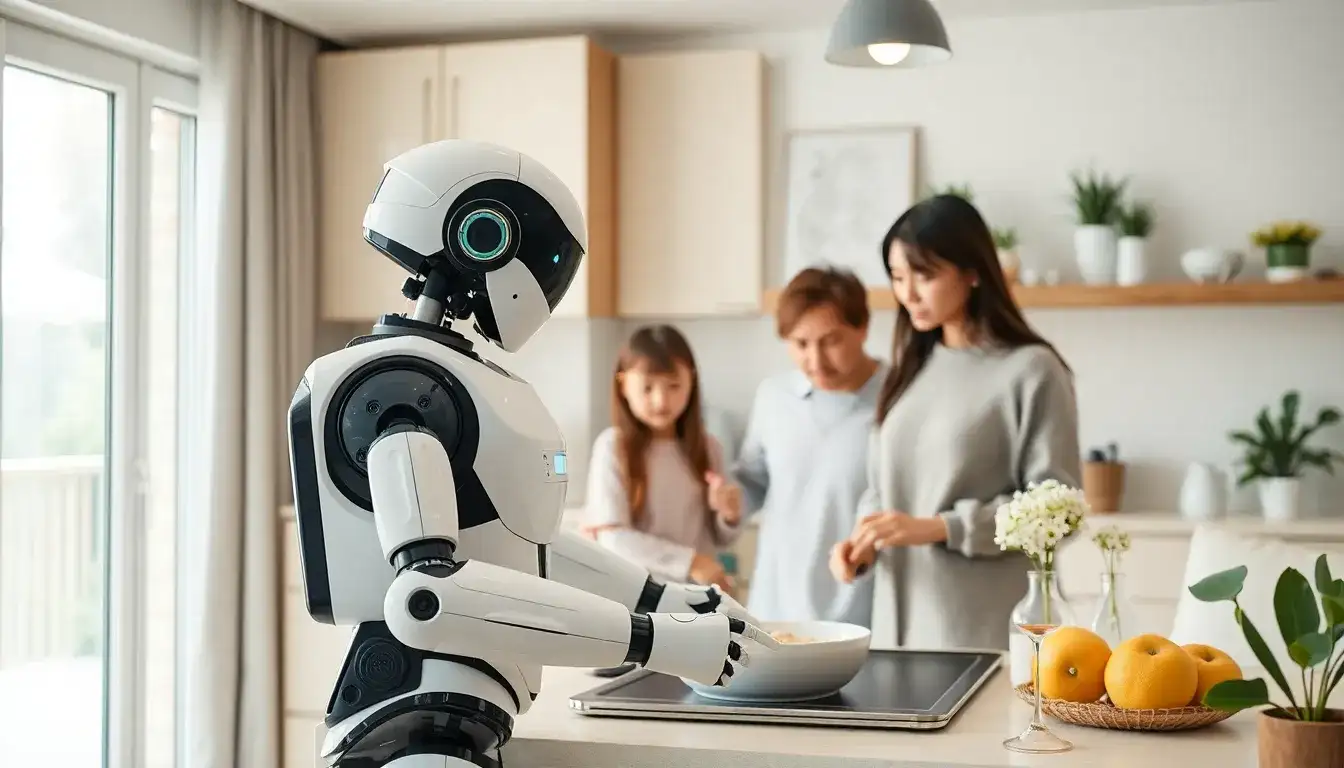
The 2026 AWE (China Household Appliances and Consumer Electronics Expo), which opened on March 12, 2026, has set a record for the largest number of robots showcased at the event. Reporters on-site noted an impressive array of household service robots, including those capable of cooking, organizing, and cleaning stairs. Embodied intelligence is expected to make its way into homes within the next three years, although it may not necessarily take the form of humanoid robots. The quicker development will be seen in equipping various home appliances with AI brains. Companies are increasingly integrating AI chips and computational power into air conditioners, televisions, kitchen appliances, and more. The rise of AI in everyday life is becoming increasingly tangible for the general public.
During this AWE, Haier introduced three types of household robots: a companion robot that can detect falls and remind users to take medication, a cleaning robot for tidying up and targeted cleaning, and a home robot that can open refrigerator doors and handle utensils and clothing. Hisense also launched a companion robot, while Ecovacs presented a butler robot, and Roborock showcased a stair-climbing vacuum cleaner. Notably, Ecovacs unveiled a non-humanoid household service robot equipped with wheels and mechanical arms, capable of picking up toys, clearing surfaces, and placing clothes into a washing machine. “We expect it to enter households within three years,” said Qian Dongqi, Chairman of Ecovacs. This robot integrates advanced technologies such as AI large models and intelligent agents, but its success in homes will depend on both the maturity of the technology and consumers’ willingness to invest in it.
Li Wei, President of Hisense Visual, also indicated that embodied intelligence is rapidly advancing into homes. The household service sector encompasses various aspects of daily life, and the household service robot industry is currently experiencing significant breakthroughs. Hisense’s newly launched intelligent companion robot has evolved from the “girlfriend machine” concept, offering services like companionship, outfit suggestions, health monitoring, and safety inspections, with plans to develop into a smart living assistant.
Masaharu Nakayama, Chief Strategy Officer of Panasonic Corporation and President of its Northeast Asia Business, shared insights with reporters, noting that while people often think of humanoid robots when discussing embodied intelligence, some robotic technologies have already been integrated into washing machines, even if consumers are not fully aware of it. AI and robotics are gradually becoming widespread in household appliances, but the full integration of humanoid robots into homes will take time. Besides technological capabilities, pricing is also a significant factor hindering the widespread adoption of embodied intelligence in households.
At the event, a retail platform showcased a range of humanoid robots, each with a QR code for scanning. Some attendees, upon discovering one humanoid robot priced at 69,999 yuan on the platform, expressed that they were merely “browsing.”
In contrast to the new “species” of service robots entering homes, the AI transformation of household appliances is a more attainable path for making AI accessible to everyday life. Over the past decade, smart appliances have evolved from smartphone control to smart speakers and voice control. More recently, the trend has shifted towards a distributed model, with air conditioners, televisions, and kitchen appliances equipped with AI brains, transforming them into the central hub of smart homes.
A representative from Gree Electric Appliances explained that the three main upgrade directions for household air conditioners in 2026 will be proactive intelligence, high energy efficiency, and comfortable airflow, all powered by AI. Gree’s air conditioners serve as the core hub, featuring an integrated home system that connects to a wide range of appliances, enabling data sharing, computational synergy, and cloud-edge collaboration to create a self-decision-making AI brain for dynamic energy savings.
The “AI + television” concept will also introduce several changes. Li Wei noted that AI image processing chips will enhance display quality, televisions will utilize AI large models for natural language interaction with users, and AI technology integration will gradually evolve televisions into companion robots or even the central hub of smart homes.
Another innovative approach is the combination of smart appliances and AI glasses. Boss Appliances showcased a cooking assistance scenario using AI glasses at this AWE. Once users download the relevant cooking app onto the glasses, they can connect with smart ovens and other kitchen appliances, making cooking more convenient with guided prompts from the AI glasses.
A representative from Vatti mentioned that instead of focusing solely on embodied intelligence, they are applying AI technology to enhance the kitchen experience. For instance, range hoods equipped with AI can predict smoke trajectories and clean themselves proactively. Martian is also considering small kitchen spaces, developing integrated kitchen appliances with AI technology that occupy no more than one square meter.
According to Zhao Zhiwei, Vice President of Ovi Cloud Network and General Manager of the Kitchen and Bathroom Division, the smart kitchen appliance sector still has a gap compared to ideal expectations and requires continuous upgrades.
During AWE, the China Household Electrical Appliances Association hosted a forum on the development of household service robots and established a special committee dedicated to this industry. Fifty robotics-related companies, including Haier, Hisense, Fourier, and Obit, became the first members of this committee. Research institutions such as Tsinghua University and Zhejiang University also participated in the forum. Attendees discussed strategies for nurturing the household service robot industry and promoting the integration of robots into appliances and appliances into robots. There was a consensus in the industry that the development of household robots must be accelerated, requiring collective efforts to break down barriers and build a cohesive ecosystem.
Original article by NenPower, If reposted, please credit the source: https://nenpower.com/blog/awe-2026-highlights-rise-of-household-robots-with-embodied-intelligence-expected-to-enter-homes-within-three-years/

