

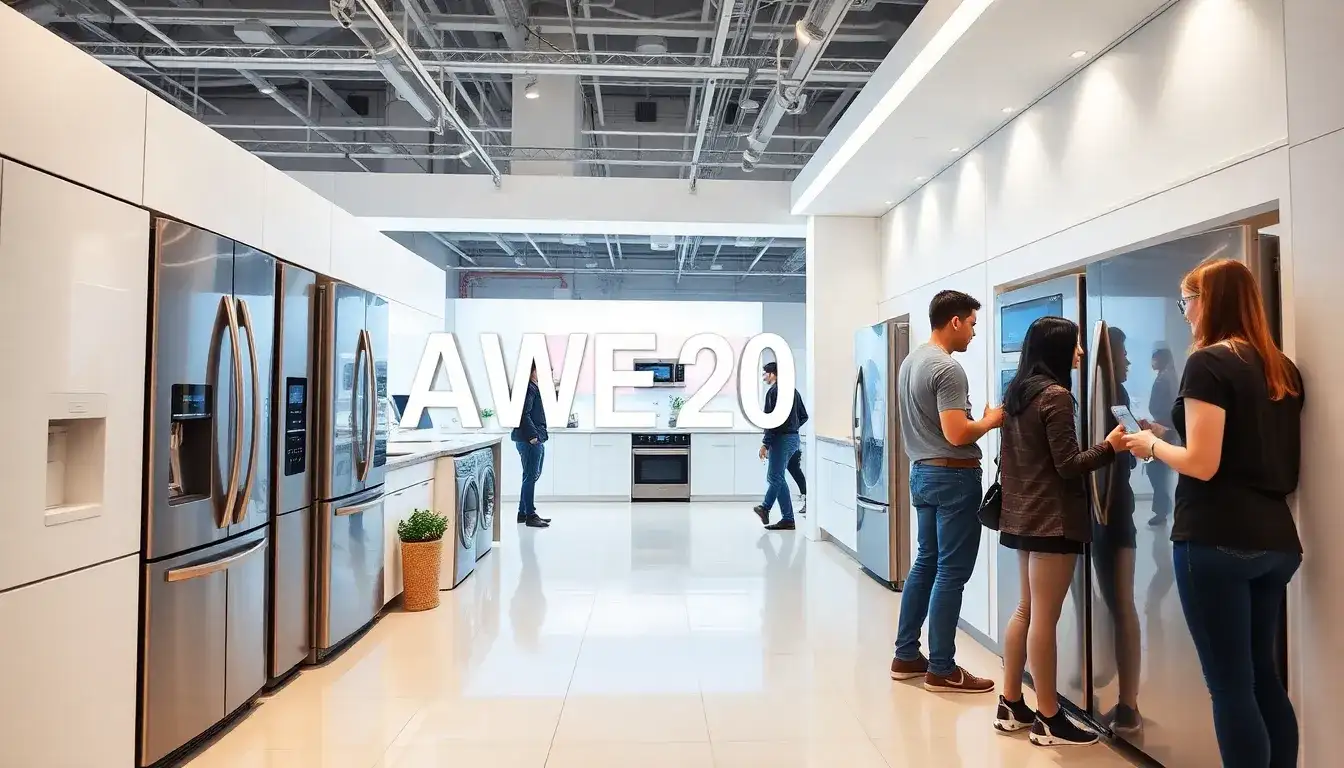
AWE 2026: Major Companies Invest in “Physical AI” and Integrate Large Models into Traditional Appliances
From March 12 to 15, 2026, the China Household Appliances and Consumer Electronics Expo (AWE 2026) took place in Shanghai. The main exhibition area at the Shanghai New International Expo Center spanned 13 halls and covered over 140,000 square meters, featuring more than 1,000 exhibitors from both domestic and international markets. A notable takeaway from the AWE 2026 was that “AI technology” has become a central theme throughout the event.
Major traditional companies such as Alibaba, TCL, and Ecovacs (603486.SH) are accelerating their investment in “Physical AI.” New technology startups like Trifo and Qiangbrain Technology showcased their strengths in emerging fields. More established appliance manufacturers, including Gree, Hisense, TCL, and Changhong, also displayed their AI capabilities. As AI begins to permeate various industries in 2026, the much-discussed “future” seems to have arrived.
“Physical AI” Takes Center Stage
At the start of 2026, the tech industry is focused on a specific direction: “Physical AI.” At this year’s AWE, manufacturers that were previously concentrated on televisions, vacuums, mobile phones, and e-commerce presented their latest innovations in the realm of “Physical AI.” Trifo took over an entire E7 hall to showcase a full range of products, including smart cars, smartphones, smart home appliances, space exploration tools, energy equipment, and universal chips. Their exhibition featured AI smartphones, a robot vacuum capable of climbing stairs, an all-in-one household management robot, a folding robot, computing cabinets, and storage chips, all echoing the theme of the “Physical AI” era.
Trifo’s founder and CEO, Yu Hao, emphasized the company’s commitment to research and development, maintaining an investment level three times higher than industry peers. Currently, Trifo employs around 20,000 R&D managers, with expectations to reach 50,000 by the end of this year to continue advancing core technologies.
In addition to Trifo, other exhibits at AWE also showed significant changes in their end-user applications. Tesla showcased its humanoid robot, Optimus. In the innovation technology zone, Qiangbrain Technology demonstrated a bionic dexterous hand capable of screwing in a light bulb, featuring 0.1mm operational precision and a grip strength of 5 kilograms. Aoshark Intelligent displayed an exoskeleton designed to reduce lifting burdens.
Notably, traditional appliance manufacturers also unveiled several embodied intelligent products. Ecovacs officially showcased its first AI bionic companion robot, “Mao Tuan Er,” designed to resemble a Maltese dog, priced at ¥3,999. According to staff at the Ecovacs booth, the robot collects real canine motion data, recognizes gestures using a high-definition wide-angle camera, and triggers feedback through touch sensors for actions like wagging its tail or rubbing against hands. Additionally, Ecovacs presented its management robot, “Ba Jie,” featuring an OpenClaw gripper that enhances storage capabilities from 2D to 3D space.
Roborock Technology introduced its wheeled and legged vacuum robot, G-Rover, designed for autonomous movement and cleaning in complex layouts like duplexes and villas. Haier Smart Home launched the “Haiwa” series of household service robots, which includes cleaning, companion, and chore robots, with the companion robot capable of reminding the elderly to take medication and monitoring falls.
Gree Electric (000651.SZ) exhibited its dual-arm intelligent flexible manipulation robot, which relies on a flexible force control six-axis design and supports millimeter-level dynamic pressure adjustments. The robot demonstrated its precision by writing the character for “horse.” A multimodal perception robot combined visual, force, and tactile senses to handle delicate items like tofu without damage, showcasing groundbreaking applications in precise gripping and flexible manipulation.
Kitchen appliance manufacturers are also extending their hardware designs to wearable devices and integrated robotic arms. At the exhibition, cookware company Aishida (002403.SZ) showcased a humanoid robot. The company, which has been invested in smart manufacturing since acquiring Zhejiang Qianjiang Robot in 2016, reported significant investment in this area. Aishida is actively promoting smart collaboration between robots and kitchen tools to create a comprehensive ecosystem that covers everything from ingredient processing and precise cooking to health management, making robots intelligent partners in the kitchen.
Boss Appliances (002508.SZ) unveiled AI cooking glasses equipped with a culinary model. Demonstrations showed that when users wear the glasses, they can recognize ingredients like pork belly and tenderloin, displaying reminders for seasoning or flipping on the AR interface while simultaneously controlling the range hood and stove settings. Fotile showcased the COOK system, which integrates heterogeneous robots and high-precision robotic arms, demonstrating an automated cooking process.
Original equipment manufacturers also revealed specific industrial operating data at the exhibition. Itstone Technology showcased its A1 robot performing flexible wiring assembly, achieving a Guinness World Record with 105 sub-millimeter-level wire assemblies completed in one hour. Ding Wenchao, Chief Scientist at Itstone, noted that high precision is essential for wiring assembly, which has long relied on manual labor. The company also presented two industrial robots: the humanoid MagicBot Gen1 and the quadruped MagicDog Y1.
Innovations in Wearable and Specialized Robots
This year saw a notable increase in new products in the fields of intelligent wearables and specialized robots. TCL’s Thunderbird Innovation collaborated with Amap to launch the Thunderbird Smart Life application, applying AR spatial computing technology to navigation and surrounding search scenarios. Alibaba’s Qianwen AI glasses opened for offline experiences at the exhibition, with some channels selling out within three hours after their launch on March 8.
Platform and channel partners are driving the deployment of robots through innovative business models. JD.com gathered over 60 robot models at its booth and launched the Smart Robot Industry Acceleration 2.0 plan, committing to support the JoyAI large model and provide standardized robot battery solutions. At the JD booth, Yushu Technology introduced a custom version of the R1 humanoid robot, while Mingshi Technology showcased the BaoBao robot, which can switch between humanoid and canine forms. JD.com reported that over 200 intelligent robot brands have joined its platform, aiming to help partners achieve a revenue target of 10 billion yuan by 2026.
Commercial leasing models also made their debut at AWE. The world’s first robot leasing service platform, Qingtian Rent, presented business deployment solutions for robots like Zhiyuan Lingxi X2 and Expedition A2. CEO Li Yiyan stated that the leasing model effectively lowers user barriers, transforming robots from mere exhibits into callable tools. Many shopping malls and cultural tourism clients inquired about incorporating robots into their offline customer engagement and reception services.
Advancements in Smart Appliances through Cutting-Edge Technology
Currently, the AI integration of household appliances is a significant market trend. With deep enhancements from AI algorithms and perception systems, various AI-powered household products are becoming increasingly “smart.” Gree Electric showcased a series of AI household appliances at the exhibition, including the AI “Wenxiang” multi-functional steam oven, which can actively sense the natural flavor of ingredients, the Ai “Calm King” air conditioner using dynamic energy-saving technology, and the Mingzhu refrigerator that accurately recognizes over 200 categories of food using AI visual sensing.
TCL exhibited numerous AI-integrated appliances under the theme “AI Technology for a Smarter Future.” This included the world’s first flagship TV, the TCL X11L, featuring next-generation SQD-Mini LED display technology, the TCL P7 Ultra AI health sleep air conditioner, and the TCL AI Super Tube Wash and Dry Machine P9 Ultra, among other smart terminal products and solutions. During an interview at AWE 2026, TCL’s China President, Lu Chunshui, highlighted that AI brings numerous development opportunities to Chinese appliance brands and manufacturing. He noted that previous smart appliances offered features for the sake of being “smart,” but modern smart appliances are now focused on genuinely addressing consumer pain points.
Lu Chunshui particularly noted the advancements in TV technology due to AI, stating, “The improvement in picture quality driven by AI is a significant leap. For example, TCL utilizes the Fuxi large model and its proprietary TSR AI picture quality chip to intelligently recognize content and viewing environments, providing real-time matching and calibration of optimal algorithms.”
Changhong showcased a new RGB Mini LED TV, AI human-sensing air conditioner, and an entire line of AI household appliances at AWE. Their RGB Mini LED TV, the Changhong Jinbiao T70S series, made its debut alongside the industry’s first RGB ambient light wall painting TV, the Chasing Light Q70S, which features emotional AI interaction and supports customized video booting and one-sentence screen mirroring.
According to Hisense Visual (600060.SH), the company has built a comprehensive AI capability system in the TV sector, covering audio and visual customization, multimodal natural interaction, generative AI desktops, and super intelligent media centers. This system transforms TVs from just “viewing devices” into the smart hub of a home.
AI-enhanced kitchen and bathroom products are increasingly addressing user pain points. Vatti (002035.SZ) presented a steam and bake integrated machine with “humidity control” and “AI cooking” technology, allowing novice cooks to replicate master-level dishes. Wanhe Electric (002543.SZ) showcased products that respond to market demands in dimensions such as AI-controlled heating and interaction, featuring super-sensitive core temperature control for consistent water temperature during bathing and a voice-activated design to accommodate elderly users.
UGREEN Technology (301606.SZ) showcased innovations in smart storage and security fast charging, unveiling the AI NAS application ecosystem and announcing its AI security ecosystem. The director of UGREEN’s AI Smart Lab, Zhou Kaijie, explained that the goal of AI NAS is to enhance the intelligence and convenience of its usage, extending from digital asset protection to physical space security.
In the smart home sector, Mousse Co., Ltd. (001323.SZ) introduced its Hongmeng Smart Select Mousse Smart Bed Pro H-Design, featuring a star flash technology digital base that achieves millisecond response times, maintaining stable connections to smartphones within 35 meters even without a network, ensuring stability and precision in controlling the entire home.
Original article by NenPower, If reposted, please credit the source: https://nenpower.com/blog/awe-2026-highlights-major-brands-invest-in-physical-ai-and-integrate-large-models-into-traditional-appliances/

