

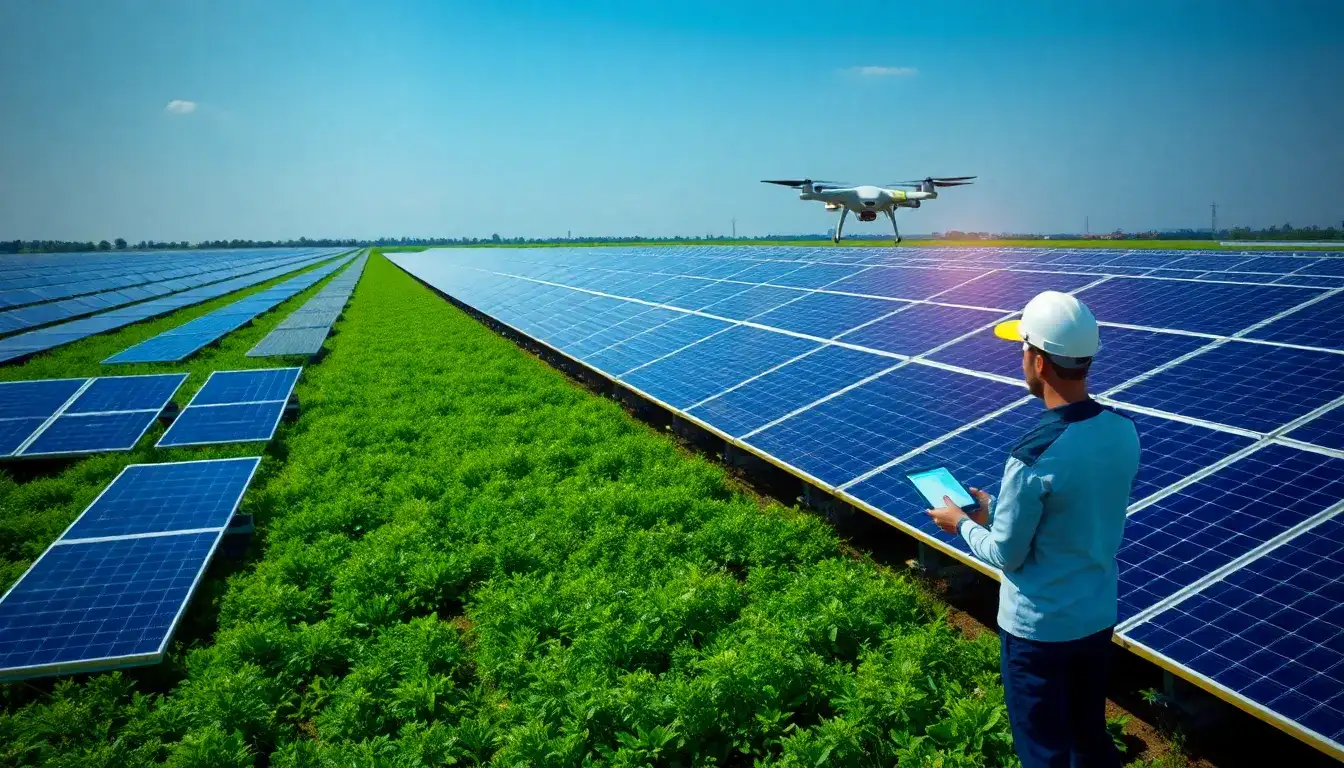
Unmanned Operation and Maintenance of Photovoltaic Power Stations: How Does Shushang Cloud’s AI Agent Achieve Automatic Fault Diagnosis and Intelligent Work Order Dispatch?
As photovoltaic power stations continue to expand and operational maintenance costs rise, unmanned operation and maintenance (O&M) has emerged as a core focus for industry transformation and upgrades. Shushang Cloud’s AI agent integrates multi-source data perception, knowledge-driven diagnostic algorithms, and intelligent work order scheduling technology to establish a closed-loop O&M system covering the entire process from fault detection to root cause analysis and execution of remedies. This innovative approach provides solutions for reducing costs and improving efficiency while ensuring safe operations in photovoltaic power stations.
1. Comprehensive Data Perception: Building a Digital Twin Foundation
The unmanned O&M of photovoltaic power stations relies heavily on the real-time and precise perception of equipment status and environmental parameters. Shushang Cloud’s AI agent deploys a network of over a million sensors, integrating voltage and current sensors, infrared thermal imaging cameras, and environmental monitoring devices, to achieve comprehensive data collection from core equipment such as photovoltaic modules, inverters, and combiner boxes. For instance, in a 100MW photovoltaic power station, the system can collect over 200,000 pieces of operational data per second, covering more than 300 dimensions including current, voltage, temperature, and light intensity—an efficiency improvement of over 10 times compared to manual methods.
To address the traditional issue of data silos in O&M, Shushang Cloud employs an edge computing and cloud collaboration architecture. Edge nodes are deployed on-site to perform initial cleaning and aggregation of raw data, only uploading critical feature data to the cloud to minimize bandwidth usage. The cloud-based big data platform utilizes time series databases (TSDB) and graph databases (Neo4j) to model device relationships, constructing a digital twin of the power station. For example, the system can map the physical locations of photovoltaic modules, their electrical connections, and historical fault records in real-time, providing contextual support for subsequent diagnostics.
2. Knowledge + Data Dual-Drive: Achieving Over 90% Fault Diagnosis Accuracy
Photovoltaic power station faults are complex and varied, including issues like module micro-cracks, PID effects, and inverter overloads. Traditional rule-based expert systems struggle to cover all scenarios. Shushang Cloud’s AI agent innovatively employs a dual-engine architecture of knowledge graphs and deep learning for more precise and intelligent fault diagnosis.
- Knowledge Graph Construction: Drawing on over 20 years of operational experience in the photovoltaic industry, the system includes a knowledge base with over 1,000 fault types and 5,000 diagnostic rules. For example, for micro-crack issues, the knowledge graph links multi-dimensional data including “EL test image features,” “power generation degradation rates,” and “environmental temperature changes” to form an interpretable diagnostic logic chain.
- Deep Learning Model: By incorporating LSTM time series networks and Transformer attention mechanisms, the system can automatically learn the spatiotemporal characteristics of equipment operational data. In inverter fault diagnosis, for instance, the model analyzes patterns in historical data such as current harmonics and temperature fluctuations, predicting equipment faults 72 hours in advance with an accuracy rate of 92%.
- Multi-modal Fusion Diagnosis: For complex faults, the system integrates multi-source data including infrared thermal images, EL test images, and equipment logs using cross-modal alignment technology to achieve information complementarity. For instance, a power station identified localized overheating of a module via infrared imaging, combined with power generation data and knowledge graph reasoning, ultimately pinpointing the issue to a failed bypass diode, reducing diagnostic time from 4 hours to 15 minutes.
3. Intelligent Work Order Dispatch: Increasing O&M Efficiency by Over 5 Times
Building on fault diagnosis, Shushang Cloud’s AI agent utilizes dynamic prioritization algorithms and resource scheduling models to automate the generation and intelligent dispatch of O&M work orders, completely transforming the traditional inefficient model of “manual work order assignment and on-site handling.”
- Automated Work Order Generation: The system automatically generates structured work orders based on fault types, impact scope, and urgency. For instance, for component-level faults affecting power generation, work orders are marked as “P0 level” (highest priority) and include key information such as fault location and historical maintenance records; whereas non-critical alerts (like environmental sensor anomalies) are labeled as “P3 level” and queued for batch processing.
- Intelligent Dispatch Engine: Utilizing data on maintenance personnel skills, real-time locations, and historical work order handling efficiencies, the system employs reinforcement learning algorithms to dynamically optimize dispatch strategies. For example, in a 500MW power station, the system analyzed over 100,000 historical work order data to construct profiles of maintenance personnel capabilities, achieving precise matching of work orders to skills, reducing response time from 2 hours to 20 minutes.
- Human-Machine Collaborative Handling: For complex faults, the system supports a hybrid O&M model of “AI-assisted decision-making, remote guidance, and robotic execution.” For example, in a power station located in a high-altitude area, a drone detected dust accumulation on modules, prompting the system to generate a cleaning work order dispatched to a cleaning robot. If an electrical connection fault is involved, the system projects operational steps to personnel on-site using AR glasses while providing real-time feedback on equipment status, ensuring safe handling.
4. Practical Results: A Cost-Reduction and Efficiency-Enhancement Case from a Large Photovoltaic Power Station
After implementing Shushang Cloud’s AI agent, a 200MW photovoltaic power station achieved comprehensive upgrades in its O&M model:
- Cost Reduction: Annual O&M costs decreased by 38%, with labor costs reduced by 65% (from 12 personnel to 4), and spare parts inventory lowered by 40%.
- Efficiency Improvement: Average fault detection time (MTTD) reduced from 2 hours to 8 minutes, while average repair time (MTTR) decreased from 4 hours to 35 minutes.
- Power Generation Gain: Preventive maintenance minimized unplanned downtime, resulting in an annual power generation increase of 6.2%, equivalent to an additional installed capacity of 12.4MW.
- Safety Enhancement: The frequency of high-risk operations dropped by 90%, with no incidents of electric shock or falls from heights reported.
5. Future Outlook: From “Unmanned” to “Autonomous O&M”
With the deepening application of AI large models and digital twin technology, the O&M of photovoltaic power stations is advancing towards a higher level of autonomy. Shushang Cloud plans to launch the Autonomous O&M 2.0 solution in 2026, focusing on breakthroughs in the following areas:
- Predictive Health Management: Implementing remaining useful life (RUL) prediction models for dynamic optimization of spare parts inventory.
- Adaptive Power Generation Optimization: Automatically adjusting module tilt angles and inverter parameters based on weather forecasts and grid demand to enhance power generation efficiency.
- Blockchain O&M Audit: Utilizing the immutable characteristics of blockchain to record all O&M operations and changes in equipment status, ensuring compliance with regulatory requirements.
Driven by the dual goals of carbon neutrality and the digital transformation of energy, Shushang Cloud’s AI agent is redefining the paradigm of photovoltaic power station O&M through technological innovation, injecting new momentum for high-quality industry development.
Original article by NenPower, If reposted, please credit the source: https://nenpower.com/blog/automated-operations-in-photovoltaic-power-plants-how-ai-enhances-fault-diagnosis-and-work-order-management/

