

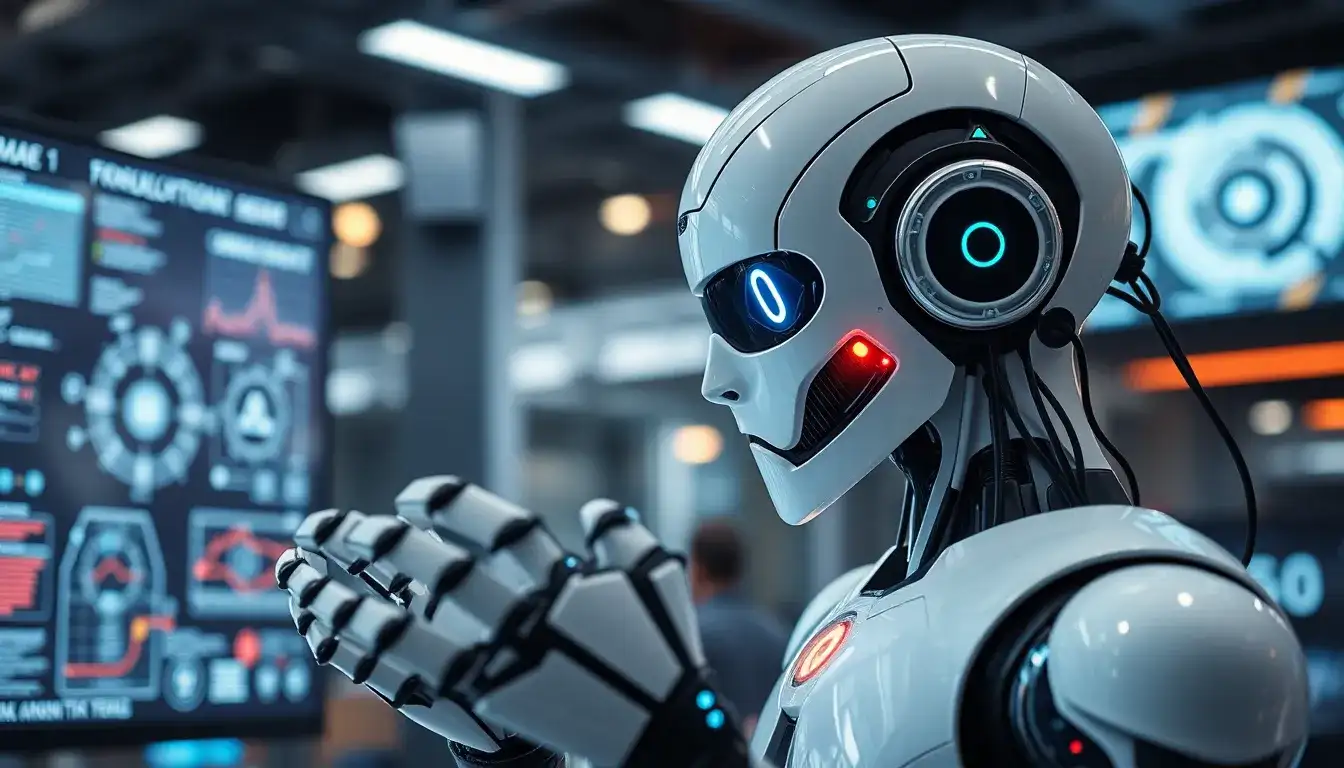
The ASC26 competition is focused on embodied intelligence, and it has identified “second-level thinking” in robots as the next major challenge. This was shared by experts from ASC26 during an interview with a reporter from the Financial Associated Press on February 1, 2026.
The 2026 ASC World University Supercomputing Competition (ASC26) recently kicked off in Beijing, attracting over 300 university teams from various countries and regions including China, the United States, Germany, Singapore, and Colombia. Notably, this year’s competition features multiple challenges, one of which specifically targets the rapidly evolving and challenging field of artificial intelligence—embodied intelligence.
Participants are tasked with optimizing the reasoning performance of a “world model.” The key objective is to enable robots to perform high-speed “mental rehearsals” similar to human thinking before executing physical actions. The efficiency of computational power is a significant hurdle that must be overcome. Embodied intelligence is seen as a critical pathway toward general artificial intelligence in the physical world. Unlike large language models that process compressed text information, embodied intelligence must perceive, understand, and predict high-dimensional continuous physical environments in real time, resulting in an exponential increase in computational demands.
Experts from the ASC26 competition emphasized that the current focus in the industry is not on cost, but rather on usability. Although humanoid robots are expected to see a breakthrough in 2025 with the introduction of products like Tesla’s Optimus Gen-2 and Figure 02, commercialization remains limited due to insufficient “brain” capabilities. Currently, robots primarily rely on preset motion libraries or remote control and lack autonomous task planning skills. The embodied world model is essential for addressing this issue, as it allows robots to simulate the consequences of actions in their “minds,” creating a decision-making feedback loop. However, this technology is still in the experimental phase.
While no organization has provided a unified market size definition for “embodied intelligence hardware,” various sources indicate that this sector is rapidly gaining momentum. IDC has predicted that the global robotics market will exceed $400 billion by 2029, and industry data shows that funding in the global embodied intelligence and humanoid robot sectors surpassed $4 billion in 2025. It is noteworthy that investments are heavily skewed towards hardware development. For example, Figure secured over $1 billion in funding, and several domestic manufacturers have received significant orders, reflecting investors’ strong preference for “deliverable products.” In contrast, software layers like underlying algorithms and world models remain primarily driven by strategic investments from large companies, with commercial pathways still under exploration.
The current competition challenges participants to generate action rehearsal videos for robots. Experts explain that producing a 10-second rehearsal currently takes about 10 minutes, which is 2-3 orders of magnitude longer than the seconds required for actual robot decision-making. To effectively implement this technology in robots, computational efficiency needs to increase by a factor of 100 to 1,000. This directly addresses a key bottleneck in the humanoid robotics industry as it transitions from demonstration to practical application.
In the past year, robots have made significant advancements in motion control (the “small brain”) through activities like running and dancing. However, their cognitive and decision-making abilities (the “big brain”) required for complex tasks still represent a substantial shortfall. This stems from the immense computational power required to process high-dimensional, continuous physical world information, which far exceeds that needed for text processing by large language models.
A technology investor highlighted that “the enhancement of computational efficiency directly defines the timeline for commercial viability.” If thinking takes ten minutes, the technology will remain confined to showrooms. The key to unlocking the home and service markets lies in compressing thinking time to seconds.
The investment landscape reflects this urgency. In the secondary market, while the robotics sector garners attention, funding is notably concentrated on companies that possess core components or have made clear breakthroughs in specific scenarios or motion control. Investors in the primary market are more cautious, directly questioning the core issues: “Is your algorithm efficiency industry-leading? What is the cost of training per instance?” The consensus within the industry is that breakthroughs in efficiency bottlenecks will be a critical metric for valuation.
The competition serves as a means to cultivate problem-solvers for the industry. In light of industrial bottlenecks, it is increasingly important to identify and nurture versatile talent capable of addressing complex system challenges through competitions. According to expert insights, the “brain revolution” of embodied intelligence is a comprehensive test that spans algorithms, chips, and computing architectures. These skills will be invaluable to students as they graduate.
ASC’s goal in presenting this challenge to top students worldwide is to prepare them for this “long-term battle” by nurturing the essential “problem-solving” talent. This talent reservoir is urgently needed. Liu Yu, a member of the ASC26 organizing committee, shared that approximately 34% of participating students pursue further studies, while 19% enter the workforce in key roles such as AI research and development.
“We are cultivating interdisciplinary talent that integrates software and hardware, possessing system-level optimization capabilities, which are critical resources for the industry,” said Cao Guangxi, vice president of the hosting university, Wuxi Institute of Technology. The institution is exploring the establishment of a micro-specialization in “supercomputing” to deepen the integration of education and industry in response to market needs.
However, the journey from the competition arena to actual production remains challenging. The most significant constraint is still the “cost and efficiency” dilemma. Low computational efficiency leads to slow R&D iterations and high single-unit costs, making large-scale commercial application elusive. Even with excellent algorithms, if real-time operation cannot be achieved within reasonable power consumption and cost, productization remains difficult.
Moreover, the collaborative nature of the innovation ecosystem is crucial. The maturity of embodied intelligence requires a deep integration of algorithms, precision hardware, sensors, and specific scenario data. The ASC26 competition has innovated its “Super Team” format, emphasizing cooperation within competition, which simulates complex industrial collaboration. Liu Yu revealed that this year’s finals will also reform the defense format, enhancing students’ international communication and expression skills, as these are essential to real research and industry practices.
Original article by NenPower, If reposted, please credit the source: https://nenpower.com/blog/asc26-competition-targets-embodied-intelligence-robot-thinking-in-seconds-as-the-next-breakthrough-challenge/

