

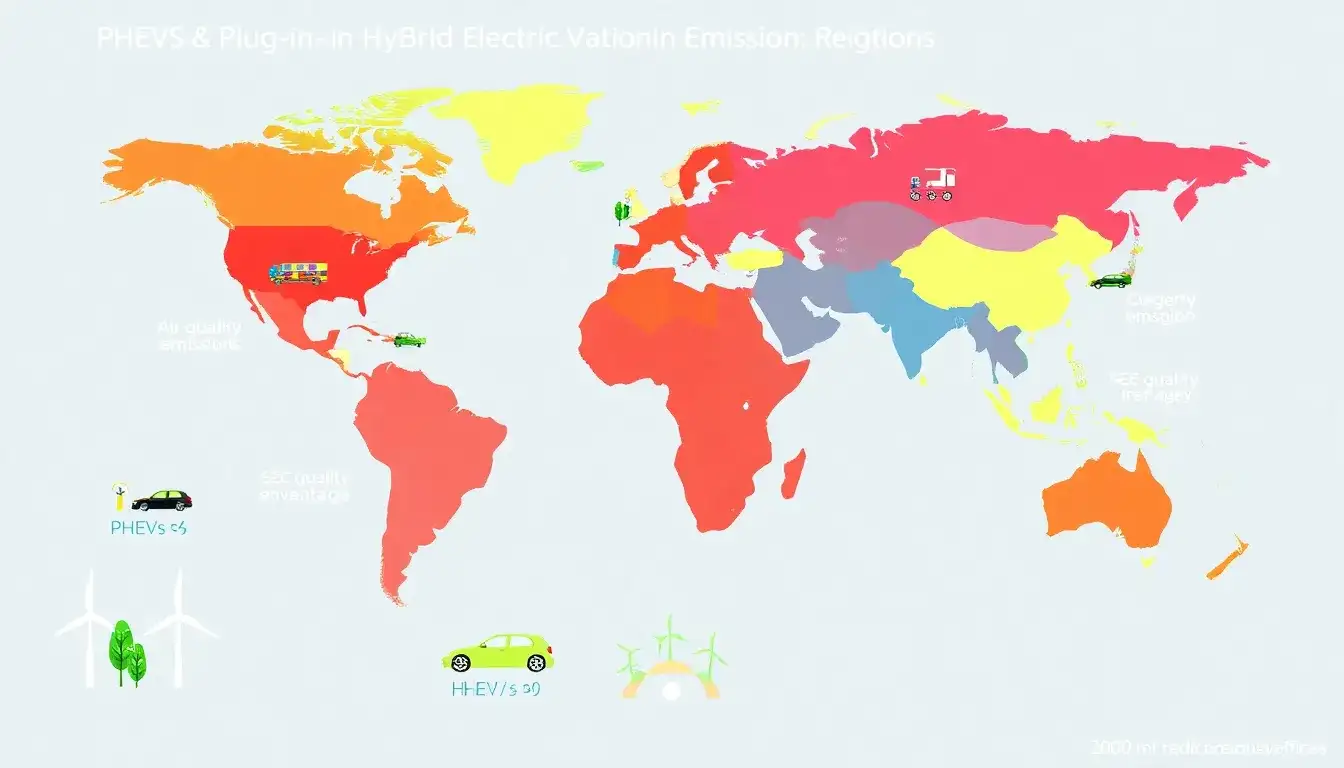
The emissions advantages of Plug-in Hybrid Electric Vehicles (PHEVs) and Hybrid Electric Vehicles (HEVs)
can vary significantly by region due to differences in grid emissions intensity and usage patterns. Here’s a breakdown of their advantages in specific regions:
Plug-in Hybrid Electric Vehicles (PHEVs)
- Emissions Advantage: PHEVs generally have a significant emissions advantage over conventional vehicles and can even surpass Battery Electric Vehicles (BEVs) in regions where the grid is not highly renewable. This is because they use less electricity during operation and have a lower battery size, reducing overall lifecycle emissions, including embodied carbon from battery production.
- Grid Emissions Spectrum: PHEVs perform well across various grid emissions spectra, offering better emissions benefits compared to BEVs in most scenarios, especially when the grid is still transitioning to cleaner energy.
- Regional Variation: While PHEVs are advantageous in many regions, their benefits can be more pronounced in areas where the grid is less renewable or carbon-intensive, as their hybrid mode reduces dependence on electricity from these grids.
Hybrid Electric Vehicles (HEVs)
- Emissions Reduction: HEVs consistently offer emissions reductions compared to conventional Internal Combustion Engine Vehicles (ICEVs), though they may not match the efficiency of PHEVs in regions with cleaner grids.
- Usage Patterns: The emissions advantage of HEVs is more consistent across regions since they do not rely on grid electricity. However, they generally do not electrify as much of the driving as PHEVs, resulting in higher emissions in comparison.
Regional Differences
- Upper Midwest and Southwest: These regions have a more carbon-intensive grid mix compared to the Pacific Coast, which means that BEVs and PHEVs would have higher emissions in these areas due to the grid source. PHEVs may offer a better emissions profile here due to their hybrid capability.
- Pacific Coast: Here, the cleaner grid mix means that both BEVs and PHEVs can achieve lower emissions, but PHEVs might still have an advantage due to lower embodied carbon in the production phase.
In summary, while both PHEVs and HEVs offer emissions advantages, PHEVs are particularly beneficial in regions with less renewable energy grids due to their hybrid capability and reduced battery size. HEVs offer consistent reductions but might be less effective than PHEVs in areas with cleaner energy sources.
Original article by NenPower, If reposted, please credit the source: https://nenpower.com/blog/are-there-specific-regions-where-phevs-or-hevs-have-a-significant-emissions-advantage/

