

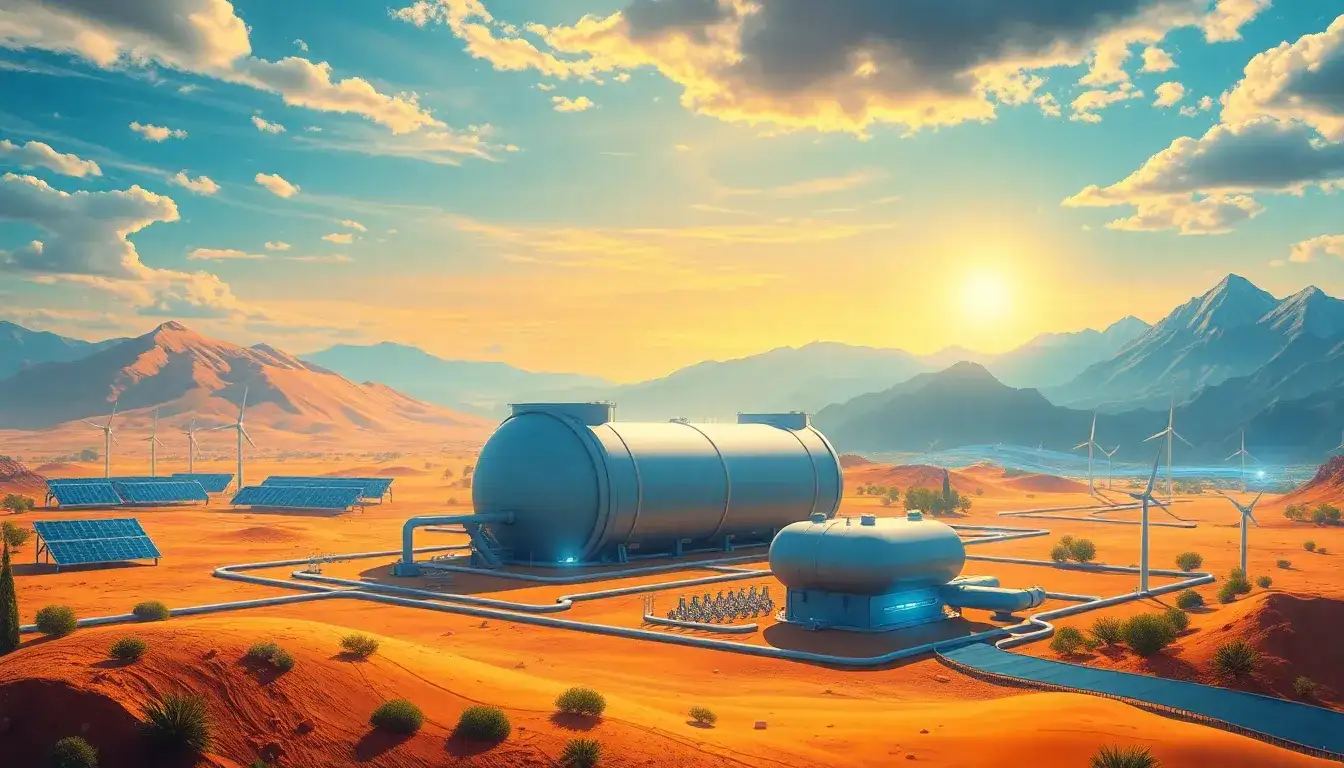
Compressed Air Energy Storage (CAES) efficiency can be influenced by the region and climate, mainly due to geological suitability for underground air storage and ambient temperature effects.
Specific Regions More Suitable for CAES
- Geological Suitability: CAES relies on underground formations like salt caverns, depleted natural gas fields, or aquifers to store compressed air. Regions with abundant suitable geological formations are naturally more favorable. For example, North America and sub-Saharan Africa have large portions of land with suitable underground structures for CAES deployment, with Western Canada highlighted as particularly promising.
- Examples of Large Projects:
- China’s Hubei province uses abandoned salt mines for air storage in its large-scale CAES project, which achieved about 64% round-trip efficiency and potentially up to 70% efficiency, comparable to flow batteries. The choice of salt mines aligns with the geological requirements, demonstrating the role of regional geology in CAES efficiency.
Climatic Influence
- Ambient Temperature Effects: The efficiency of CAES systems can be affected by ambient temperature due to the thermal management of compressed air. Compressing air generates heat, and expanding it requires managing that heat effectively. Cooler climates may help reduce losses associated with air temperature changes during compression and expansion, but more detailed regional climate efficiency correlations are not explicitly quantified in the sources.
Summary
| Factor | Influence on CAES Efficiency | Example/Note |
|---|---|---|
| Geological Formation | Essential for large, cost-effective storage | Salt caverns, depleted gas fields; Western Canada, sub-Saharan Africa, Hubei China |
| Ambient Climate | Affects thermal losses during compression/expansion | Cooler climates potentially beneficial but not explicitly quantified |
| Project Scale & Design | Efficiency varies with technology and integration | China’s Hubei project ~64–70% efficiency, pumped hydro is closer to 80% efficient |
Thus, regions with suitable underground formations such as salt caverns or depleted reservoirs, and to an extent favorable climate conditions, tend to be more efficient and cost-effective for CAES installations. North America and sub-Saharan Africa have large areas with these characteristics, indicating geographic preference for CAES deployment.
Original article by NenPower, If reposted, please credit the source: https://nenpower.com/blog/are-there-specific-regions-or-climates-where-caes-is-more-efficient/

