

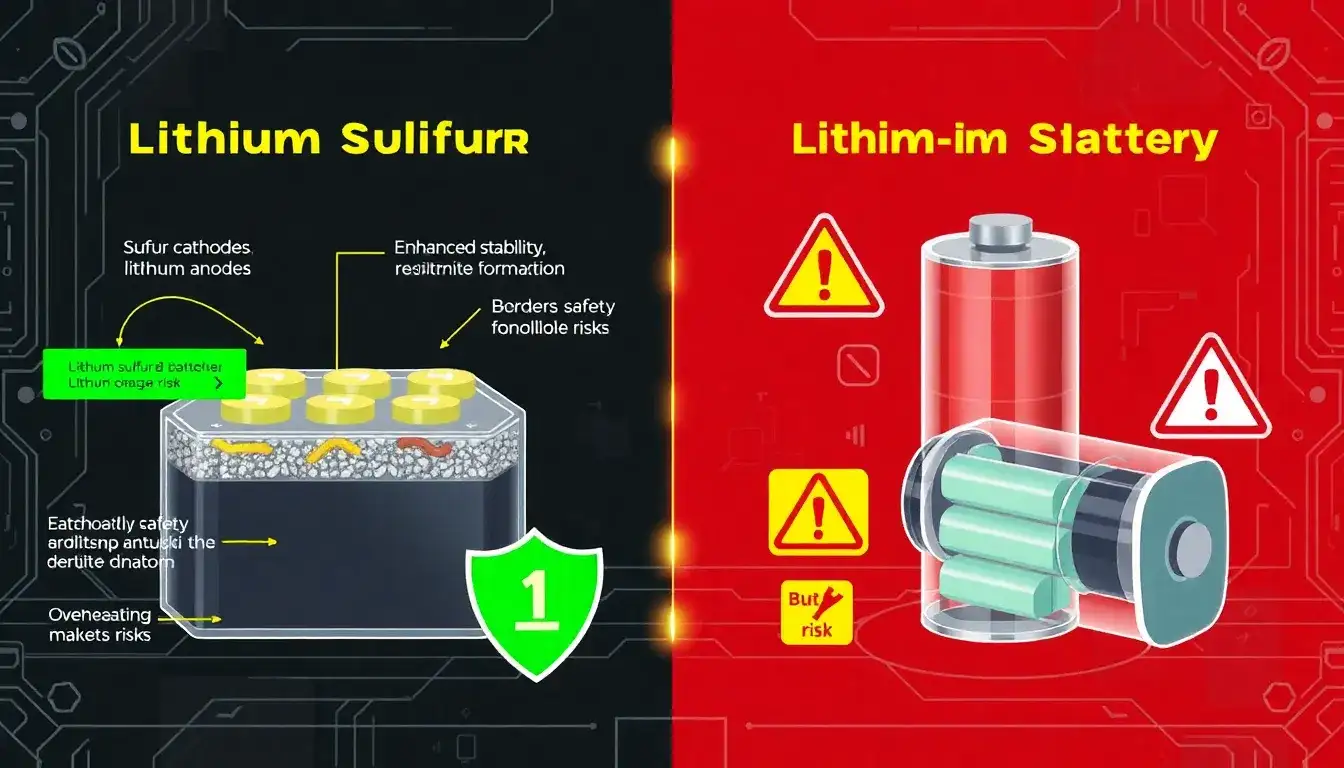
While lithium-ion batteries have well-established safety features such as built-in protection circuitry, porous separators, and battery management systems (BMS), lithium-sulfur batteries offer different advantages. Here are some specific safety features of lithium-sulfur batteries that differ from those in lithium-ion batteries:
- Operating Mechanism: Lithium-sulfur cells operate via a “conversion reaction,” which inherently provides safety benefits by potentially reducing the risk of thermal runaway compared to the intercalation reaction in lithium-ion batteries.
- Fire Safety: Solid-state lithium-sulfur batteries promise improved fire safety due to their design, which includes features like polysulfide shuttling control to stabilize the battery.
- Material Safety: In principle, sulfur is less flammable compared to the graphite and lithium cobalt oxide used in lithium-ion batteries, potentially offering inherent safety advantages, though practical implementation still faces challenges like rapid capacity decay and separator issues.
However, lithium-sulfur batteries are still in development and face challenges such as polysulfide shuttling and separator contractility, which affect their safety and performance.
Lithium-ion batteries, on the other hand, rely heavily on engineered safety features like protection circuits and BMS to manage safety risks. While lithium-sulfur batteries might offer theoretical safety advantages, practical implementations and widespread adoption are still needed to fully capitalize on these features.
Original article by NenPower, If reposted, please credit the source: https://nenpower.com/blog/are-there-any-specific-safety-features-in-lithium-sulfur-batteries-that-lithium-ion-batteries-lack/

