

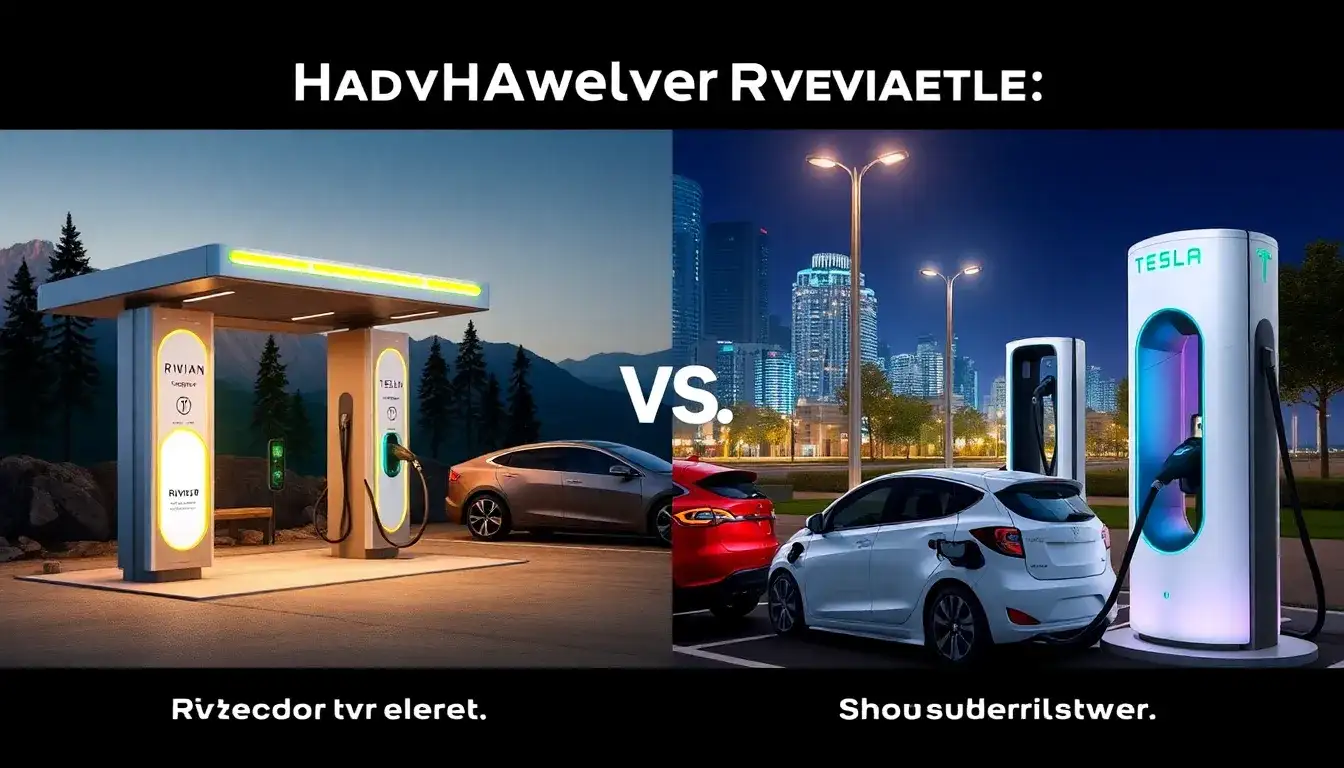
Rivian’s Adventure Network and Tesla’s Superchargers
Rivian’s Adventure Network and Tesla’s Superchargers both provide high-speed charging for electric vehicles but differ in some notable hardware quality aspects.
Rivian Adventure Network Hardware Features:
- Rivian’s current Adventure Network chargers have a maximum charging capacity around 300 kW and provide up to 500 amps, with some recent upgrades including longer charging cables (estimated around 3 meters compared to 2 meters previously), improving reach and usability for different vehicle configurations.
- The network is expanding to support the native North American Charging Standard (NACS), also known as SAE J3400, through future hardware updates. This will enable compatibility with Tesla connectors, broadening charger usability.
- New Rivian charging stations feature enhanced user interfaces with larger screens and tap-to-pay options, adding convenience.
- Rivian is developing “Charging Outposts” that include comfortable amenities, like the Joshua Tree location twice the size of the initial Yosemite site, designed with an outdoorsy, community-friendly approach.
Tesla Superchargers Hardware Features:
- Tesla’s Superchargers are widely considered to have superior charging capabilities with higher power output levels (often up to 250 kW in V3 stations and beyond with newer models), generally enabling faster charging compared to Rivian’s current max of 300 kW but typically at lower amps.
- Tesla’s hardware is mature and extensively deployed, with a large, well-established network that supports rapid, reliable charging and seamless user experience integrated into Tesla vehicles’ navigation and software.
Summary of Hardware Quality Differences:
| Feature | Rivian Adventure Network | Tesla Superchargers |
|---|---|---|
| Max Charging Power | Around 300 kW, 500 amps | Up to approx. 250 kW (V3), newer models may be faster |
| Cable Length | Longer cables (~3 meters) for better reach | Standard cable length, well-tested durability |
| Connector Standard | Currently CCS, migrating to NACS soon | NACS (proprietary Tesla connector) |
| Station Amenities | Charging Outposts with amenities (e.g., Joshua Tree site) | Generally minimal amenities, more utilitarian |
| User Interface | Larger screens, tap-to-pay | Integrated Tesla app payment, simple interface |
| Deployment Scale | Growing network, fewer chargers (hundreds) | Large widespread network (thousands) |
While Rivian’s network is designed with outdoor and adventure comfort in mind and is innovating with hardware upgrades (longer cables, larger screens, tap-to-pay), Tesla’s Superchargers currently offer more mature, potentially faster charging technology with greater network density. Rivian’s chargers support high voltage up to 900 volts, indicating future-proofing, but exact kW rates haven’t been fully detailed yet.
In conclusion, Rivian’s Adventure Network hardware is improving and tailored for an adventurous lifestyle with good usability features; however, Tesla’s Superchargers maintain a lead in charging speed, network size, and proven reliability. Rivian is closing the gap, especially with the upcoming NACS support and hardware upgrades, but Tesla’s hardware quality remains the benchmark in the fast-charging ecosystem.
Original article by NenPower, If reposted, please credit the source: https://nenpower.com/blog/are-there-any-significant-differences-in-the-hardware-quality-of-rivians-adventure-network-and-teslas-superchargers/

