

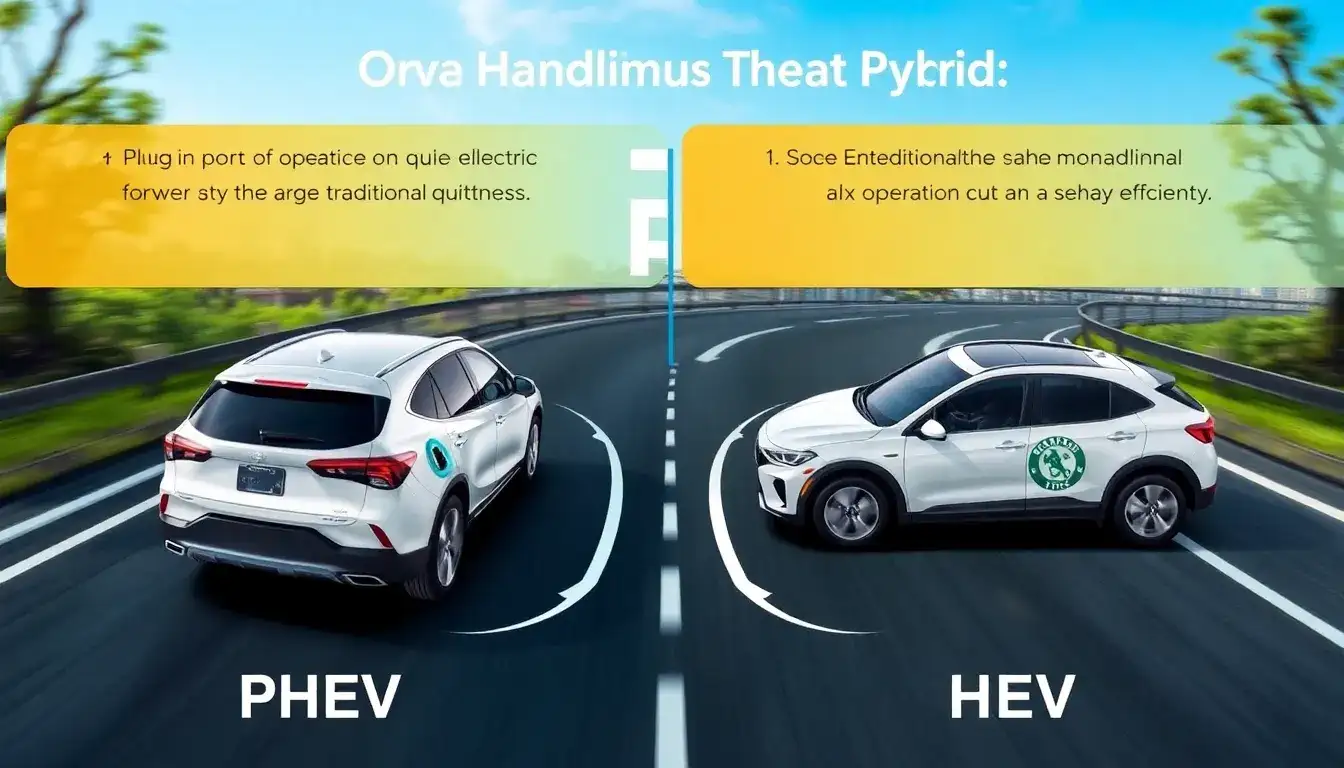
The handling differences between PHEVs and HEVs stem primarily from battery weight distribution and powertrain operation, though common hybrid features like regenerative braking apply to both. Key distinctions include:
1. Weight Distribution
- PHEVs often carry larger batteries, resulting in more weight but potentially better low-center-of-gravity stability due to floor-mounted battery placement.
- HEVs are lighter overall, which may improve agility in city driving.
2. Powertrain Behavior
- PHEVs prioritize electric-only propulsion at low-to-moderate speeds when charged, offering smoother acceleration and quieter operation. The gas engine engages only when battery charge depletes or under heavy acceleration.
- HEVs rely more on engine-motor coordination, with the gas engine activating frequently (especially during highway speeds). This can lead to a more noticeable transition between power sources.
3. Driving Modes
- PHEVs often include selectable modes (e.g., EV-only, hybrid, engine-only) that alter handling characteristics. For example, EV mode provides instant torque and quieter operation, while hybrid mode balances efficiency and range.
- HEVs typically lack these modes, defaulting to automatic hybrid operation with minimal driver input.
4. Braking Feel
Both use regenerative braking, but heavier PHEVs may exhibit a slightly stronger regen effect to maximize energy recovery, which could influence pedal responsiveness.
Practical Impact
| Feature | PHEV Handling | HEV Handling |
|---|---|---|
| Weight | Heavier due to larger battery, but stable at low speeds | Lighter, potentially more nimble |
| Transitions | Smoother in EV mode; engine engagement less frequent | More frequent engine-motor swaps, noticeable in mixed driving |
| Modes | Adjustable driving styles (e.g., sport/EV) alter throttle/brake response | Fixed hybrid behavior, optimized for fuel efficiency |
In summary, PHEVs may feel more refined in EV mode, while HEVs prioritize simplicity and lighter weight. The differences are most apparent in stop-and-go traffic and during aggressive acceleration.
Original article by NenPower, If reposted, please credit the source: https://nenpower.com/blog/are-there-any-significant-differences-in-handling-between-phevs-and-hevs/

