

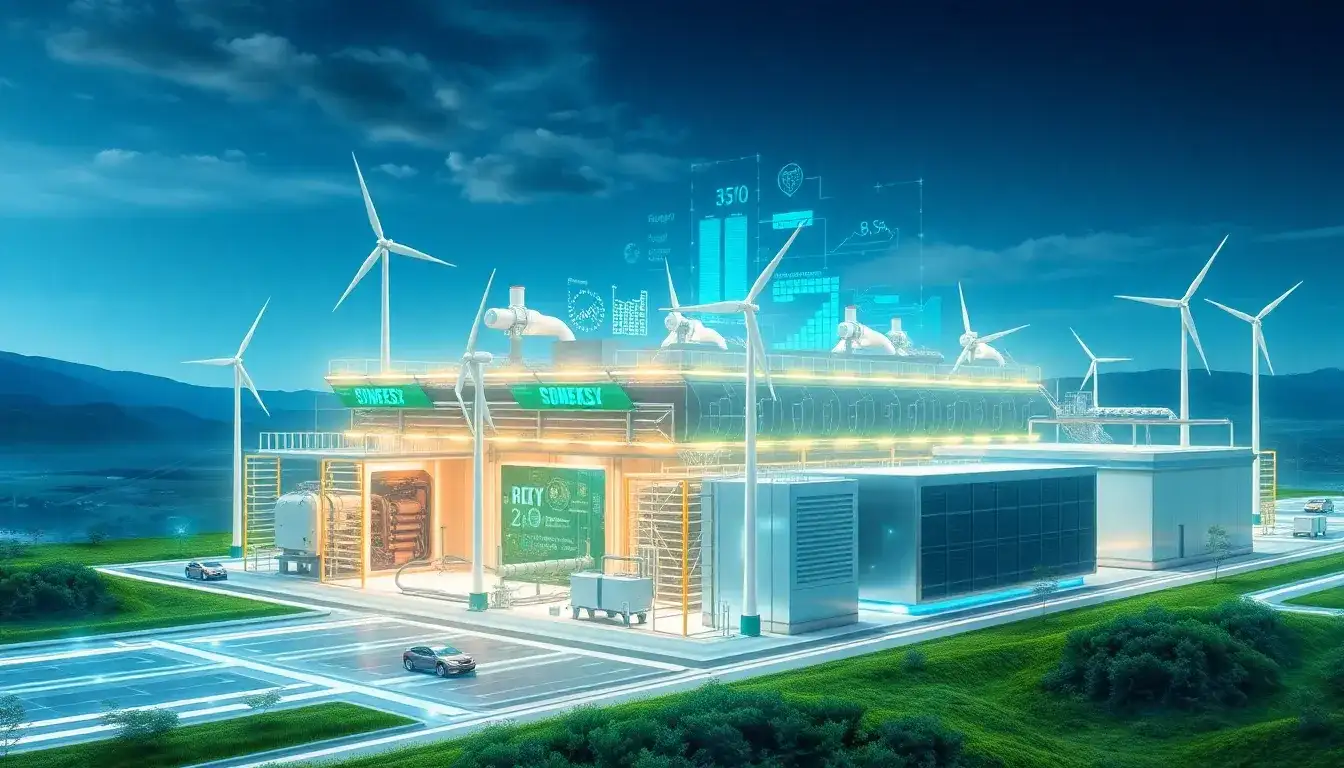
There are several innovative solutions currently being developed to improve the efficiency of Compressed Air Energy Storage (CAES) systems, aiming to overcome traditional limitations such as heat loss during compression and the need for additional fuel to reheat air during expansion.
Innovative Approaches to Improve CAES Efficiency
1. Thermal Energy Management and Adiabatic CAES
A key innovation is the use of thermal energy management systems that capture and store the heat generated during air compression. This stored heat is then reused to reheat the air during expansion, eliminating the need for external fuel sources, such as natural gas, which reduces emissions and significantly improves efficiency. For instance, the UK-based startup Storelectric has developed a “Green CAES” solution that uses such a system. Their technology reportedly increases the efficiency of traditional CAES by 10–15% while cutting costs by over 40%, and they have designed the system to be hydrogen-ready for future integration with clean fuel sources. Similarly, developments in adiabatic CAES aim to achieve efficiencies of around 70% by fully capturing and reutilizing thermal energy within the storage cycle, further reducing costs per unit energy stored.
2. Fuel Options for Air Heating
Traditional CAES plants, such as those in Huntorf and McIntosh, rely on burning natural gas to reheat compressed air before expansion, which limits efficiency and increases emissions. Newer systems explore alternative heating methods during expansion such as using hydrogen combustion or electric heating, which can potentially make the technology cleaner and more efficient.
3. Advanced System Flexibility and Fast Response
Modern CAES technology, like that developed by Siemens Energy, enhances operational efficiency with rapid startup and shutdown capabilities (full load in less than 10 minutes), excellent load-following, and part-load efficiency. The ability to independently operate compression and expansion systems allows simultaneous load absorption and generation balancing, improving grid stability and operational flexibility.
4. Integration with Renewable Energy and Grid Stability
CAES solutions are increasingly designed to support the integration of intermittent renewable energy sources by providing reliable backup power and grid balancing services over long durations, making the system economically feasible and operationally efficient in variable conditions.
Summary Table of Innovations
| Innovation Aspect | Description | Impact on Efficiency |
|---|---|---|
| Thermal Energy Management | Capturing and reusing compression heat (adiabatic CAES) | +10–15% efficiency, lower fuel need |
| Alternative Heating Fuels | Use hydrogen or electric heating instead of natural gas | Reduced emissions, cleaner operation |
| Rapid Start and Flexibility | Fast startup, load-following, independent system operation | Improved operational efficiency |
| Renewable Integration & Storage | Backup power and smoothing renewables intermittency | Enhanced grid stability, economic feasibility |
These innovations collectively contribute to overcoming traditional CAES efficiency limits (typically 42-54%) and moving towards systems with efficiencies approaching or exceeding 70%, along with reduced operational costs and environmental impact.
In conclusion, advances such as thermal energy storage and management, alternative fuel utilization, improved system operation flexibility, and enhanced renewable integration represent the forefront of innovation for boosting the efficiency and sustainability of CAES technologies.
Original article by NenPower, If reposted, please credit the source: https://nenpower.com/blog/are-there-any-innovative-solutions-to-improve-the-efficiency-of-caes/

