

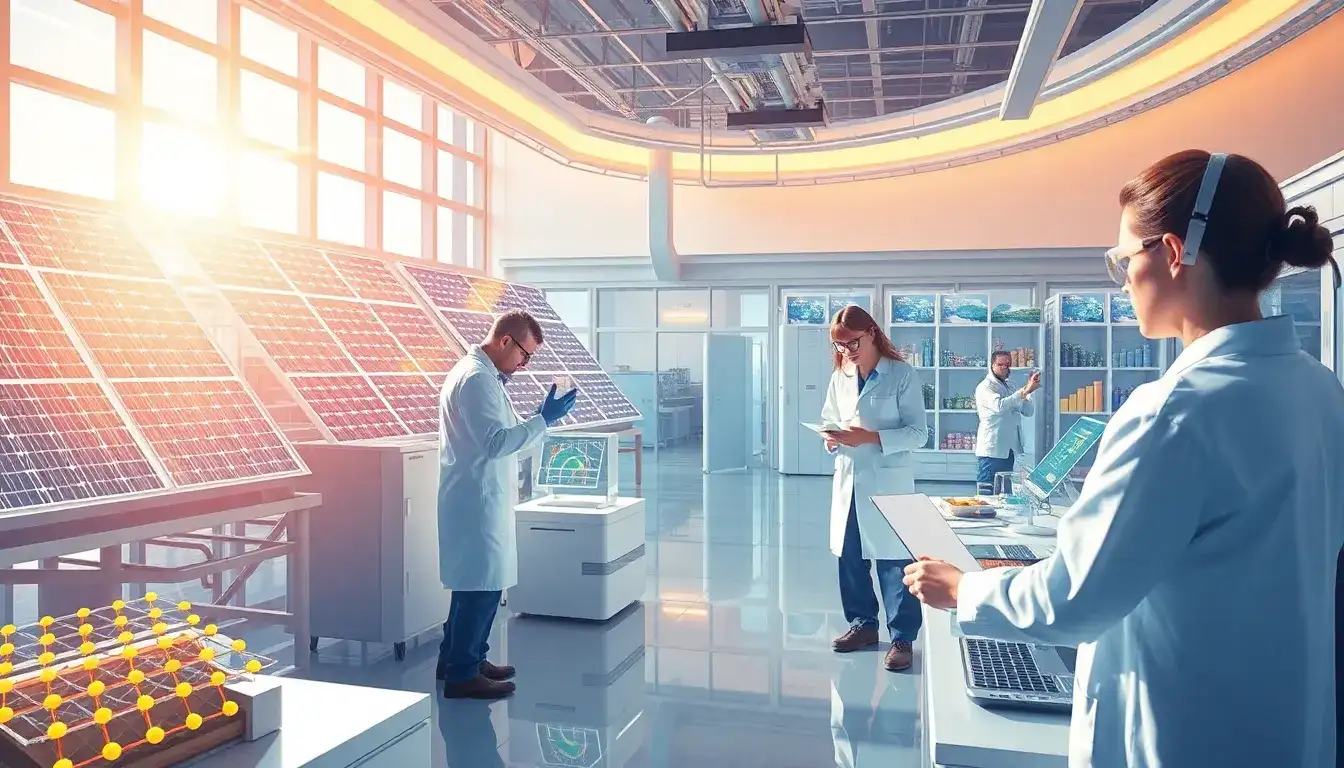
Emerging technologies are significantly advancing solar panel efficiency and transforming the solar energy landscape. Key innovations include:
Perovskite Solar Cells
- Perovskite materials have a crystalline structure that allows them to capture a broader spectrum of sunlight than traditional silicon cells.
- When combined with silicon in tandem cells, perovskites can push efficiencies beyond the theoretical limits of single-material cells, achieving certified efficiencies up to 33.9% in laboratory settings.
- Perovskite cells are cheaper and easier to manufacture, can be made flexible and lightweight, and can be printed or integrated into building materials like solar windows and fabrics.
- Challenges remain regarding their long-term stability under heat and moisture exposure, but ongoing research aims to overcome these issues.
- Recent lab tests show perovskite cells reaching efficiencies above 29%, approaching or even surpassing high-end traditional panels.
Bifacial Solar Panels
- These panels capture sunlight from both the front and back sides, increasing energy harvest by up to 30% by utilizing reflected light from surfaces such as snow, water, or reflective roofs.
- Bifacial technology enhances energy density without increasing panel footprint, making solar installations more space-efficient and cost-effective.
Smart Solar Technology and AI Integration
- The use of sensors, IoT, and AI in solar panels enables real-time monitoring, predictive maintenance, and optimization of solar array performance.
- AI algorithms optimize panel orientation, forecast weather, and adapt energy consumption patterns to maximize solar generation and storage utilization, contributing to improved efficiency and system reliability.
Quantum Dot Solar Cells and Multi-Junction Cells
- Quantum dots are nanoscale semiconductor particles whose energy absorption can be tuned by size, allowing for custom spectral capture. This technology is promising but still early-stage and sometimes involves toxic materials.
- Multi-junction solar cells use multiple layers to capture wider ranges of the solar spectrum, aiming to exceed the efficiency limits of single-junction cells, potentially pushing efficiencies above 50% in the future.
Flexible and Lightweight Solar Panels
- Technologies such as ultrathin fabric solar cells developed by research institutions like MIT offer highly portable and lightweight options that generate significantly more power per kilogram than traditional panels.
- This enables solar energy use in new applications, including portable electronics, wearables, vehicles, and off-grid scenarios.
Advanced Energy Storage and Virtual Power Plants
- Improved battery technologies (lithium-ion, solid-state) combined with smart grid solutions like virtual power plants enable more reliable use of solar energy by storing excess power and distributing it efficiently.
- These advances help address the intermittency challenge of solar power and maximize the value of solar installations.
Additional Innovations
- Transparent solar windows that convert ultraviolet and infrared light to electricity are being deployed to turn buildings into solar farms.
- Emerging concepts such as solar panels that generate power from rain friction and those functioning partially in the dark are being researched.
Summary Table of Emerging Technologies Increasing Solar Panel Efficiency:
| Technology | Efficiency Impact | Key Benefits | Challenges |
|---|---|---|---|
| Perovskite Solar Cells | Lab-records ~33.9%, commercial ~29%+ | Low cost, flexible, broad spectrum | Stability, durability |
| Bifacial Solar Panels | Up to 30% more energy harvested | Higher yield same footprint | Installation complexity |
| Smart Solar + AI | Optimizes real-time output | Predictive maintenance, energy use | System complexity, cost |
| Quantum Dots & Multi-junction | Potential >50% efficiency (future) | Wide spectrum absorption | Toxicity, commercial readiness |
| Flexible Lightweight Panels | High power-to-weight ratio | Portable, versatile applications | Commercial scaling |
| Transparent Solar Windows | Adds power generation to buildings | Aesthetic, dual-function power source | Lower efficiency vs panels |
In conclusion, perovskite solar cells and bifacial panels are currently the most promising emerging technologies driving increased solar efficiency, with smart AI integration and advanced materials like quantum dots poised to contribute further in the near future. These advances promise higher energy yields, more versatile applications, and lower costs, accelerating solar power adoption globally.
Original article by NenPower, If reposted, please credit the source: https://nenpower.com/blog/are-there-any-emerging-technologies-that-could-increase-solar-panel-efficiency/

