

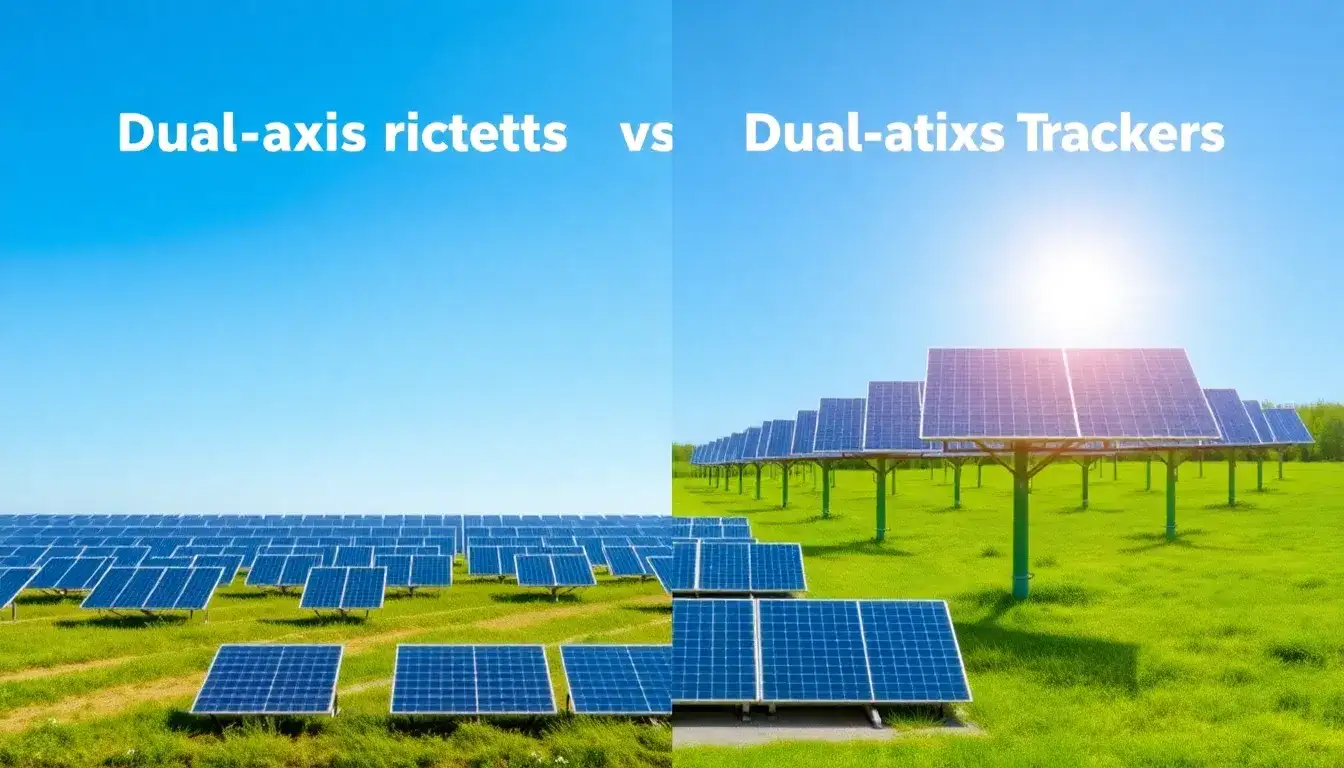
Benefits of Dual-Axis Trackers for Small-Scale Projects
- Higher Energy Yield: Dual-axis trackers can increase solar energy production by about 40% compared to fixed solar panels because they follow the sun’s path both horizontally and vertically. This allows the panels to absorb sunlight more efficiently from all directions throughout the day and across seasons.
- Space Efficiency: Since dual-axis trackers boost power output per panel, fewer panels are needed to reach the same energy goals. This makes them suitable for small or space-constrained residential and commercial projects where maximizing energy density is critical.
- Land Use Flexibility: The elevation and design of dual-axis trackers allow for dual use of land underneath, such as for agriculture or parking (carports), which is a valuable feature in areas where land availability or use is limited.
- Suitability for Various Terrains: Systems like the sTracker offer modular designs that can be installed on uneven, sloped, or challenging surfaces, requiring less ground preparation and thus potentially lower site development costs.
Considerations and Drawbacks
- Higher Initial Cost and Complexity: Dual-axis tracking systems are more complex and costly upfront than fixed or single-axis systems. This includes the cost of the tracking mechanism, installation, and maintenance.
- Maintenance Requirements: The moving parts and sensors in dual-axis trackers introduce more points of failure and require upkeep, which can be a factor in small-scale projects with limited technical support.
- Cost-Benefit Balance: For very small or low-budget projects, the incremental energy gain may not justify the higher initial investment and maintenance. However, in small-scale settings where space is limited but energy needs are high, they often make sense to optimize production in a smaller footprint.
Summary
| Factor | Dual-Axis Trackers | Fixed Solar Panels |
|---|---|---|
| Energy Yield | Up to ~40% more energy | Baseline production |
| Space Efficiency | High (fewer panels needed) | Lower (more panels needed) |
| Installation Complexity | More complex, higher initial cost | Simpler, lower cost |
| Maintenance | Periodic maintenance required | Minimal maintenance |
| Land Use | Allows dual use under panels | Land typically fully occupied |
| Terrain Flexibility | Can be installed on varied terrains | Generally requires flat area |
In conclusion, for small-scale solar projects where maximizing energy output per area is a priority and upfront investment plus maintenance can be managed, dual-axis trackers provide a compelling advantage by significantly increasing power generation and offering flexible land use. They are especially recommended when space constraints or the desire for modular, scalable installations exist. However, for very small or low-budget projects, fixed or single-axis options may still be more practical due to lower costs and simpler maintenance.
Thus, dual-axis trackers are often worth the investment in small-scale projects that need high efficiency and have the resources to support initial and ongoing costs.
Original article by NenPower, If reposted, please credit the source: https://nenpower.com/blog/are-dual-axis-trackers-worth-the-investment-for-small-scale-solar-projects/

