

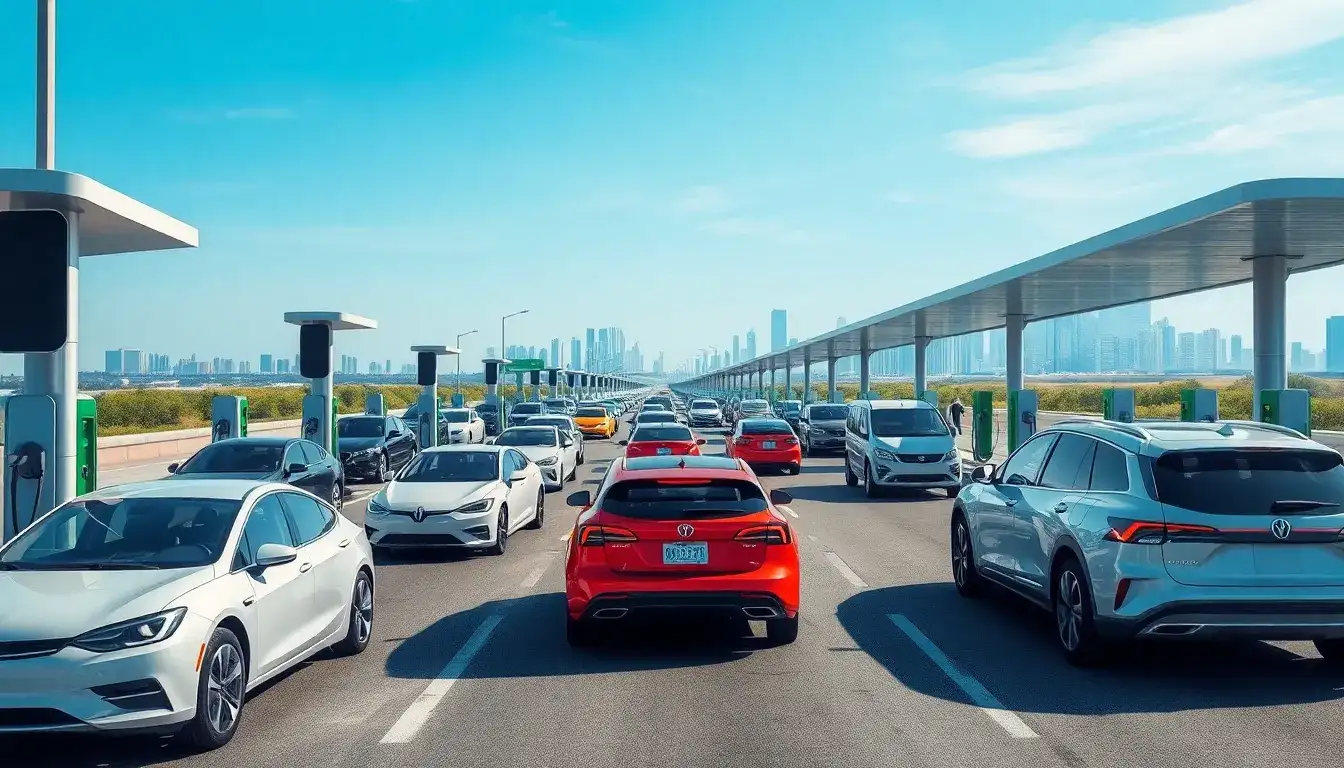
With 14 million new energy vehicles on the highways, are there enough charging stations?
During the holiday travel peak, many drivers expressed concerns about charging their electric vehicles (EVs). Mr. Gao, a Model Y owner and an experienced long-distance driver, shared his insights: “I don’t quite understand why people wait one to two hours at highway charging stations when they can usually find an available one within five kilometers if they exit the highway.”
Reports from social media indicated long queues at charging stations in highway service areas leading into and out of major cities like Beijing, Hangzhou, Wuhan, Changsha, Guangzhou, and Shenzhen from the night of September 30 to the early morning of October 1. Waiting times ranged from one to four hours.
To manage the congestion and maintain order, staff members at several service areas implemented a queue management system to guide vehicles in an orderly manner. According to some service area personnel, dedicated staff were assigned to charging zones during the holiday. Their roles included helping EV drivers queue properly and managing charging times and amounts. “We typically recommend charging up to around 80%, keeping the charging time to about half an hour to improve the efficiency of the charging stations and reduce waiting times for other vehicles,” they noted.
At a press conference held by the State Council Information Office on September 28, Li Yang, Vice Minister of Transport, mentioned that self-driving remains the primary mode of travel during this year’s National Day and Mid-Autumn Festival holiday. It is estimated that 1.87 billion people will travel by car, accounting for about 80% of total travel volume. During peak periods, traffic on highways could exceed 70 million vehicles per day, with 14 million of those being new energy vehicles.
The China State Grid predicted that the peak demand for charging during the holiday would occur between September 30 and October 1, as well as from October 6 to 7. Regionally, the provinces of Jiangsu, Zhejiang, and Anhui are expected to see record-high charging volumes on their highways. Notably busy highways for EV charging include the Shenhai Expressway, Changshen Expressway, and Jinghu Expressway.
In response to the charging challenges during the National Day holiday, Li Yang stated that the transportation department is reviewing the busiest charging service areas nationwide and implementing tailored strategies to enhance charging service capabilities.
As of now, China has developed the world’s largest charging service network, which is the most extensive and diverse. Yang Zhongping, Deputy Secretary-General of the China Automobile Industry Association, revealed that by the end of August this year, the total number of charging infrastructure units reached 17.348 million, including 4,946 battery swap stations. Preparations for the holiday charging peak have included increasing the number of charging stations and mobile charging facilities at various service areas.
Li Yang mentioned that while researching in some provinces, he observed that certain service areas had increased their number of charging stations. The transportation department is implementing strategies to alleviate congestion on highways and improve service capabilities at service areas. For routes prone to significant congestion, special measures have been established.
Prior to this year’s National Day, many service areas had already enhanced their charging services. For instance, Henan Province’s New Energy Development Company launched over 1,400 new charging guns across more than 60 service areas on key highways like the Jingguang and Daguang. Additionally, many service areas are now equipped with ultra-fast charging stations, with some employing Huawei’s full liquid cooling technology, allowing for charging power up to 600 kW, enabling a full charge in the time it takes to enjoy a cup of coffee.
On the urban front, the construction of charging networks has also made significant progress. In the first half of this year, Shenzhen established 1,057 ultra-fast charging stations and over 487,000 charging piles, becoming the first city globally where the number of ultra-fast charging stations exceeds that of gas stations. The city has entered the “megawatt era” for EV charging. Earlier this year, BYD unveiled its “megawatt fast charging” technology, achieving a peak charging speed that can provide 2 kilometers of range in just one second and 407 kilometers in five minutes, effectively matching the refueling speed of gasoline vehicles.
Furthermore, cities like Guangzhou, Chongqing, Fuzhou, and Urumqi are advancing their “supercharging city” initiatives, with Urumqi planning to establish 300 ultra-fast charging stations by the end of the year, creating a 3-kilometer “supercharging zone” in its urban area.
On the policy front, China has established a multi-level and comprehensive policy framework to support the development of charging infrastructure. From the issuance of guidelines by the State Council in 2015 to recent directives in 2023 aimed at enhancing the quality of the charging infrastructure system, the country’s development of charging stations has shifted from merely being “sufficient” to “user-friendly.” According to Zou Peng, Executive Secretary-General of the Charging and Battery Swap Branch of the China Automobile Industry Association, during the 14th Five-Year Plan period, significant progress has been made in charging network construction, with two charging stations provided for every five new energy vehicles, effectively addressing the public’s concerns about charging difficulties.
Chen Si, Chief Technology Officer of Kaimais New Energy Technology Co., stated, “By the end of 2025, the annual charging volume of public charging facilities will reach 80 billion kWh, equivalent to the annual power generation of the Three Gorges Hydropower Station.” He emphasized that the total power supply from fully charged vehicles will approach the annual output of the Three Gorges Hydropower Station, indicating that vehicle-grid interaction will be a significant trend in future development.
Despite these advancements, charging challenges persist. Wang Yao, Secretary-General of the China Electric Vehicle Charging Infrastructure Promotion Alliance, pointed out that the industry faces issues such as “inward” competition, uneven facility utilization rates, and difficulties in implementing vehicle-grid interaction, leading some vehicle owners to still experience charging issues.
Lu Xudong, a senior engineer at the Academy of Transportation Sciences under the Ministry of Transport and an expert in vehicle-energy integration, noted that the coverage of charging facilities at highway service areas is close to 100%, with approximately 66,000 charging stations, but these represent less than 1% of the total charging stations nationwide. He candidly stated that during holidays like the National Day, charging difficulties on highways remain a significant issue. “The demographic of highway service users has changed; previously, most vehicles were gasoline-powered, but now around 20% of vehicles on the road are electric.” Lu Xudong believes that highway service facilities should enhance their service capabilities to accommodate this shift.
Highways require high-power charging equipment, as users have higher demands for charging speed and are less sensitive to charging costs. On peak travel days during major holidays, such as the Spring Festival and National Day, they coordinate with higher-level companies to initiate a “full manpower charging assistance” mechanism, organizing staff to assist in high-traffic service areas.
Qiu Xinyuan, Deputy General Manager of Hubei Jiaotou New Energy Investment Co., explained that dynamic adjustments to the state of charge (SOC) limits can shorten charging times, improve charging station utilization, and effectively alleviate vehicle congestion. Additionally, they offer charging navigation services to drivers, providing cards that clearly indicate the distribution and real-time availability of charging stations near the next service area or highway exit, thereby efficiently diverting traffic away from popular charging stations.
Furthermore, to assist anxious drivers, small discount vouchers for charging fees are distributed. “The tidal phenomenon of vehicle flow in highway service areas is very prominent during holidays,” stated Zhou Qiang, CEO of Lingchong New Energy Technology Co., proposing a flexible direct current interconnection solution. “Because highway service areas are paired, the tidal phenomenon typically sees a higher volume of vehicles leaving the city at the start of the holiday and a dense return of vehicles towards the end. This solution can effectively reduce some of the power demand, especially in areas with weak power supply on highways.”
Lu Xudong also pointed out that there are over 8,000 existing highway service areas, with a higher density of toll booths, some in economically developed provinces reaching one every 10 kilometers, which is four to five times the density of service areas. As new energy vehicles expand into rural areas, some underdeveloped regions face challenges related to insufficient electricity and transformer resources. Traditional toll booths have a better power foundation, and with the proliferation of electronic toll collection (ETC), there is surplus land available under the original design. Thus, transitioning toll booths into open-type comprehensive energy stations that integrate energy storage, photovoltaics, and charging is an important direction for future development.
Did you find yourself waiting to charge your vehicle on the highway during this year’s National Day holiday?
Original article by NenPower, If reposted, please credit the source: https://nenpower.com/blog/are-charging-stations-ready-for-14-million-new-energy-vehicles-on-highways/

