

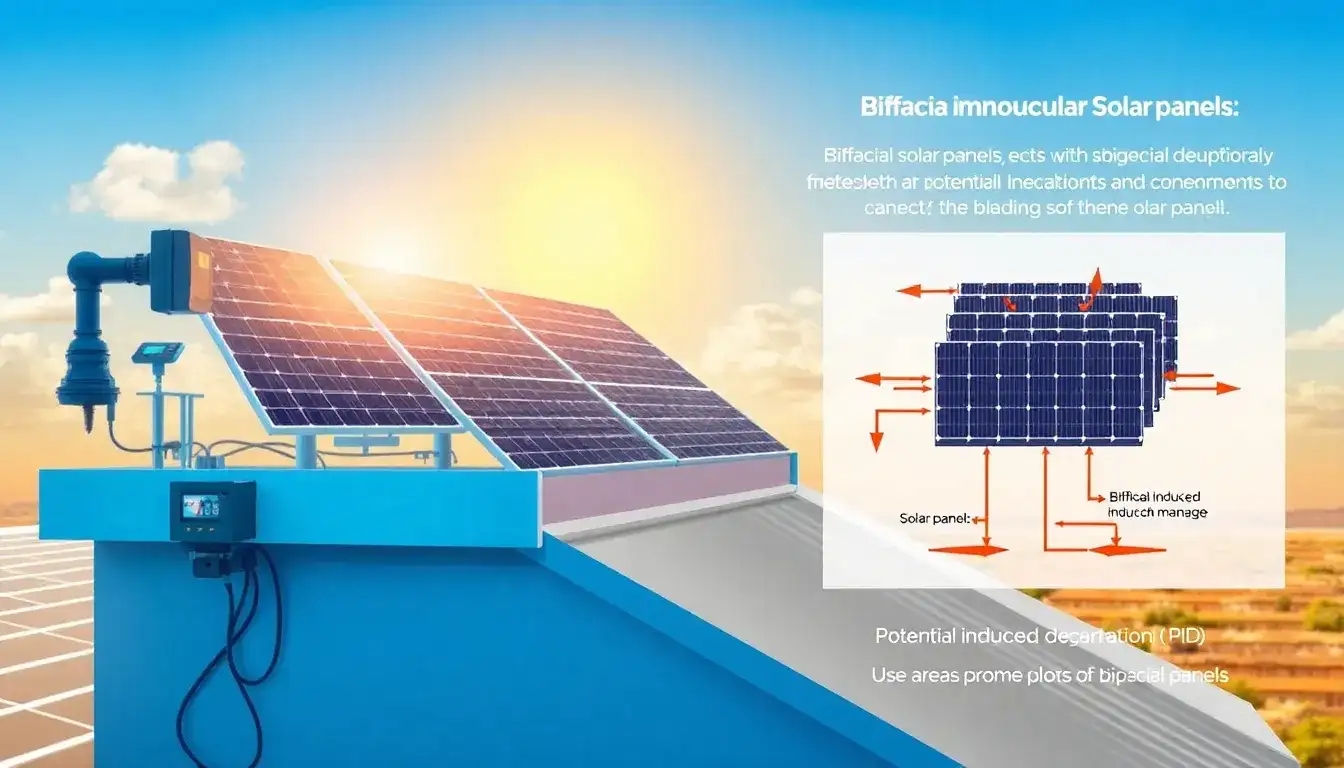
Bifacial solar panels are indeed more prone to certain types of potential-induced degradation (PID) compared to traditional monofacial panels, particularly due to their design and operational characteristics.
Reasons Why Bifacial Panels Are More Prone to PID
- Dual-Side Exposure: Unlike monofacial modules that have a fully metallized back surface, bifacial solar cells expose both front and rear sides to light and environmental conditions. This exposure increases the complexity of PID mechanisms, as degradation can occur on both sides, not just the front.
- Rear Side Vulnerability: Bifacial cells often have patterned rear metallization instead of full-area metallization, which removes electromagnetic shielding on the rear side. This makes the rear side more susceptible to PID, especially when subjected to high voltage stress under real operating conditions.
- Different PID Mechanisms: Research has identified multiple PID types affecting bifacial modules that differ from those in monofacial modules. These include:
- Polarization-type PID (PID-p): Often reversible, related to a polarization effect that temporarily reduces surface passivation on the rear side.
- Corrosion-type PID (PID-c): More severe and often irreversible, involving corrosion and structural damage to passivation layers on the rear of the solar cells, which negatively impacts long-term module reliability.
- Impurities and Passivation Damage: Studies show that impurities like calcium, sodium, and potassium in manufacturing processes can damage passivation layers and lead to corrosion (PID-c) on the rear side of bifacial cells under PID stress, causing cracks and performance loss.
Impact and Research Status
- Performance Losses: Field and laboratory tests on bifacial PERC+ modules have shown significant performance drops (10% to 50%) due to PID after exposure times ranging from tens to over a hundred hours under stress conditions of elevated voltage and temperature.
- Testing Challenges: Standard PID test protocols, which focus on front-side degradation, do not adequately detect or characterize rear-side PID phenomena in bifacial modules. New testing methods involving simultaneous illumination and high temporal resolution of power measurements are necessary for proper diagnostics.
- Mitigation and Ongoing Research: Various mitigation strategies are being studied, including cell design improvements (e.g., adding conductive interlayers) and updates to testing standards. However, fully addressing PID in bifacial panels requires further research, and currently, the lack of standardized tests complicates early detection and warranty management.
Summary
| Aspect | Monofacial Modules | Bifacial Modules |
|---|---|---|
| Rear Side Exposure | Fully metallized, shielded | Patterned metallization, rear side exposed |
| PID Occurrence | Mostly front-side PID | Both front and rear side PID mechanisms |
| PID Types | Primarily shunting PID | Polarization-type PID (reversible) and corrosion-type PID (irreversible) on rear side |
| Testing | Established standards for front-side PID | Testing standards evolving to address rear-side PID |
| Vulnerability | Lower rear side PID risk | Higher susceptibility, especially to irreversible rear PID |
In conclusion, bifacial solar panels have a higher risk of potential-induced degradation, especially at the rear side, due to their structure and the complex PID mechanisms that affect both sides. This makes PID a more critical reliability issue for bifacial modules than for monofacial ones, necessitating ongoing research and improved testing to manage and mitigate these effects effectively.
Original article by NenPower, If reposted, please credit the source: https://nenpower.com/blog/are-bifacial-solar-panels-more-prone-to-potential-induced-degradation-pid/

