

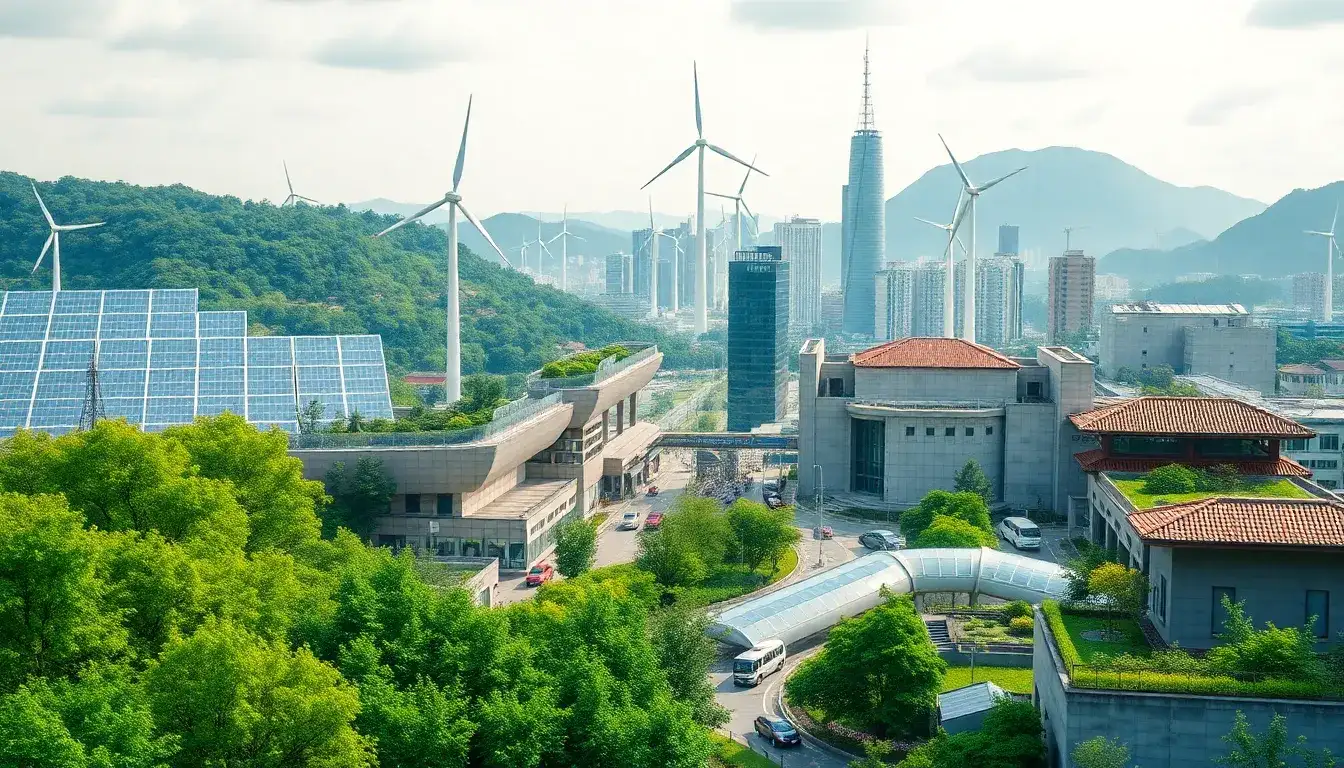
Analyzing the “14th Five-Year Plan”: From Systematic Layout to Comprehensive Breakthroughs in Building a New Global Green and Low-Carbon Development Paradigm
During the “14th Five-Year Plan” period, China has established a systematic framework for green and low-carbon development based on energy structure optimization, industry transformation, enhanced environmental governance, and financial innovation. This has led to significant achievements that inject robust green momentum into high-quality development and contribute Chinese wisdom and strength to global sustainable development.
This article is the third installment of “Data on the 14th Five-Year Plan,” showcasing the full panorama of China’s green and low-carbon development, from reducing emissions at the source to validating practical effects and ensuring long-term funding.
Dual-Driven Energy Consumption Continues to Decline
Since the beginning of the “14th Five-Year Plan,” China has made significant strides in energy conservation and emission reduction through a dual-driven approach of industrial transformation and energy revolution. By the end of 2024, the energy consumption per unit of GDP nationwide has decreased by 6.96% compared to the end of the “13th Five-Year Plan,” and carbon dioxide emissions per unit of GDP have significantly dropped. High-energy-consuming industries have made steady progress in their green transformation.
In the steel industry, advancements in technology and management have led to improved water resource utilization efficiency and significant reductions in pollutant emissions. By 2024, the new water consumption per ton of steel has decreased by 4.9% compared to 2020, while emissions of sulfur dioxide and nitrogen oxides per ton of steel have respectively decreased by 47.09% and 37.88% compared to 2020. For instance, Baosteel, a leading company in the sector, invested 10.076 billion yuan in environmental protection in 2024, a 61.47% increase from 2020, with new water consumption per ton of steel down 13.79% and emissions of nitrogen oxides and sulfur oxides each dropping by over 40%.
Furthermore, by the end of 2024, China’s installed capacity of renewable energy reached 1.889 billion kilowatts, accounting for approximately 56% of the total installed capacity, doubling from the end of the “13th Five-Year Plan.” This has made renewable energy a core pillar of energy supply. The number of national-level green factories has surged from 2,783 in 2021 to 6,430 in 2024, with green technologies widely adopted in production processes, leading the way in industrial low-carbon development.
Technological innovation has injected core momentum into industrial emission reduction. The “Implementation Plan for Carbon Peak and Carbon Neutrality Support by Science and Technology (2022-2030)” issued by nine departments, including the Ministry of Science and Technology, set clear targets for breakthroughs in low-carbon core technologies. By the end of 2024, the number of patents held by A-share companies in the environmental protection sector reached 23,000, over 70% more than at the end of the “13th Five-Year Plan,” highlighting a significant acceleration in the research and industrial application of green and low-carbon technologies.
New Energy Vehicles Lead Globally
The explosive growth of the new energy vehicle (NEV) industry has become a core highlight of the green transportation transformation during the “14th Five-Year Plan.” In 2024, NEV sales in China reached 12.8659 million units, representing 40.93% of total automobile sales, an increase of 35.53 percentage points from 2020, with an impressive annual compound growth rate of 75.14%. In the first four months of 2025, NEV sales remained robust at 4.3 million, marking a 46.24% year-on-year increase and further boosting market share to 42.75%.
Leading enterprise BYD has shown remarkable performance, dominating not only the Chinese market but also playing a significant role in the global NEV market. In the first four months of 2025, BYD sold 1.3809 million NEVs, a 46.98% increase compared to the previous year. From 2021 to 2024, the company achieved a staggering annual compound growth rate of 117.85%, with total NEV sales reaching 4.2721 million in 2024, securing the top positions in sales among car manufacturers in China and globally. BYD’s ESG rating has also been recognized by international agencies, consistently maintaining an A rating or higher since 2020.
The development of the NEV industry has not only reduced carbon emissions in the transportation sector but also enhanced the overall competitiveness of the industrial chain. In the battery sector, China’s lithium-ion battery production increased by 20.1% year-on-year in 2024, reaching 29.457 billion units, with a compound annual growth rate of 11.81% from 2021 to 2024, demonstrating a strong growth trend and capturing approximately 80% of the global market share. The rapid expansion of charging infrastructure has also been noteworthy, with the number of public charging stations reaching 3.579 million by the end of 2024, a 3.43-fold increase since 2020, establishing a robust charging network that supports the widespread adoption of NEVs.
Comprehensive Success in Blue Sky, Clear Water, and Clean Land Campaigns
The effectiveness of environmental governance has become evident during the “14th Five-Year Plan.” By 2024, the annual average concentration of PM2.5 in 338 cities nationwide fell to 29.42 micrograms per cubic meter, a 9.72% decrease compared to the end of 2020. Beijing, as a model for air pollution control, saw its PM2.5 concentration drop by 19.74% since 2020, maintaining a trend of continuous improvement in air quality. Key areas for air pollution prevention also showed significant improvements, with the average proportion of days with good air quality in 74 cities reaching 82.7% by December 2024, an increase of 17.9 percentage points from December 2020.
Water quality has also improved, with the proportion of surface water rated good (Ⅰ-Ⅲ class) rising from 84.6% in December 2020 to 93% in December 2024. The ecological restoration in key river basins has achieved notable success. In the Yangtze River Economic Belt, the proportion of surface water rated good reached 98% by December 2024, exceeding the national average by 5 percentage points and improving by 2.6 percentage points since December 2020, thus realizing a virtuous cycle of “protecting while developing.”
Furthermore, the national soil environment risk has been effectively controlled. In 2024, the heavy metal content at key soil risk monitoring points showed an overall declining trend, with the safe utilization rate of polluted farmland reaching 92%. The safe use of key construction land has been effectively ensured, with pollution control measures implemented on over 75% of prioritized monitoring plots.
Financial Support Fuels Low-Carbon Development
The green transformation relies heavily on financial support. In recent years, the government has issued multiple key documents, including the “Guiding Opinions on Further Strengthening Financial Support for Green and Low-Carbon Development,” to promote the growth of green finance. Currently, China’s green finance landscape is thriving, with an expanding array of products such as green loans, bonds, and funds supporting clean energy and environmental protection sectors.
Notably, green loans serve as a primary financing channel, with the balance of green loans from financial institutions rising from 11.95 trillion yuan at the end of 2020 to 36.6 trillion yuan by the end of 2024, with more than 60% directed towards projects with carbon reduction benefits. The green bond market has also experienced remarkable growth, with the domestic market averaging an annual issuance scale of 1.11 trillion yuan from 2021 to 2024, which is 3.94 times that of the “13th Five-Year Plan” period, introducing innovative products like carbon-neutral bonds and blue bonds, and expanding issuers from financial institutions to real enterprises.
Moreover, green funds have played a significant role in promoting the green economy. ESG funds, in particular, which focus on investing in environmentally friendly, socially responsible, and well-governed companies, are increasingly becoming a powerful force for driving green economic development. By the end of 2024, the total number of domestic ESG funds had risen to 553, with a total scale of 513.617 billion yuan, reflecting increases of 207.22% and 4.25% respectively since the end of 2020.
Support from capital markets for environmentally friendly companies has also intensified. From 2021 to 2024, the average annual financing amount for listed companies in the ecological protection and environmental governance sector (including initial public offerings, additional issuances, rights issues, and convertible bonds) reached 5.684 billion yuan, representing a 32.78% increase compared to the 2016-2020 period. Companies like Huicheng Environmental Protection and Sanfeng Environment have achieved technological upgrades and scale expansions through the capital market.
The green achievements of the “14th Five-Year Plan” represent not just a series of dynamic numbers but also a profound transformation in development philosophy. Under the guidance of the “dual carbon” goals, China is marching forward with greater determination toward a modernized harmonious coexistence between humanity and nature, enhancing the quality of high-quality development and contributing Eastern wisdom to global climate governance.
Original article by NenPower, If reposted, please credit the source: https://nenpower.com/blog/analyzing-chinas-green-development-achievements-during-the-14th-five-year-plan-a-comprehensive-shift-towards-a-low-carbon-future/

