

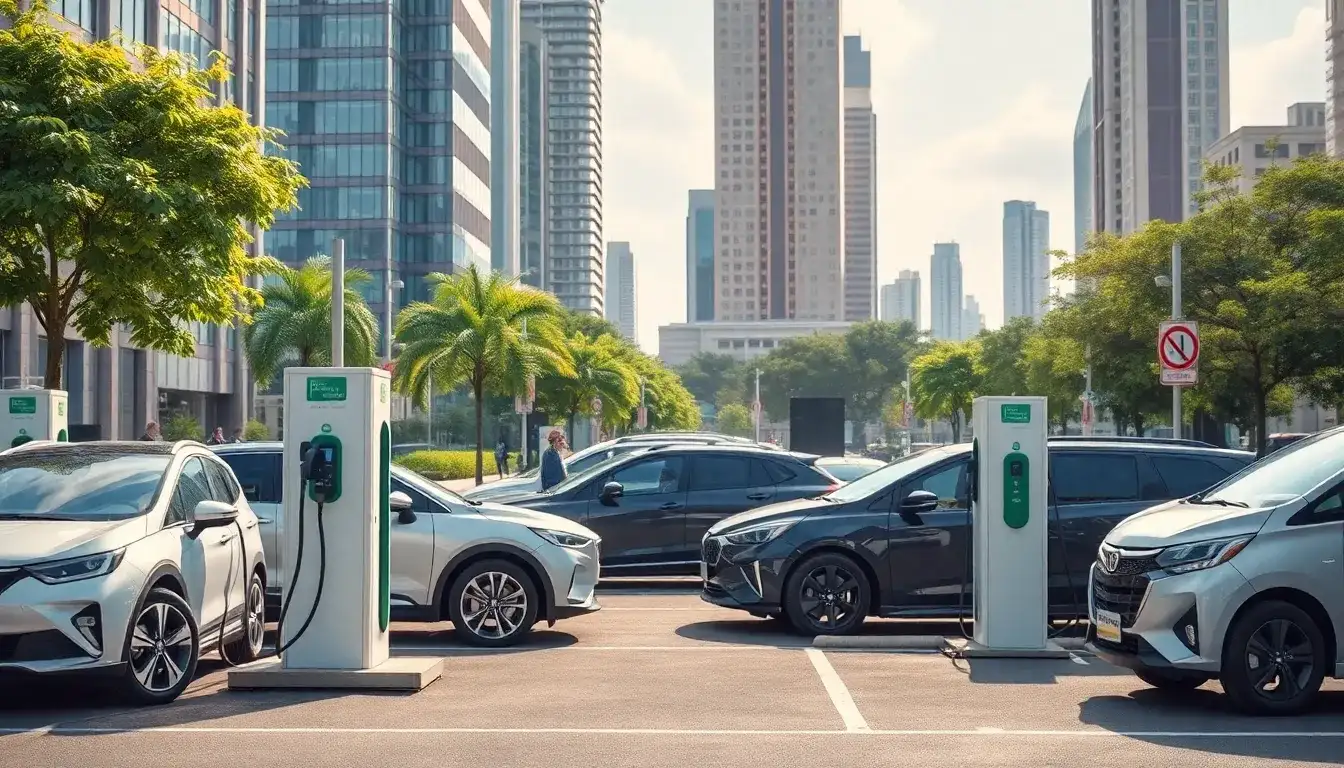
Analysis of Thailand’s New Energy Electric Vehicle and Charging Station Market in 2025
The 9th EV Asia 2025 exhibition, focusing on new energy electric vehicles and charging stations, is scheduled to be held from July 2-4, 2025 at the Queen Sirikit National Convention Center in Bangkok, Thailand. This annual event is organized by UBM and the Electric Vehicle Association of Thailand (EVAT).
Market Overview
In 2025, Thailand’s new energy electric vehicle (NEV) and charging station market is set to enter a phase of rapid growth, establishing itself as a key strategic market for energy transformation in Southeast Asia. The Thai government has been actively promoting the “EV 3.5” strategy and carbon neutrality goals, aiming for electric vehicles to account for 30% of new car sales by 2030, and for all newly sold vehicles to be zero-emission by 2035. This policy has significantly boosted the confidence of both domestic and international investors and manufacturers, invigorating the entire supply chain encompassing vehicle manufacturing, key components, battery technology, and charging infrastructure.
In terms of sales, the total sales of pure electric vehicles (BEV) and plug-in hybrid electric vehicles (PHEV) in Thailand are expected to exceed 100,000 units in 2025, with a year-on-year growth rate of over 70%. Notably, pure electric vehicles will account for over 60% of this growth. Chinese brands such as BYD, MG, Great Wall Motors, Xpeng, and NIO are expanding their presence in the Thai market by establishing local manufacturing plants, localizing products, and offering financial subsidies, which help transition electric vehicles from a niche market to mass adoption.
Charging Infrastructure
As of the first quarter of 2025, Thailand has established over 5,000 public charging stations, with approximately 20,000 private charging stations, doubling the number from the previous year. Major players like PTT, EGAT, and real estate groups are accelerating the deployment of charging networks in core cities such as Bangkok, Chiang Mai, and Phuket, creating a comprehensive “urban + long-distance” charging network. Chinese suppliers of charging equipment and systems, such as Telda, Star Charging, and Incore, are actively engaging in local partnerships to develop smart charging solutions.
Investment Environment
The Thai government has introduced various tax reductions, land incentives, and reductions in import tariffs for components to attract global vehicle manufacturers and suppliers. For instance, BYD and Great Wall Motors have established vehicle manufacturing bases in the Eastern Economic Corridor (EEC) of Thailand, while companies like Hyundai and Volkswagen are evaluating the feasibility of Thailand as a manufacturing hub for electric vehicles in Southeast Asia.
Market Segmentation
The NEV and charging station industry in Thailand is rapidly evolving, with the following key segments:
- Electric Vehicle Sector:
- Passenger Vehicles: Compact cars and SUVs that cater to urban commuting and family travel. Compact cars focus on affordability, while SUVs are popular due to their spaciousness and versatility.
- Commercial Vehicles: Including electric buses and logistics vehicles. Electric buses are gradually replacing traditional diesel buses, enhancing the environmental sustainability of public transport, while logistics vehicles are widely adopted for urban deliveries, reducing operational costs.
- Two-Wheel and Three-Wheel Vehicles: Electric motorcycles and tricycles hold significant market share, suitable for short-distance travel, delivery services, and tourism.
- Charging Station Sector:
- By Charging Speed:
- Slow Charging Stations: Suitable for home and office use, with longer charging times, typically used overnight.
- Fast Charging Stations: Located along highways and in shopping malls, these stations provide quicker charging and enhance long-distance travel convenience.
- Super Charging Stations: Offering even faster charging speeds for high-demand users and long trips.
- By Installation Location:
- Home Charging Stations: Provide daily charging convenience for private users.
- Public Charging Stations: Located in public areas, serving a large number of electric vehicle users.
- Dedicated Charging Stations: Designed for specific fleets or businesses, such as bus stations or logistics centers.
- By Charging Speed:
- Smart Technology and Innovation:
- Smart Charging: Implementation of V2G (Vehicle-to-Grid) technology and wireless charging solutions.
- Autonomous Driving: Some electric vehicles are equipped with driver-assistance systems, promoting greater automation.
Government Policies
The Thai government places great importance on the development of new energy vehicles and charging infrastructure, integrating them into long-term national strategic planning to achieve the “30@30” goal (30% of total vehicle production being electric by 2030) and the broader objective of achieving net-zero carbon emissions by 2050. To facilitate the rapid establishment of the NEV industry chain, the government has rolled out a series of financial subsidies, tax cuts, and investment incentives, creating a systematic policy support framework.
Since 2022, Thailand has launched the “EV3.0” initiative, which was updated to the “EV3.5” policy in 2023. Key elements include cash subsidies ranging from 70,000 to 150,000 Baht for imported and locally assembled electric vehicles, along with exemptions from import tariffs and consumption taxes. The zero-tariff policy for electric vehicle batteries, electric drive systems, and charging stations is expected to continue through 2025, further enhancing market attractiveness.
In terms of infrastructure, the Ministry of Energy and the Electricity Generating Authority of Thailand (EGAT) are actively promoting the “National Charging Station Network Construction Plan,” encouraging private enterprises to establish both fast and slow charging facilities, offering up to 75% subsidies for charging station operators. Additionally, electric vehicle buyers can benefit from financial support for home charging equipment installation and preferential electricity rates (EV pricing tier system) to enhance the convenience and affordability of purchasing electric vehicles.
Investment incentives from the Thailand Board of Investment (BOI) specifically targeting electric vehicle, battery, and charging facility manufacturing include corporate income tax exemptions of up to 8 years, land use incentives, and foreign ownership allowances, attracting brands like BYD, Great Wall, and MG to set up manufacturing facilities in Thailand, as well as numerous charging equipment manufacturers and operators. Local governments in cities like Bangkok and Chiang Mai have also introduced regional incentives, with some even proposing fuel restrictions and electric vehicle promotion tasks to drive urban green transportation transformation.
Market Trends
In 2025, Thailand’s new energy electric vehicle (EV) and charging station market is expected to maintain its rapid growth trajectory, transitioning from a policy-driven phase to one dominated by market demand and a well-developed industry chain. As international and local brands such as BYD, Great Wall, MG, and Tesla actively position themselves in the market, breakthroughs are being achieved in both passenger and commercial vehicle segments, particularly in the small electric vehicle and electric pickup truck markets. According to data from the Thai Ministry of Transport and the Industrial Federation, the number of registered new energy vehicles in Thailand is expected to surpass 200,000 units by the end of 2024, with total sales in 2025 projected to exceed 120,000 units, representing an annual growth of over 50%.
The penetration of electric vehicles in core cities such as Bangkok, Chiang Mai, and Phuket continues to rise, gradually expanding into secondary cities and tourist areas. Charging infrastructure is also rapidly expanding, with over 40,000 charging stations established nationwide by the first quarter of 2025, and the proportion of DC fast chargers increasing as the public fast-charging network begins to take shape. As electric vehicle sales grow and advancements in range technology progress, demand for high-power fast charging, intelligent scheduling, and cross-platform connectivity is on the rise, driving the Thai charging station market toward digitization and intelligence.
Furthermore, the application of electric two-wheelers, three-wheelers, and logistics vehicles is diversifying in Thailand, particularly in sectors such as food delivery and e-commerce logistics, further expanding the market. With the ongoing green transition of the energy structure, new business models like integrated solar storage charging and V2G (Vehicle-to-Grid) are being piloted, creating more opportunities for industry integration. Overall, Thailand’s new energy electric vehicle and charging station market is evolving from a “pilot introduction phase” to an “accelerated growth phase,” with 2025 serving as a critical turning point. Market trends include:
- Expansion of industry scale.
- Diversification of product technology.
- Systematic service networks.
- Increasing integration with the ASEAN region.
Industry Overview
As a core country in Southeast Asia’s automotive manufacturing sector, Thailand has been actively promoting electrification in recent years, gradually establishing a complete supply chain for new energy electric vehicles that encompasses vehicle production, battery manufacturing, drive systems, electric control, charging equipment, and after-market services. The collaboration among the Thai government, foreign brands, and local enterprises has fostered an interconnected industrial ecosystem, resulting in a relatively mature electric vehicle manufacturing and supporting system.
In terms of vehicle manufacturing, Thailand has attracted several major international brands, including BYD, MG, Great Wall, Ford, and Honda, to set up local production facilities or expand electric vehicle capacity. For instance, BYD’s factory in Rayong is expected to be completed and operational by mid-2025, with an annual production capacity of 150,000 units, serving as a vital export hub for the ASEAN market. The development of power batteries and key components is also evolving concurrently, with Chinese, Japanese, and Korean battery companies such as CATL, EVE Energy, and Samsung SDI establishing local operations, fostering the initial establishment of a localized battery supply system. Additionally, local companies like Energy Absolute and EA Mobility are actively involved in battery manufacturing and battery management system (BMS) development to enhance local capabilities.
In the charging infrastructure sector, Thailand has established a dominant operator system represented by the Electricity Generating Authority of Thailand (EGAT), PTT Group, and EA Anywhere, while also attracting manufacturers from China and Korea for production and cooperative operations. By 2025, Thailand is expected to have a comprehensive capacity that spans from charging module production, installation, to operational services. Moreover, Thailand has expanded its EV service ecosystem, encompassing financial insurance, battery leasing, vehicle sharing, used car transactions, and maintenance services, creating a commercial closed loop around electric vehicles. The development of industrial parks is also accelerating; for example, the Eastern Economic Corridor (EEC) has become a strategic hub for new energy industries, attracting a cluster of electric vehicle and clean energy enterprises.
Market Dynamics
In 2025, the new energy electric vehicle and charging station market in Thailand continues to exhibit an active atmosphere, characterized by frequent industry dynamics across several dimensions, including increased foreign investment, accelerated local enterprise development, deepened industrial cooperation, and optimized policy environments. Leading brands like BYD, Great Wall, and MG are continuously expanding their investment in Thailand, driving the establishment of supporting enterprises and further refining local manufacturing and supply chain systems. Throughout the year, BYD’s vehicle manufacturing facility in the Rayong Industrial Park officially commenced construction, and multiple supply agreements were signed with local enterprises, with an anticipated annual production capacity of 150,000 units. Great Wall Motors is also advancing its localization strategy by not only expanding capacity but also opening several direct sales experience stores in Bangkok to strengthen its retail network.
Meanwhile, MG is solidifying its market share with its affordable pricing and reasonable range. In the charging infrastructure domain, EGAT, PTT Oil & Retail (OR), EA Anywhere, and other service providers are accelerating the deployment of fast-charging networks in key cities and along highways. EGAT plans to add 1,000 fast-charging terminals by 2025 and is promoting collaborations with shopping centers and office buildings to cover more scenarios. Industry cooperation is also deepening; for instance, PTT Group is collaborating with Foxconn on an EV platform project aimed at creating a domestically produced electric vehicle platform in Thailand. Furthermore, enterprises from China and Thailand are forming multiple technical and capacity cooperation agreements in the fields of batteries, energy storage, and charging modules, injecting more technological and capital strength into the market. Additionally, the Thai government has launched upgraded incentive policies under “EV3.5” and “EV4.0” to provide consumers with purchase subsidies, tax reductions, and preferential road rights, significantly enhancing public acceptance of electric vehicles. Industry exhibitions, forums, and demonstration projects are frequently held, maintaining high market enthusiasm.
Brand Market Share
According to statistics published by the Thailand Automotive Industry Association (TAIA) and related market research institutions in 2025, the brand landscape of Thailand’s electric vehicle market has essentially formed a competitive structure dominated by Chinese brands, supplemented by Japanese, Korean, and Western brands. BYD, leveraging its diverse product range and rapid policy response, holds approximately 33% of the pure electric vehicle market share, maintaining its leading position. MG, one of the first Chinese brands to enter Thailand, retains about 25% market share in 2025, securing the second position due to its pricing advantages and after-sales network. Great Wall Motors ranks third with around 15% market share, driven by popular models like the Ora Good Cat among younger consumers. Among Japanese and Korean brands, Honda, Nissan, and Hyundai have launched electric SUVs and hybrid sedans, collectively accounting for about 10% market share. Western brands like Tesla and Ford focus on the high-end market, with relatively smaller shares but strong brand influence in major cities like Bangkok.
In the charging station market, EA Anywhere leads with approximately 30% market share, benefiting from its nationwide layout and the resource integration capabilities of the EA Group. PTT OR’s “EV Station Pluz” holds around 25% market share, leveraging its extensive gas station resources and state-owned enterprise background. EGAT, through public-private partnerships, has established a significant number of fast-charging stations, accounting for about 20% of the market. The remaining market consists of small private enterprises and real estate developers constructing charging facilities, with the overall market exhibiting a stable growth trend.
As we move through 2025, with continued policy enhancements and rising consumer awareness, the brand market landscape is likely to further optimize, accelerating the process of market consolidation. The competition among leading enterprises in terms of technology, service, and operational systems will be crucial in shaping the future direction of the market.
Original article by NenPower, If reposted, please credit the source: https://nenpower.com/blog/analysis-of-thailands-new-energy-electric-vehicle-and-charging-station-market-for-2025/

