

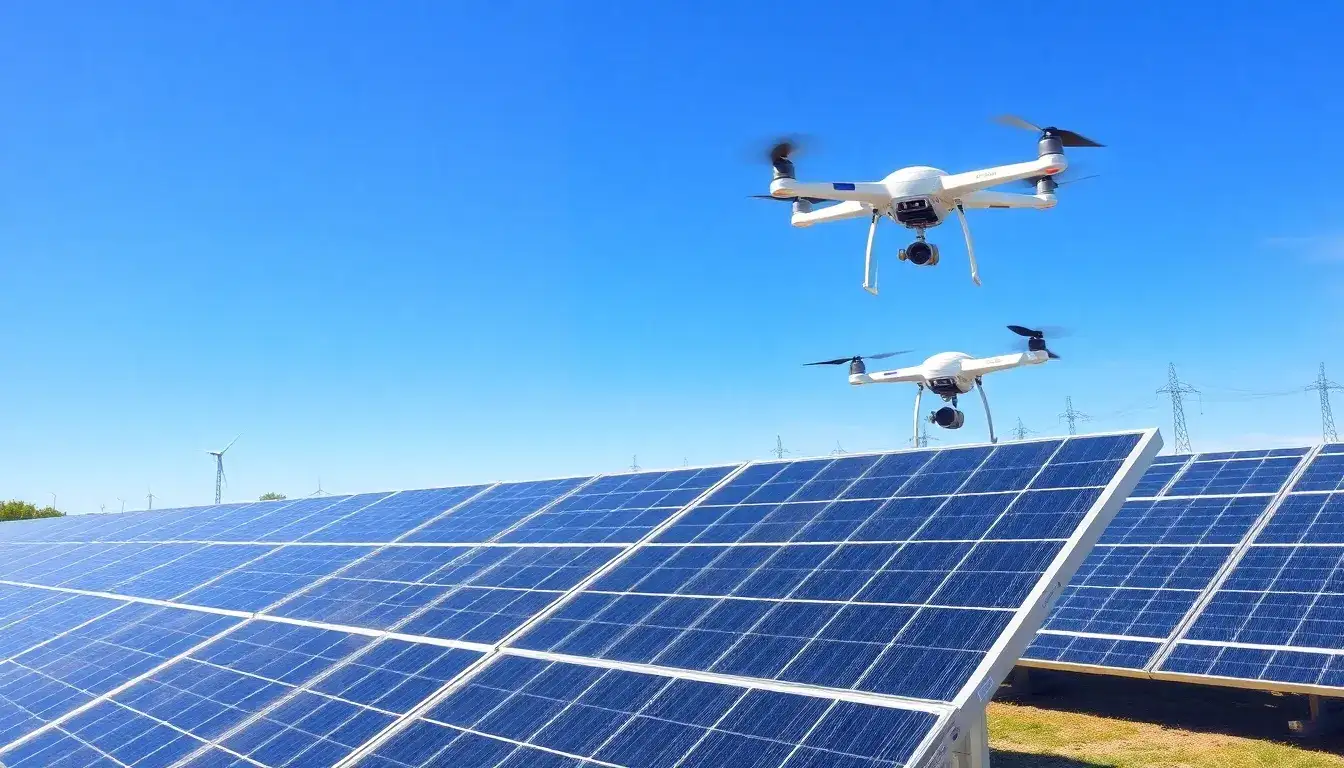
The photovoltaics (PV) industry is experiencing a significant transformation in 2025, with Artificial Intelligence (AI) emerging as a crucial player. From the initial design and manufacturing of solar panels to their real-time operation and maintenance, AI is enhancing efficiency, lowering costs, and accelerating the global adoption of solar energy. This technological integration represents not just an incremental improvement but a fundamental shift in how solar power is harnessed and managed.
### Revolutionizing Solar Panel Manufacturing and Material Discovery
AI is speeding up the research and development of new, more efficient solar cell materials. Traditional methods for discovering innovative materials are often time-consuming and involve extensive trial and error. In contrast, AI algorithms can analyze vast datasets of material properties and predict performance before synthesis, significantly reducing the innovation cycle. This is particularly evident in the advancement of perovskite solar cells, where AI identifies formulations that improve stability and performance, addressing key challenges that have previously hindered their commercial viability. Moreover, AI optimizes manufacturing processes by identifying defects early in the production line, ensuring higher quality control and resulting in more reliable and durable solar panels.
### Enhancing Solar Energy Forecasting and Grid Integration
One of the most critical applications of AI in the photovoltaics industry is energy forecasting. The intermittent nature of solar power has historically presented challenges for grid stability. In 2025, AI-powered forecasting tools utilize historical weather patterns, real-time sensor data, and satellite imagery to predict solar power generation with unprecedented accuracy. This allows grid operators to manage supply and demand more effectively, optimize energy storage, and seamlessly integrate solar power into the broader electricity grid. AI also plays a vital role in managing decentralized energy resources and microgrids, ensuring efficient energy transfer and reducing dependence on centralized infrastructure.
### Optimizing Solar Farm Operations
The operational efficiency of large-scale solar farms is being dramatically enhanced by AI. Machine learning algorithms continuously analyze data from thousands of panels, monitoring performance, identifying anomalies, and optimizing energy production. AI-driven systems can dynamically adjust panel angles and orientations based on real-time weather conditions and sun tracking, maximizing energy yield throughout the day and across different seasons. Additionally, AI is essential in balancing electricity supply and demand within the grid, ensuring optimal distribution of solar energy and minimizing waste.
### Advancing Predictive Maintenance and Anomaly Detection
AI is transforming maintenance practices from reactive to proactive. By analyzing sensor data, thermal imaging, and historical performance records, AI systems can predict equipment failures, such as overheating inverters or malfunctioning panels. This capability enables operators to schedule maintenance precisely when needed, reducing unexpected downtime, lowering repair costs, and extending the lifespan of critical components. Drone-based inspections, enhanced by AI for image processing and analysis, are making the monitoring of large solar installations faster and safer, automatically detecting issues like microcracks, dirt accumulation, or structural damage. This early fault detection minimizes energy losses and improves the overall reliability of solar power systems.
### Empowering Smart Energy Management and Cost Savings
Beyond individual components, AI is orchestrating entire solar energy ecosystems. Smart energy management systems powered by AI learn the energy consumption habits of households or businesses, predicting usage patterns and optimizing the flow of solar power. This includes intelligent battery management, where AI determines the best times for charging and discharging, and even enables peer-to-peer energy trading in advanced setups. The cumulative effect of AI’s diverse applications across the PV value chain results in a significant reduction in operational expenses and an increase in energy yields, making solar power an even more economically attractive and sustainable energy source in 2025.
### Frequently Asked Questions (FAQs) on the Photovoltaics Market
**What is the photovoltaics market?**
The photovoltaics (PV) market refers to the global industry involved in developing, producing, and deploying solar power systems that convert sunlight directly into electricity using semiconductor-based solar cells. This market includes solar modules, inverters, mounting structures, and other associated technologies used in residential, commercial, and utility-scale applications.
**What is driving the growth of the photovoltaics market?**
The growth of the photovoltaics market is driven by increasing environmental awareness, decreasing solar panel costs, favorable government incentives and policies, technological advancements in solar cell efficiency, and the rising demand for clean, renewable energy to combat climate change and reduce dependence on fossil fuels.
**What are the major segments in the photovoltaics market?**
The photovoltaics market is typically segmented by technology (monocrystalline silicon, polycrystalline silicon, thin-film), application (residential, commercial, industrial, utility-scale), and region (North America, Europe, Asia Pacific, and the rest of the world), with Asia Pacific currently leading due to strong adoption in China and India.
**What are the latest trends in the photovoltaics industry?**
Key trends in the photovoltaics industry include the rise of bifacial and PERC solar cells, integration of AI for predictive maintenance and performance optimization, solar-plus-storage solutions, floating solar farms, and growing interest in building-integrated photovoltaics (BIPV) for urban infrastructure.
**How is artificial intelligence (AI) impacting the photovoltaics market?**
AI is transforming the photovoltaics market by enabling smart grid integration, optimizing solar panel placement and performance through data analytics, enhancing predictive maintenance, and improving energy yield forecasting. This ultimately increases the overall efficiency and cost-effectiveness of solar power systems.
Original article by NenPower, If reposted, please credit the source: https://nenpower.com/blog/ais-role-in-revolutionizing-the-photovoltaics-industry-in-2025/

