

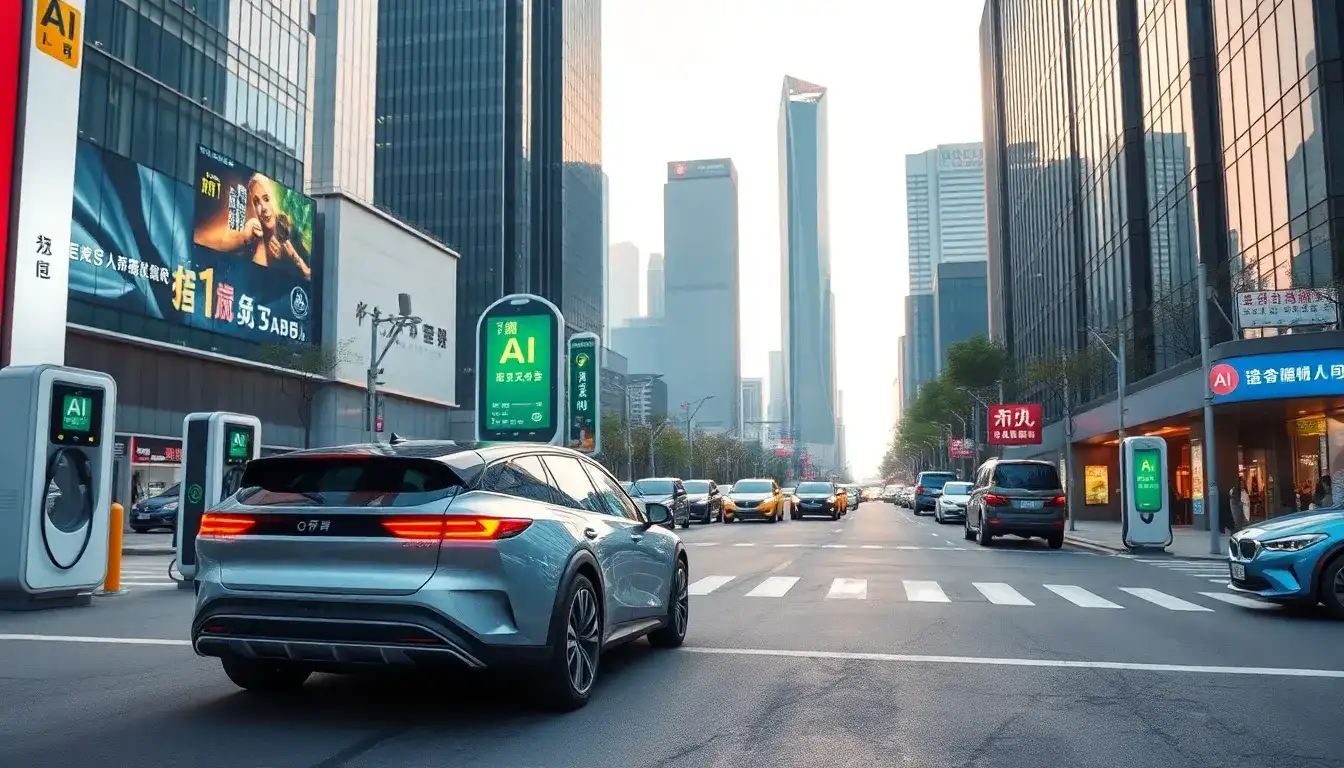
China’s Economic Observation for Q1 2025 – AI Empowerment: The New Energy Vehicle Industry Advances in Intelligence and Competition
On the heels of surpassing 12 million units in both production and sales last year, a question arises: is there still room for growth in China’s new energy vehicle (NEV) market? The latest Q1 report from the China Association of Automobile Manufacturers provides an answer—production and sales have increased by 50.4% and 47.1% year-on-year, respectively. This sustained high growth trend showcases the vitality of the automotive industry and confirms the resilience of China’s economic development.
What drives such rapid growth?
The answer lies in several factors, including robust policy support, a massive market scale, and the rich benefits of a comprehensive supply chain. In addition, reports indicate that behind the rising market data, <b>AI and intelligent technology</b> are becoming the new DNA of vehicles, aiding the NEV industry in enhancing quality through intelligence.

<b>AI in Smart Production Lines</b>
Recently, a visit to Changan Automobile's intelligent factory in Chongqing's Liangjiang New Area revealed hundreds of robotic arms precisely at work. Online AI visual inspection covers over <b>20</b> scenarios and more than <b>70</b> workstations, with production data displayed on smart terminals indicating that a new car rolls off the line every <b>60 seconds</b>.

Meanwhile, at Brilliance BMW's production base in Shenyang, nearly <b>100</b> AI applications are fully operational. The AI intelligent quality inspection system can analyze single image data from the stamping process in just <b>0.01 seconds</b>, identifying minute gaps invisible to the naked eye, ensuring that components enter the next process in optimal condition.

The installation of a "smart brain" in production workshops has significantly enhanced efficiency. In various NEV industrial parks, the data "pulse" is strong and vibrant: the Geely Starry Sky Computing Center boasts a computing power of <b>10.2 trillion</b> operations per second, capable of supporting real-time computational needs for millions of online vehicles. The intelligent computing platform co-built by Changan Automobile and Alibaba Cloud trains its autonomous driving system with daily mileage exceeding the distance from Earth to the Moon. The widespread application of AI is reconstructing the entire industry chain.

<b>AI Revamping Intelligent Cockpits</b>
Commands like "turn on the air conditioning" or "roll down the window" now seem outdated. Today, multimodal large models are entering intelligent cockpits, providing a more natural and rich human-machine interaction experience.

With the ability to recognize <b>20</b> dialects and mixed language commands, these systems can detect emotions and monitor driver status in real-time, issuing timely warnings for fatigue. AI is transforming vehicles from mere transportation tools into "intelligent partners" capable of emotional interactions, making cars smarter and more in tune with their users.

As over <b>20</b> automakers, including Geely, BYD, Chery, and Great Wall, announce their integration with the DeepSeek large model, and brands like Mercedes-Benz deeply integrate ChatGPT technology, new energy vehicle manufacturers such as Li Auto and Xpeng are pivoting their strategies to focus on becoming "AI automotive companies." This trend underscores a consensus that no entity can afford to hesitate in this new competitive landscape.

According to <b>Chen Qingtai</b>, Chairman of the China Electric Vehicle Hundred Persons Association, "Cutting-edge AI technologies represented by large models are rapidly penetrating the NEV sector, driving the automotive industry towards greater intelligence." AI is redefining automotive products, companies, and the industry itself, establishing itself as a fundamental competitive edge for future automobile enterprises.

Today, features such as adaptive cruise control and lane departure warnings are enhancing the driving experience. Data from the Ministry of Industry and Information Technology shows that in <b>2024</b>, <b>57.3%</b> of newly sold passenger cars in China will be equipped with Level 2 driver assistance functions.

Many industry insiders point out that the focus of competition has shifted from price to intelligence, prompting automakers to enhance their core competitiveness and product value through continuous technological innovation.

In the view of <b>Cao Xudong</b>, CEO of Beijing Initial Speed Technology Co. (Momenta), increased investment from domestic and foreign capital in the field of intelligence can attract more resources such as funds, talent, and technology, thereby expanding market scale and accelerating the development of the entire industry chain. "We choose to transform the pressure of 'the wolf is coming' into a driving force for 'healthy competition,' leveraging market momentum for better growth."

Maintaining the courage to forge ahead while remaining open to cooperative win-win opportunities is essential.

In March of this year, news of BMW's collaboration with Huawei to develop a smart application ecosystem based on the HarmonyOS attracted significant attention. Gao Xiang, President and CEO of BMW Group Greater China, stated that BMW collaborates with approximately <b>460</b> local suppliers in China and is accelerating R&D partnerships with Chinese counterparts, focusing on cutting-edge technologies like AI.

"A number of innovative ICT high-tech companies entering the automotive sector are bringing endless possibilities for mutual empowerment, greatly boosting our confidence in development," said <b>Fu Yuwu</b>, Honorary Chairman of the China Society of Automotive Engineers. "Seizing the disruptive innovation opportunities of the AI era and working in close coordination is the future path for the automotive industry."

However, there is also a downside. Some automakers exaggerate Level 2 driver assistance as "autonomous driving," misleading consumers and creating potential safety hazards. Instances of drivers overly relying on technology and encountering safety incidents after activating "smart driving" features are not isolated cases.

It is crucial to remember that safety is the "golden" standard for the application of intelligent technologies and an inviolable baseline for industry development.

The new national standard for electric vehicle batteries, organized by the Ministry of Industry and Information Technology, will take effect on <b>July 1, 2026</b>, raising requirements for power batteries to prevent fire and explosion. Additionally, the Ministry of Industry and Information Technology, along with the State Administration for Market Regulation, has jointly issued a notice to strengthen the management of intelligent connected vehicle product access, recalls, and software online upgrades, emphasizing the need for thorough testing and validation, as well as clear system boundaries and safety response measures.

<b>Fu Bingfeng</b>, Executive Vice President and Secretary-General of the China Association of Automobile Manufacturers, stated, "The sustainable development of the intelligent connected vehicle industry relies not only on technological breakthroughs and market promotion but also urgently requires institutional guarantees and industry self-discipline to work in tandem." Providing the necessary growth space for innovation, while building a coordinated, orderly, and transparent industry ecosystem, is key to driving the intelligentization of automobiles toward a brighter future.
Original article by NenPower, If reposted, please credit the source: https://nenpower.com/blog/ai-empowerment-drives-growth-in-chinas-new-energy-vehicle-industry-amidst-competition-and-innovation/

