

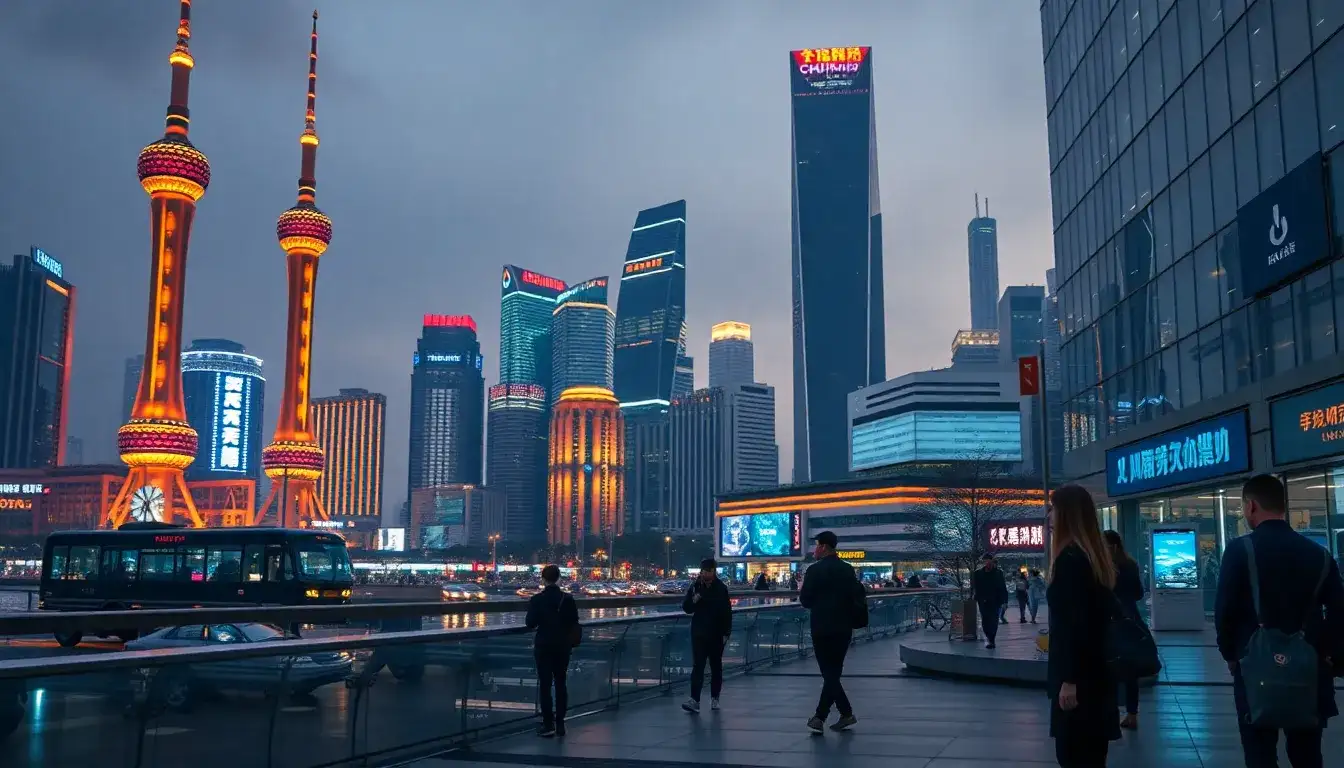
AI is becoming increasingly integrated into various forms of technology, marking significant developments in Shanghai. Smart terminals, often seen as the “embodiment” of artificial intelligence, are gaining momentum in this vibrant city.
One notable example is the AI toy Fuzozo, which leverages the SenseTime’s daily updated large model. This toy features long-term memory, emotional perception, and humanoid feedback, acting as a 24/7 “emotional companion.” Since its launch last year, it has sold over 120,000 units, topping the Volcanic Engine AI hardware list. In the field of humanoid robots, Shanghai companies are also leading the charge. Zhiyuan Robotics shipped over 5,100 units last year, surpassing competitors like Yushu and Tesla, making it the global leader.
Another indicator of Shanghai’s booming smart terminal industry is the recent surge of companies like Minimax, Muxi, Birun, and Tianzi Zhixin, which are based in the area and have recently gone public. These companies are at the forefront of large model development, pushing AI technologies beyond screens and dialogue boxes into tangible applications. The rise of domestic intelligent computing chips is further supporting the explosive demand for smart terminal applications.
As Shanghai continues to build its platform, upcoming events such as the China Household Electrical Appliances and Consumer Electronics Expo (AWE 2026) in March and the World Artificial Intelligence Conference (WAIC 2026) in July will serve as stages for showcasing smart terminals.
AI and IC (integrated circuits) are both critical areas of growth. Shanghai is home to about one-third of the nation’s AI talent, with an AI industry scale exceeding 550 billion yuan and a growth rate of 30% last year. The city also boasts over 1,200 integrated circuit companies, contributing to 40% of the country’s IC talent and 50% of industrial innovation resources, with an IC industry scale of nearly 490 billion yuan, reflecting a 25% growth.
This dual strength fosters the development of top-tier algorithms. For instance, SenseTime’s multimodal large model and its embodied intelligence platform enable capabilities like embodied perception, visual navigation, and audio-video interactive integration. An example of this is a robot equipped with a large model “brain,” which can generate professional narratives and humorously explain cultural topics such as “Lychee from Chang’an.” This robot can engage with audiences, answer spontaneous questions, and maintain overall memory, providing an immersive interactive experience rather than just playing back content.
SenseTime’s large model has also been integrated into products from companies like Xiaomi, XREAL, Guixu Electronics, and Lingyuzhou. For instance, the AI learning device “Lingyuzhou Xiaofangji” topped its category during the “618” shopping festival last year, with sales soaring over 230% during the “Double 11” event. Notably, SenseTime’s model is just one of 138 large models registered in Shanghai.
Shanghai has no significant shortcomings in terms of computing power, data resources, or chips. The city’s intelligent computing power has surpassed 120 EFLOPS (exaflops), accounting for nearly 10% of the national total. It also operates the country’s first public service platform for data, having completed over 400 functional modules, applying data in sectors such as healthcare, education, finance, and urban governance. Furthermore, domestic chip manufacturers like Suijuan, Tianshu Zhixin, and Pingtouge have achieved breakthroughs in mass production, supporting Shanghai’s goal of having over 70% of its computing power be self-controlled by 2027.
This establishes a complete cycle in Shanghai where “good models are supported by ample computing power, quality applications are backed by abundant data, and excellent products are not short of chips.”
AI needs a physical form, and as a major manufacturing hub, Shanghai is achieving a symbiotic relationship between software and hardware. Established only in 2023, Zhiyuan Robotics has quickly become the global leader in humanoid robot shipments, largely due to the mature supply chain in Shanghai and its surrounding areas. Experts estimate that all core components needed for humanoid robots can be sourced within a 150-kilometer radius of Shanghai.
As a result, companies like XREAL have chosen to establish their headquarters in Shanghai when nearing commercialization. XREAL’s founder and CEO, Xu Chi, highlighted that their self-developed optical factory in Wuxi collaborates with top global display partners, ensuring that their Micro-OLED screens meet industry standards. They also work with giants like Luxshare Precision to establish automated assembly lines for AR glasses, allowing for seamless collaboration between R&D and production. Additionally, XREAL’s chip development team partners with Qualcomm and Longqi Technology for ongoing research in Shanghai.
On December 18 last year, XREAL 1S was officially launched, with fourth-quarter sales increasing by over 50% year-on-year. This signifies that despite facing unexpectedly high global orders, Shanghai’s supply chain efficiency has enabled XREAL to maintain high-quality deliveries.
Many other companies in Shanghai are also thriving. In the Pudong New District alone, a “4+X” development model has emerged, encompassing smart phones, smart computing, smart glasses, and various innovative consumer terminals, driving projects with companies like Goertek, H3C, Inspur, Huaqin, and DuerOS.
Moreover, seeds for future success have already been planted. For instance, Yinghe Zhiling, established in March last year, successfully launched its Ximi and Haixi brand AI PCs by mid-year. Recently, the globally popular open-source AI agent OpenClaw can be deployed on personal computers to assist with tasks like organizing files and sending emails. However, concerns over privacy data exposure remain significant. Yinghe Zhiling’s AI PC aims to safeguard personal data, offering ready-to-use local computing solutions to schools, government departments, businesses, and individuals. As more users seek to create personalized AI assistants akin to “JARVIS” from the movie Iron Man, the AI PC is expected to see widespread adoption.
Additionally, Apple recently announced plans to integrate Google’s Gemini model into Siri. In Shanghai, Nubia, a subsidiary of ZTE, has partnered with ByteDance to develop the first AI-native phone, the Nubia M153, which allows users to operate across apps using natural language. This AI phone can automatically compare prices and apply coupons across platforms like Douyin and JD.com, streamlining the purchasing process. The phone’s assistant technology preview version quickly sold out among professional users, indicating strong future production potential.
According to the Action Plan for the High-Quality Development of Shanghai’s Smart Terminal Industry (2026-2027), released last October, Shanghai aims to exceed 300 billion yuan in overall smart terminal industry scale by 2027, establishing three globally influential consumer-grade terminal brands and achieving a production scale of over ten million units for intelligent computers, smartphones, and new intelligent terminals. The new generation of electronic information industry, propelled by smart terminals, is recognized as one of Shanghai’s six emerging pillar industries, poised to significantly contribute to economic growth.
Original article by NenPower, If reposted, please credit the source: https://nenpower.com/blog/ai-driven-smart-devices-in-shanghai-set-to-generate-300-billion-in-new-growth/

