

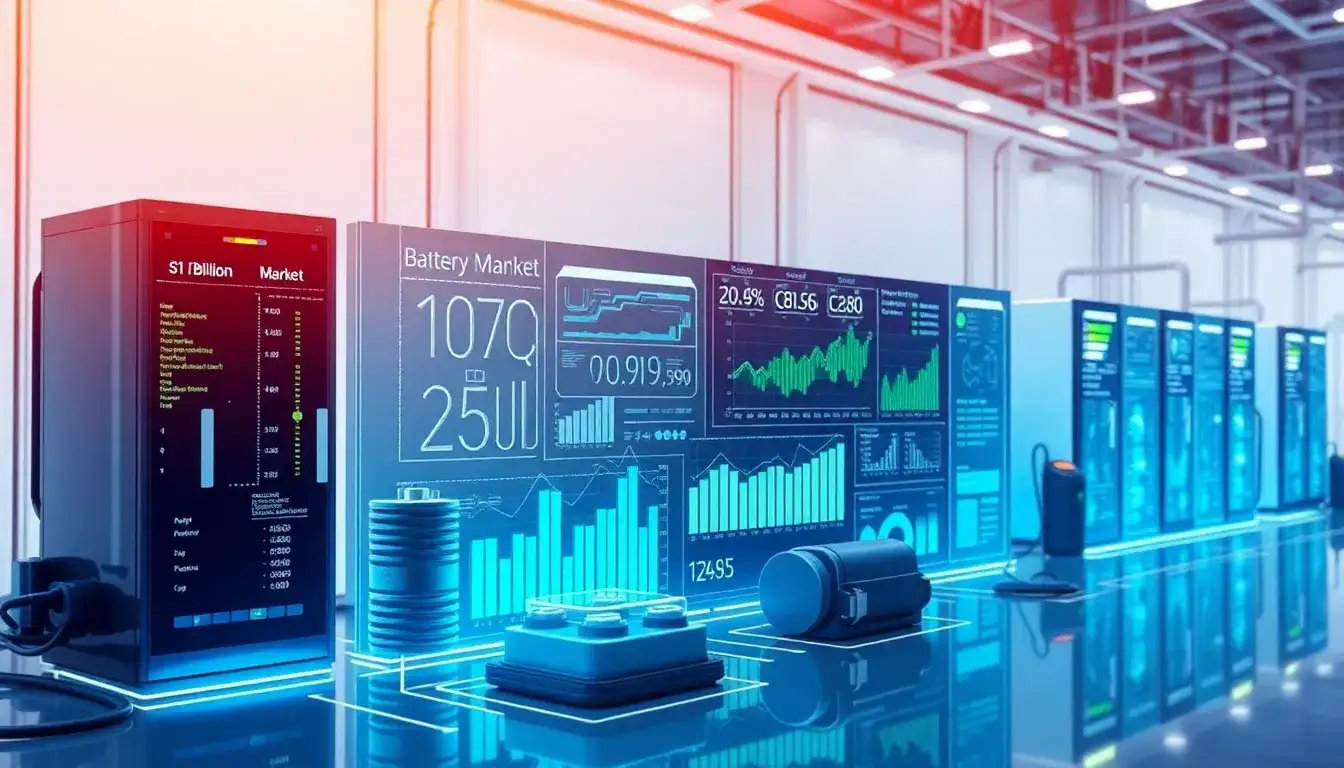
According to a detailed market research report titled “AI-Driven Battery Management Systems Market by Component (Hardware, Software, Services), Application (Electric Vehicles, Energy Storage), Distribution Channel, End User, and Geography – Global Forecast to 2032,” the AI-driven battery management systems market is anticipated to reach $18.5 billion by 2032, increasing from an estimated $4.1 billion in 2025. This growth represents a robust compound annual growth rate (CAGR) of 20.6% during the forecast period.
The rapid expansion of the AI-driven battery management systems market is primarily driven by the pressing need for improved battery performance, longer lifecycles, and enhanced safety protocols within electric vehicles and energy storage applications. Factors such as the rising adoption of predictive analytics, the precision requirements for state-of-charge (SOC) and state-of-health (SOH), and the integration of machine learning algorithms for real-time battery monitoring and thermal management are propelling this growth.
The industry is undergoing a significant transformation, characterized by the adoption of digital twin technology, wireless battery management system (BMS) architectures, edge AI processing capabilities, and a shift from hardware-centric to software-defined solutions. Leading companies are capitalizing on cloud-to-edge computing architectures while exploring vehicle-to-grid (V2G) integration and Battery-as-a-Service (BaaS) models for next-generation energy management solutions.
### Revolutionary Market Transformation Through Intelligent Battery Optimization
The AI-driven battery management systems market signifies a transformative shift in energy storage technology and intelligent power management. As industries increasingly demand longer battery lifespans, improved safety protocols, and precise performance monitoring, AI-enabled BMS solutions present groundbreaking capabilities that address the complexities of modern battery applications across automotive, energy storage, and data center environments. Market leaders are heavily investing in advanced machine learning algorithms and edge computing technologies, establishing development capabilities to deliver real-time battery optimization, predictive maintenance, and adaptive thermal management. These technological advancements are making AI-driven BMS solutions more accessible while providing superior performance, safety, and operational efficiency.
### Dynamic Growth Across Key Market Segments
In 2025, the Software and AI Solutions segment is expected to dominate the market, capturing the largest share due to the increasing adoption of predictive analytics and state estimation algorithms essential for battery optimization and safety. However, the Hardware segment is projected to experience the fastest growth, fueled by the rising demand for real-time, on-device processing and AI-optimized BMS processors for edge computing applications. Among services, the Implementation & Integration Services segment leads with the largest market share, reflecting the complexity of integrating AI technologies into existing battery infrastructures. The Data Centers segment is anticipated to grow the fastest among applications, driven by the critical need for uninterrupted power and precise battery monitoring in backup systems.
### Strategic Market Opportunities and Innovation Drivers
The market presents exceptional growth opportunities through the integration of digital twin technology, the adoption of wireless BMS architectures, and expansion into second-life battery applications. Companies are discovering new revenue streams via vehicle-to-grid integration and BaaS models, while developing performance-based licensing frameworks for intelligent energy management ecosystems. Key market drivers include:
– **Rising Electric Vehicle Adoption**: The global surge in electric vehicle sales is driving the demand for advanced battery management systems with enhanced range, rapid charging, and safety features.
– **Energy Storage System Expansion**: Utility-scale projects are necessitating grid stabilization, renewable energy integration, and peak demand management solutions.
– **Data Center Power Requirements**: There is a critical need for uninterrupted power and precise battery monitoring, aided by AI-enhanced real-time health insights and predictive maintenance.
– **Advanced Thermal Management**: The growing adoption of fast charging technologies requires sophisticated temperature control and safety protocols.
### Regional Market Leadership and Emerging Growth
In 2025, North America is expected to command the largest market share, driven by the advanced adoption of electric vehicles, substantial R&D investments, robust regulatory frameworks supporting battery safety and efficiency, and established infrastructures for energy storage deployment across automotive and utility sectors. The Asia-Pacific region is projected to be the fastest-growing area, spurred by large-scale EV production in countries like China, South Korea, and Japan, proactive government initiatives advancing battery technologies, and rising deployments of energy storage systems. Europe also represents a significant market, bolstered by stringent environmental regulations promoting EV adoption and strong investment in renewable energy storage infrastructure.
### Dynamic Competitive Landscape Driving Innovation
The global AI-driven battery management systems market features a diverse and innovative competitive ecosystem that includes established battery manufacturers, semiconductor companies enhancing their AI capabilities, and specialized software-focused startups. This varied landscape fosters rapid technological advancements and algorithm development. Industry leaders are implementing integrated solutions that combine advanced machine learning algorithms with edge computing capabilities and digital twin modeling, pursuing vertical integration strategies to tackle battery optimization and safety challenges across various applications and regions.
### Market Leaders Shaping Industry Future
Key players driving the global AI-driven battery management systems market include CATL (Contemporary Amperex Technology Co., Limited), LG Energy Solution, Ltd., Panasonic Holdings Corporation, Tesla, Inc., Samsung SDI Co., Ltd., BYD Company Limited, Siemens AG, Texas Instruments Incorporated, Analog Devices, Inc., NXP Semiconductors N.V., Northvolt AB, Infineon Technologies AG, TWAICE Technologies GmbH, ABB Ltd., and Bosch Mobility Solutions.
### Latest Industry Developments
Recent developments in the market include:
– **Major Trend Shifts**: A transition from hardware-centric to software-defined BMS solutions, integration of digital twin technology for predictive battery modeling, and the adoption of wireless BMS architectures to reduce weight and enhance performance.
– **Technology Advancement**: The development of edge AI processors optimized for battery applications, enabling real-time local processing while continuously improving algorithms through fleet-wide learning.
– **Business Model Innovation**: The emergence of performance-based BMS licensing models and Battery-as-a-Service offerings, which reduce upfront capital expenditure while ensuring long-term battery performance optimization.
For more insights, visit [Meticulous Research](https://www.meticulousresearch.com) or connect with us on LinkedIn.
Original article by NenPower, If reposted, please credit the source: https://nenpower.com/blog/ai-driven-battery-management-systems-market-set-to-reach-18-5-billion-by-2032-with-20-6-cagr-growth/

