

Artificial Intelligence and Robotics Enhance the Efficiency of Electrified Railway Construction
On December 22, 2025, the G9785 Fuxing high-speed train departed from Baiyun Station in Guangzhou, Guangdong, heading towards Zhanjiang. This event marked the full operational launch of the Guang-Zhan High-Speed Railway, allowing travelers to reach Zhanjiang from Guangzhou in just 1.5 hours. At the same time, a 50-year exhibition celebrating the achievements of China’s electrified railways was held in Shijiazhuang, Hebei, showcasing a large model of the China Railway Pioneer Four Electrical Systems, which has already been implemented in the Guang-Zhan High-Speed Railway’s Guang-Fo section.
The China Railway Pioneer Four Electrical Systems model is the first large-scale model in the field of rail transit’s four electrical systems in China. It has developed 26 smart components that cover the entire industry chain of railway design, construction, operation, and equipment. This model can automatically recognize drawings, convert two-dimensional drawings into three-dimensional models, issue conflict warnings, and compute engineering quantities with just a click. According to Pei Ning, the Deputy Director of the Information Technology Center at China Railway Electrification Bureau, the implementation of this large model has reduced inter-departmental collaboration costs by 60% and has shortened emergency hazard response times from hours to mere minutes. The model is set to be applied in high-speed rail projects such as Xiong-Shang and Jin-Wei, further enhancing the level of intelligent construction in railway projects.
This development is a glimpse into the journey of China’s electrified railways towards intelligence. Since the opening of the country’s first electrified railway, the Baocheng Railway, in 1975, China has evolved from catching up to leading in electrified railway technology.
From Manual to Intelligent Arm Preparation
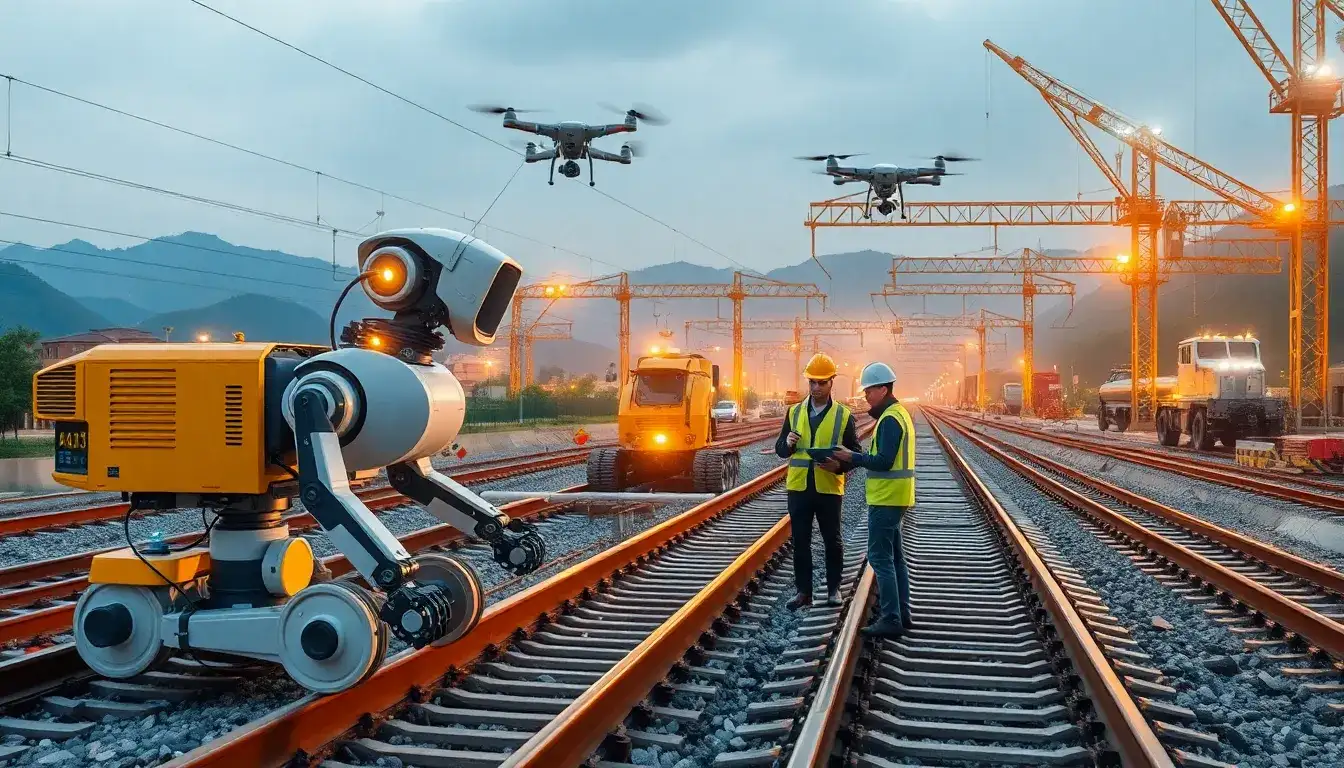
The constant tension wire laying vehicle is a core piece of equipment for contact network construction, which previously relied on imports. The latest generation of domestically developed modular constant tension wire laying vehicles by the China Railway Electrification Bureau now incorporates autonomous tension control, closed-loop dynamic monitoring, and automatic correction systems, with an overall precision error of less than 0.05 millimeters, exceeding national standards. In the construction of the Shen-Bai High-Speed Railway, the bureau developed a new generation of automated arm preparation platforms, integrating robotics, sensors, and visual systems. This technology enables all-weather, full-process, and fully automated production of four types of arm products, achieving an average daily capacity of 300 sets, a 40% efficiency increase, and millimeter-level precision.
Li Yubing, Chief Engineer at the Beijing Electrification Company of China Railway Electrification Bureau, has witnessed the entire transition from manual to intelligent arm preparation. “When I started working in 2007, we were still doing manual preparations. By 2014, we addressed key dimensional stability issues. Between 2018 and 2021, we continuously upgraded our processes and ultimately developed flexible pipe-through technology, enabling robotic arms to manipulate over four-meter-long arm pipes through components.” He noted that while manual assistance is still needed for loading, which poses risks, they have developed the necessary equipment and are currently testing it in complex scenarios to ensure reliability.
New Technologies Enhance Electrified Railway Construction Efficiency
With the introduction of intelligent equipment, the focus must also shift to intelligent construction. By continuously integrating technologies such as BIM, GIS, digital twins, artificial intelligence, and 5G communication, the construction of electrified railways has become more efficient. Initial measurements have been upgraded to a “data intelligence empowerment” model, achieving millimeter-level accuracy. Data calculations have transitioned to a full-chain management system that includes “data import—intelligent computation—result application,” improving efficiency several times over. The preparation system can now receive design data in real-time, automatically optimize production parameters, and utilize the Internet of Things for complete data traceability. Comprehensive testing vehicles equipped with computer and laser video technologies can collect data in real time, realizing integrated “real-time monitoring—intelligent analysis—remote control.” Digital delivery supports online, one-click distribution, allowing for real-time reception of design, construction, and operation and maintenance methods, with over 60% improvement in collaborative efficiency.
During the construction of the Western Extension High-Speed Railway, the China Railway Electrification Bureau completed 97.9% of the contact network wire framework construction for the Tongchuan to Yan’an section in less than three months by leveraging a smart project management platform. “During the 14th Five-Year Plan, we will place greater emphasis on artificial intelligence,” Pei Ning stated. “In the future, intelligent systems and robots will be deeply integrated into the entire construction process of electrified railways.”
The pace of intelligent operations and maintenance is also accelerating. The “Starry Sky Intelligent Analysis System,” independently developed by the China Railway Electrification Bureau, has been applied to multiple high-speed rail networks, covering 60% of the 50,000 kilometers of high-speed rail in the country. This system integrates comprehensive detection data from dimensions 1C to 6C and has analyzed over 700,000 kilometers of 4C contact network suspension status data, equivalent to circling the Earth’s equator 17 times. Currently, this system utilizes core technologies such as multi-source data fusion, deep learning, and large models to achieve an upgrade from “machine recognition” to “cognitive intelligence,” increasing the ability to detect hazards by tenfold and providing faster and more accurate support for operational and maintenance decisions. “The ultimate goal of driving this transformation is to build a modern railway system that is safer, more efficient, economically viable, and sustainable,” said Lin Yunzhi, Chief Engineer of the China Railway Electrification Bureau.
Original article by NenPower, If reposted, please credit the source: https://nenpower.com/blog/ai-and-robotics-revolutionize-the-efficiency-of-electrified-railway-construction-in-china/

