

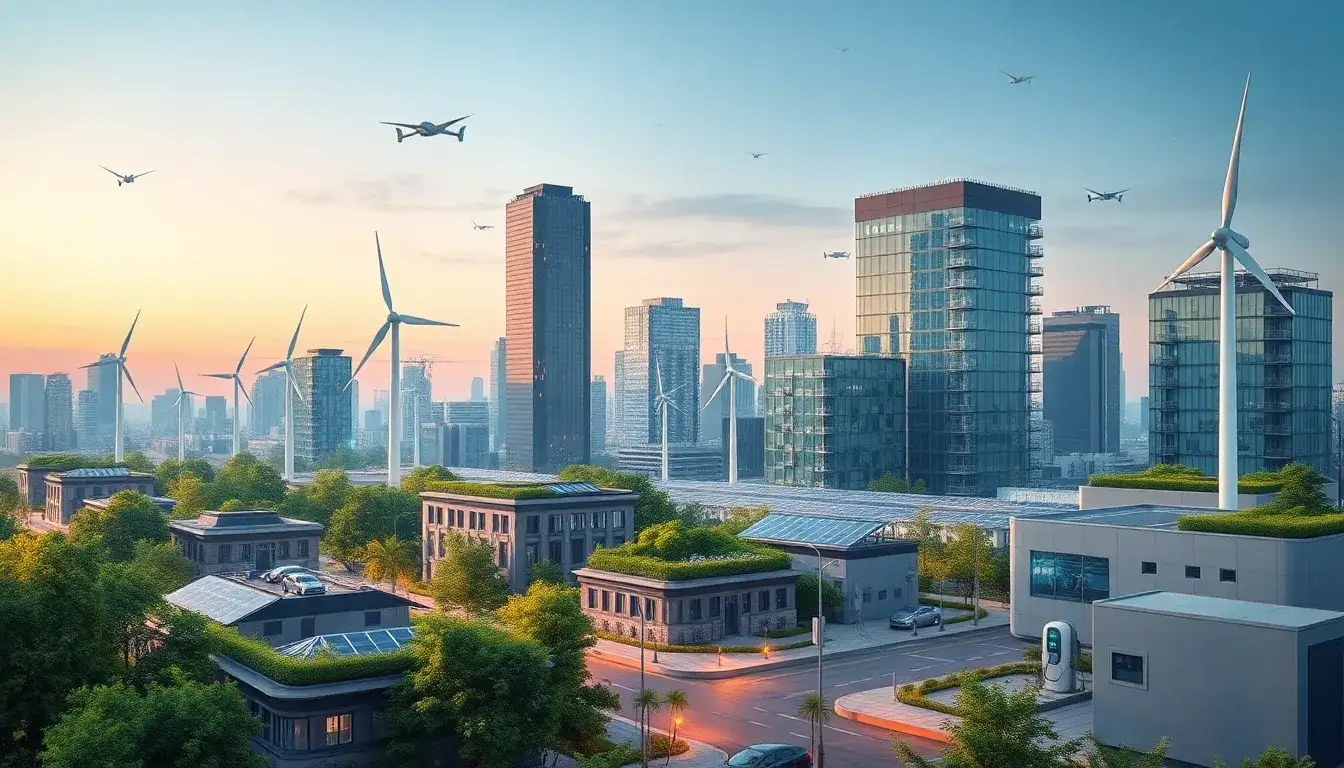
Discussion on Zero-Carbon Development of Urban Power Grids: A New Blueprint for Energy Transition
Organizer: Anhui Yangtze River Delta Carbon Neutral Development Research Institute
Date: May 28, 2025
The global energy transition has positioned zero-carbon development of urban power grids as a key area for achieving the “dual carbon” goals. Recently, the 2025 International Forum on Energy and Power Transition hosted a technical seminar focusing on “Zero-Carbon Development of Urban Power Grids.” This event brought together representatives from domestic and international energy companies, international organizations, and industry experts to explore multidimensional pathways for zero-carbon development of urban power grids.
The discussions centered on the utilization of new energy, technological innovation, the improvement of policy mechanisms, carbon management, and emission reduction measures, collectively outlining a clear blueprint for zero-carbon development of urban power grids.
Utilization of New Energy: The Cornerstone and Engine of Zero-Carbon Transition
The development and utilization of new energy serve as the foundation for achieving zero-carbon development in urban power grids. In recent years, the demand for new energy has been steadily increasing worldwide. Notably, China has been particularly prominent in this sector, consistently growing its installed capacity and providing substantial momentum for global new energy development.
Since China announced its “dual carbon” goals in 2020, the new energy industry has experienced explosive growth. According to Shu Yinbiao, Chairman of the Chinese Institute of Electrical Engineering, by the end of 2024, China’s new energy installed capacity reached 1.45 billion kilowatts, maintaining its position as the world leader for several years and laying a solid foundation for the zero-carbon transition of urban power grids.
Data from the International Energy Agency (IEA) indicates that in 2023, global renewable energy generation increased by approximately 10% year-on-year, with China contributing over 40%. In February of this year, the National Energy Administration released the “2025 Energy Work Guidance”, proposing that the proportion of non-fossil energy in electricity generation should reach around 60%, while non-fossil energy should account for approximately 20% of total energy consumption, further promoting the application of new energy in urban power grids.
However, the large-scale integration of new energy presents higher adaptability requirements for urban power grids. Ouyang Changyu, Deputy Chief Engineer of State Grid Corporation, emphasized the need to enhance the adaptability of distribution networks to distributed energy and to establish a mechanism for collaborative multi-energy planning, thereby achieving seamless integration between distributed and traditional energy sources to improve the efficiency and stability of the entire grid system.
Chen Lewen, General Manager of the Engineering Construction Department at Hong Kong Electric Company, shared that the company is gradually phasing out coal power, increasing the proportion of natural gas generation, and actively promoting the construction of photovoltaic power and offshore wind energy. Adjusting the energy structure is expected to help reduce carbon emissions and provide new momentum for sustainable development.
Andrew Grimshaw, Global Energy Lead at CDP and Chair of the RE100 Technical Advisory Group, noted that while China’s electrification process in renewable energy transition is leading globally, its reliance on coal-fired power remains significant, and the integration of renewable energy faces challenges in regional access. Therefore, further optimization of the grid structure is essential for enhancing new energy access capacity.
In Singapore, the transition relies on a diverse energy mix and regional cooperation, focusing on green hydrogen networks, cross-border green electricity trading, and policy innovations to achieve the net-zero emissions target by 2050. Huang Haoming, Chief Operating Officer of Tuas Power, stated that efforts will be made to maximize solar energy use, deepen regional grid interconnections, develop low-carbon alternative energy sources, and optimize carbon emissions from natural gas.
Technological Empowerment: Digitalization and Innovation Leading Power Grid Transformation
In the wave of energy transition, technological innovation remains a crucial driver for industry development. For the zero-carbon development of urban power grids, innovation not only enhances energy efficiency but also supports intelligent management of the grid. The rapid advancement of digital technologies presents new opportunities for the transformation of the grid, positioning it as an essential option for energy technology transition.
According to the International Renewable Energy Agency (IRENA), digital technologies can reduce grid losses by 10% to 20%. Shang Weilin, Vice President of EDF and President of EDF China, believes that digital technologies enable precise monitoring and intelligent control of the grid, enhancing operational efficiency and stability. For instance, the application of smart grid technology can minimize losses during energy transmission and improve overall energy efficiency.
Rudolph Colli da Cunha, Director of Regulation and Energy Management at State Grid’s Brazilian subsidiary CPFL, shared practical experiences in technological innovation, emphasizing the importance of collaboration in advancing critical technologies related to hydrogen-electric coupling, system efficiency, cost, and market research. This collaborative model accelerates the pace of technological innovation and broadens the application of new energy technologies.
Schneider Electric has implemented low-carbon and digital technologies, such as using environmentally-friendly equipment to eliminate sulfur hexafluoride, optimizing grid structures, and applying AI-driven scheduling automation systems to reduce emissions while enhancing asset operational efficiency. Wang Zhao, Senior Architect in Schneider Electric’s Power Grid Industry, noted that these approaches not only help reduce carbon emissions but also enhance the reliability and efficiency of the power grid.
David Gillespie, Director and General Manager of State Grid Australia, remarked that leveraging the technological advantages of State Grid fosters proactive technological assessments and promotes the export of “soft power” related to technology, standards, and regulations, contributing to global energy technology advancements and providing Chinese solutions for the global energy transition.
Chen Bin, spokesperson for State Grid Beijing Power, stated that measures such as “clean coal, alternatives, green energy, energy conservation, and collaboration” are being implemented to accelerate the construction of a new power system in large cities, with Beijing serving as a model. By 2025, Beijing’s external supply of green electricity will exceed 40 billion kilowatt-hours, increasing the share of green electricity in total electricity consumption to 35%. The ongoing construction of a new power system will continue to provide strong momentum for high-quality zero-carbon development in the capital.
Carbon-Electric Synergy: Multi-Dimensional Interaction of Policy Mechanisms and Emission Reduction Practices
In the pursuit of zero-carbon development for urban power grids, the improvement of policies and market mechanisms is an indispensable guarantee. Supportive policies provide clear directions and robust backing for industry development, while innovative market mechanisms can stimulate intrinsic motivation and innovative capacities within enterprises.
To promote zero-carbon development in urban power grids, it is essential to enhance relevant policy mechanisms, including collaborative planning, safety assurance, and a “power-carbon-certification” market synergy mechanism. Ouyang Changyu suggested that by clarifying the safety responsibilities of various stakeholders, a safety risk control mechanism should be established, along with enhanced emergency collaboration guarantees to ensure the stable operation and safe supply of urban power grids.
Previously, the National Development and Reform Commission and the National Energy Administration jointly released the “Opinions on Improving the System and Policy Measures for Green and Low-Carbon Energy Transition,” advocating for establishing a collaborative development mechanism for distributed energy and promoting deep integration between urban power grids and distributed energy sources.
Zhang Defa, Senior Manager of TÜV Rheinland China’s Industrial Services Division, emphasized that companies should actively pursue low-carbon certification to adapt to the rising trend of global carbon pricing. The implementation of the European Union’s Carbon Border Adjustment Mechanism (CBAM) has profound implications for China’s industrial sector. He recommended that companies swiftly implement carbon reduction measures during the CBAM transition period to lower carbon emissions per product and invite EU-authorized entities for verification to comply with regulatory requirements post-transition.
Green electricity procurement is one of the most mature supply chain emission reduction solutions internationally. By increasing the proportion of green electricity used by supply chain enterprises, significant progress can be made in reducing Scope 2 and Scope 3 emissions. Andrew Grimshaw from CDP noted that applying supply chain emission reduction models can effectively lower corporate carbon emissions while advancing the green transformation of the entire industry chain.
Zhang Wenquan, a researcher at the World Resources Institute (WRI), stated that the “Greenhouse Gas Accounting System” serves as the core framework for global corporate carbon accounting, with Scope 3 emissions being a crucial area for corporate reduction efforts. The power sector must keep abreast of updates to international standards and adapt to changes in global carbon accounting rules to assist in the zero-carbon transition of power grids and align with international standards.
Currently, the zero-carbon development of urban power grids is advancing through collaborative efforts in new energy utilization, technological innovation, policy mechanism improvement, and carbon management. Through collective industry efforts and enhanced international cooperation and communication, significant strides have been made in zero-carbon development of urban power grids, contributing to the achievement of global “dual carbon” goals and the establishment of a clean, low-carbon, secure, and efficient energy system.
Original article by NenPower, If reposted, please credit the source: https://nenpower.com/blog/advancing-zero-carbon-urban-power-grids-a-new-blueprint-for-energy-transition/

